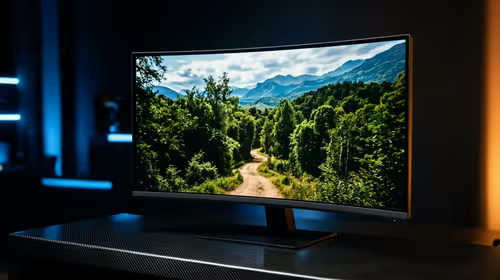
Staring at your screen, you know something’s off. That epic boss fight in Helldivers 2 looks a bit… washed out. Or maybe that sniper hiding in the shadows of Tarkov was just an invisible blur. Your monitor might be the culprit. Choosing a new display in 2025 boils down to a massive duel: IPS vs OLED for gaming. It’s the single biggest decision that will define how your games look and feel. Let's settle the debate.
Understanding IPS: The Tried-and-Tested Champion
For years, In-Plane Switching (IPS) panels have been the gold standard for gamers who demand vibrant, accurate colours. They're the workhorses of the display world, known for their fantastic viewing angles and consistent performance. If you're a streamer or content creator who also games, the colour fidelity of an IPS panel is hard to beat for photo and video editing. 🎨
The technology has matured brilliantly, meaning you get incredible performance without having to remortgage your house. Brands like AOC have perfected high-refresh-rate IPS displays, while companies like Dahua offer amazing value, making them a go-to choice for many South African gamers building a new rig.
Key Strengths of IPS:
- Colour Accuracy: Superb colour reproduction, making them ideal for creative work.
- Viewing Angles: Colours stay true even when viewed from the side.
- Price-to-Performance: Generally more affordable than their OLED counterparts.
- Longevity: No risk of the infamous "burn-in" effect.
Enter OLED: The Contrast King 🚀
Organic Light-Emitting Diode (OLED) technology is where things get really exciting. In an OLED vs IPS gaming monitor comparison, the difference is night and day... literally. Because each pixel creates its own light, OLEDs can turn individual pixels completely off to create perfect, absolute black. This "infinite contrast" makes colours pop and dark scenes incredibly immersive.
What about response times? They're practically instant. We're talking sub-1ms response times, which translates to zero ghosting and unbelievably crisp motion clarity in fast-paced shooters. While early models had concerns about burn-in, modern OLED gaming monitors come with built-in features to keep them healthy for years. This is the premium choice for gamers who want the absolute best visual experience, especially when paired with powerful Adaptive Sync technology.
Sync Up for Smoothness ⚡
get the best tear-free experience, match your monitor's sync technology to your graphics card. If you're running a NVIDIA GeForce card, look for a display with [G-Sync](https: www.evetech.co.za PC-Components gaming-monitors-89?attributes-adaptivesync=G-Sync+%28NVIDIA%29). For AMD Radeon users, a monitor supporting [FreeSync](https: www.evetech.co.za PC-Components gaming-monitors-89?attributes-adaptivesync=FreeSync+%28AMD%29) is your best bet. This simple check ensures buttery-smooth gameplay without screen tearing.
IPS vs OLED for Gaming: The 2025 Showdown
So, how do they stack up head-to-head on the factors that matter most to gamers?
- Contrast & Black Levels: OLED wins, no contest. The ability to achieve true black provides a level of depth and realism IPS simply can't match.
- Response Time & Motion Clarity: OLED wins again. Its near-instantaneous pixel response time delivers the sharpest image during fast motion.
- Colour & Brightness: It's a tie, depending on your needs. IPS often achieves higher peak brightness, making it better for very bright rooms. Both offer fantastic colour gamuts, but IPS is still the trusted choice for professional colour-critical work.
- Price: IPS is the clear winner. You can get a top-tier IPS gaming monitor for a fraction of the cost of a comparable OLED.
- Longevity: IPS has the edge. While OLED technology has improved, the risk of burn-in (image retention) is still a long-term consideration that IPS panels don't have.
The Verdict: Which Monitor Is Right for Your Rig?
The IPS vs OLED for gaming debate doesn't have one simple winner—it has a winner for you.
Choose an IPS monitor if:
- You're on a budget but still want high refresh rates and great colours.
- You use your PC for both gaming and colour-sensitive creative work.
- You often leave static images on your screen (like a UI or desktop) and worry about burn-in.
Choose an OLED monitor if:
- You want the absolute best image quality and immersion, especially in dark, atmospheric games.
- You're a competitive gamer who needs the fastest possible response time.
- Budget is less of a concern than pure visual performance.
Whether you land on a versatile IPS workhorse from a brand like HP or decide to dive into the stunning world of OLED, the right panel will completely transform your gaming. ✨
Ready to Find Your Perfect Match?
The IPS vs OLED debate comes down to your priorities and budget. The best way to decide is to see the options. Explore our massive range of PC monitors and find the perfect screen to conquer your virtual worlds.