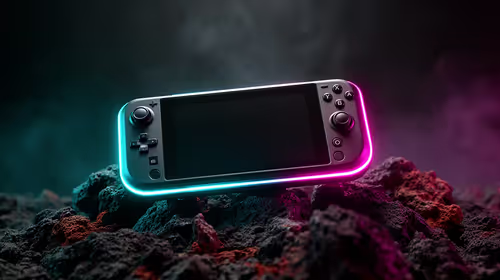
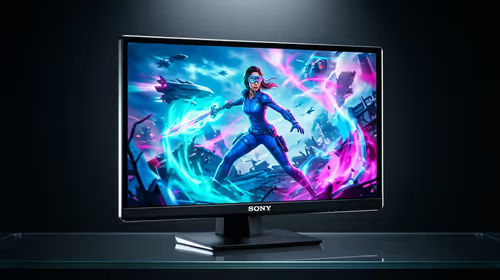
So, you’ve got your eye on a new handheld gaming PC. You’ve compared processors and storage, but there’s one critical choice that will define every single moment of your gameplay: the screen. The debate of IPS vs OLED for portable gaming isn’t just about specs�� it’s about how you experience your favourite worlds. Will you choose the bright, reliable performance of IPS or the stunning, cinematic visuals of OLED? Let’s break it down.
Understanding IPS: The Bright and Balanced Choice
IPS (In-Plane Switching) panels are the trusted standard in the PC gaming world for a reason. Think of them as the reliable workhorse. Their main strength is producing bright, colour-accurate images with excellent viewing angles. This means the picture looks great even if you’re not holding the device perfectly straight on.
For portable gaming, this brightness is a huge plus, especially if you’re playing near a window or outdoors. Devices like the powerful Lenovo Legion Go use a stunning QHD+ IPS display that pushes crisp detail and high brightness. The trade-off? In very dark scenes, blacks can look more like a dark grey due to the panel's backlight, a phenomenon known as "IPS glow."
The OLED Advantage: Unbeatable Contrast and Colour 🎨
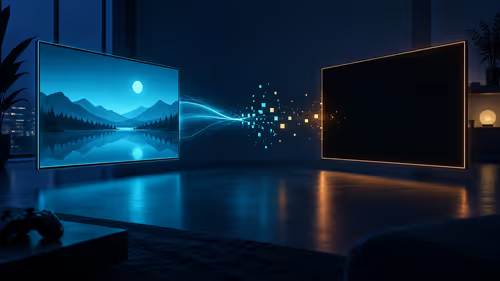
OLED (Organic Light Emitting Diode) technology works differently. Each individual pixel creates its own light. When a pixel needs to be black, it simply turns off completely. This results in perfect, true blacks and a theoretically infinite contrast ratio. The difference is immediately noticeable. Colours appear incredibly vibrant and pop off the screen, making cinematic games and dark, atmospheric titles like Alan Wake 2 feel intensely immersive.
This tech gives OLED screens an edge in the IPS vs OLED for portable gaming showdown when it comes to visual fidelity. While once a premium, high-end feature, OLED is now appearing on more of the latest handheld gaming consoles, offering gamers a truly next-level visual experience.
IPS vs OLED for Portable Gaming: The Head-to-Head Breakdown
So, how do these two screen types stack up in the areas that matter most to a gamer on the move? Let's get specific.
Colour, Contrast, and Immersion
For pure visual punch, OLED is the clear winner. The perfect blacks and vibrant colours create a depth and richness that IPS panels can't quite match. If you play visually stunning AAA titles, an OLED screen will make them sing.
Brightness and Outdoor Play ☀️
While OLED technology has improved, high-end IPS panels can often achieve a higher peak brightness. This makes them a more practical choice if you frequently game in brightly lit environments or want the best possible visibility outdoors.
Battery Saver Pro Tip ⚡
screen types benefit from this trick: Lower your screen brightness! On a handheld, dropping from 100% to 75% is barely noticeable indoors but can add a significant amount of time to your play session. On an OLED screen, using a dark mode or theme can also save power, as black pixels are turned off.
Motion Clarity and Response Time
OLED pixels respond almost instantly, which results in exceptionally clear motion with minimal ghosting or blur. This gives them a slight advantage in fast-paced competitive games like Apex Legends or Call of Duty, where every millisecond counts.
The Verdict: Which Screen Is Right for Your Games?
Ultimately, the best screen for your portable gaming console depends entirely on you and the games you play. There’s no single right answer, only the right answer for your needs.
You should lean towards IPS if:
- You often play in bright rooms or want better outdoor visibility.
- You want proven, reliable technology at a potentially more accessible price point.
- You prioritise crisp, accurate colours over extreme contrast.
- Many excellent devices from brands like ASUS and MSI offer fantastic IPS displays.
You should go for OLED if:
- Visual fidelity and immersion are your top priorities.
- You play a lot of cinematic, story-driven, or horror games with dark environments.
- You want the best possible motion clarity for fast-paced action.
- You’re a connoisseur who wants the absolute best picture quality possible on a handheld. 🎮
Ready to Level Up Your Visuals?
The IPS vs OLED for portable gaming debate comes down to personal preference. Whether you crave the vibrant punch of OLED or the bright reliability of IPS, the perfect handheld is waiting for you. Explore our massive range of handheld gaming consoles and find the screen that will bring your games to life.