Quick Answer
A dual-chamber gaming case is worth it when clean aesthetics and independent airflow are your priorities. By isolating the PSU and HDDs in a separate lower chamber, the main chamber gets cleaner airflow with less turbulence from the power supply fan, and cable clutter is physically separated from the component showcase area. The premium over a single-chamber case is typically R1,500 to R3,000 locally.
What a Dual-Chamber Design Actually Changes 🖥️
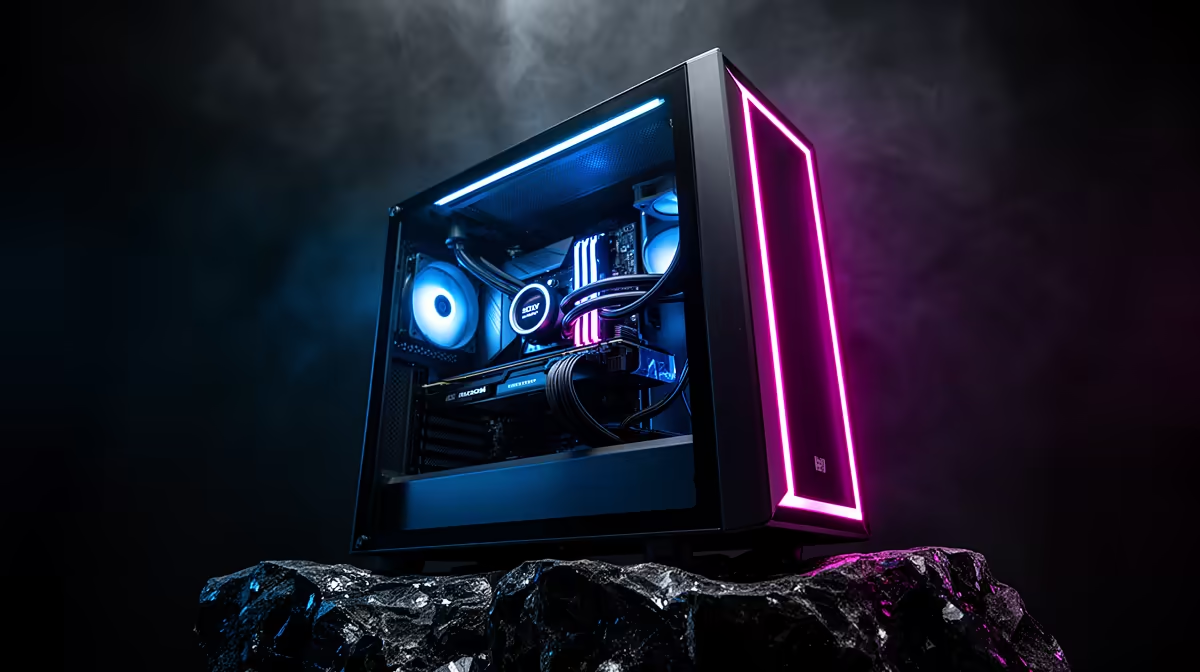
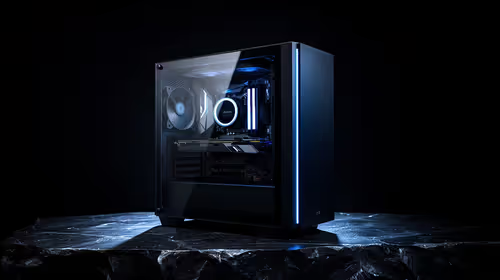
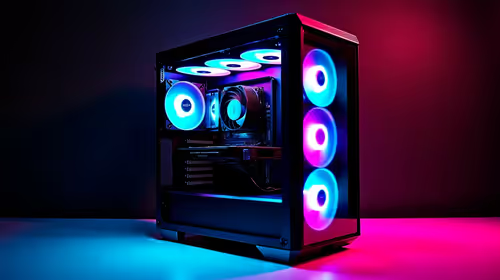
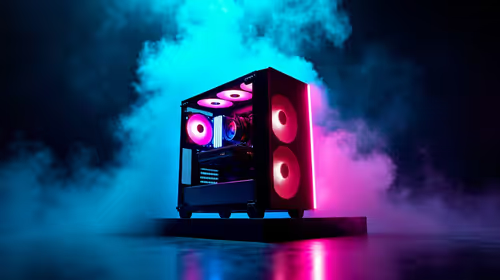
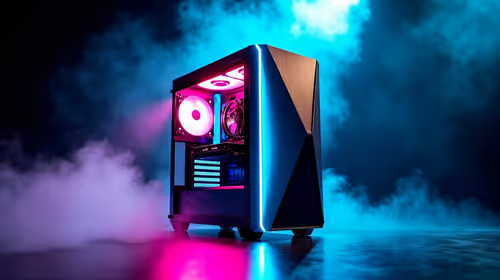
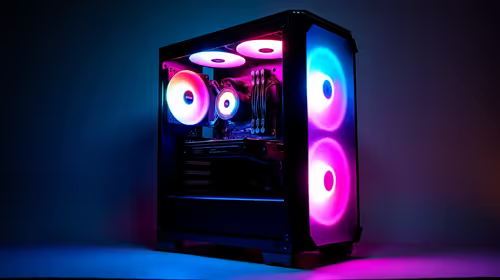
A dual-chamber case divides the chassis into two internal volumes using a horizontal or vertical partition. The primary chamber houses the motherboard, GPU, and CPU cooler and is designed for maximum visibility and airflow. The secondary chamber contains the PSU, drive cages, and cable routing. The practical benefit is threefold: PSU heat does not mix with motherboard airflow, cables are physically hidden behind the partition, and the primary chamber maintains a cleaner visual appearance through glass panels. The Lian Li O11 Dynamic and its successors popularised this design, and it is now found in cases from R4,000 upward locally.
Thermal Performance of Dual-Chamber Designs 🌡️
The thermal benefit of dual-chamber designs is real but secondary to the aesthetic benefit. In the primary chamber, air enters from the front or bottom, passes over the GPU and CPU cooler, and exits at the top or rear without contamination from PSU exhaust. GPU temperatures in dual-chamber cases typically measure 3 degrees Celsius to 7 degrees Celsius lower than equivalent single-chamber cases with the same fan configuration. The PSU in the secondary chamber runs its own air path entirely independent, meaning a PSU at high load does not raise inlet air temperature for the GPU or CPU.
Cost Justification for High-Performance SA Builds 💰
In South Africa, dual-chamber cases typically start around R3,800 for mid-range designs and reach R7,500 for premium full-tower versions. On a R50,000 to R80,000 high-performance build, the R1,500 to R3,000 premium is 2 percent to 6 percent of total budget. The value is highest for showcase builds where the primary chamber's visual cleanliness is part of the build identity. For a purely thermal benefit, a well-configured single-chamber mesh-front case can match dual-chamber temperatures at R1,000 to R2,000 less. Choose dual-chamber for aesthetics first; any thermal benefit is a bonus.
Drive Layout in a Dual-Chamber Case ⚡
Mount NVMe drives on the motherboard M.2 slots in the primary chamber and use the secondary chamber for large-capacity 2.5-inch SSDs storing your game library. This keeps active thermal loads in the ventilated primary chamber and relegates passive storage to the secondary chamber where it does not need additional airflow.
FAQ
Does a dual-chamber case require more fans than a single-chamber design?
Not necessarily. The secondary chamber relies on the PSU's built-in fan for its own ventilation, so you do not need to add case fans to it. The primary chamber fan count is the same as in a single-chamber case of equivalent size.
Are dual-chamber cases harder to build in for first-time builders?
The initial build is slightly more complex because you must route PSU cables through the partition. However, once built, maintenance in the primary chamber is easier because cable clutter is entirely hidden, leaving more room to manoeuvre around the motherboard and GPU.
Can I mount a 360mm AIO in the primary chamber of a dual-chamber case?
Yes, most dual-chamber designs support 360 mm or 420 mm radiators in the primary chamber at the top or side position. The AIO stays in the clean primary chamber with the CPU and GPU, while power delivery is isolated in the secondary chamber below.
Want a cleaner, higher-performance PC build?
Evetech stocks dual-chamber gaming cases, high-performance AIOs, and flagship components to build the setup worth showing off.