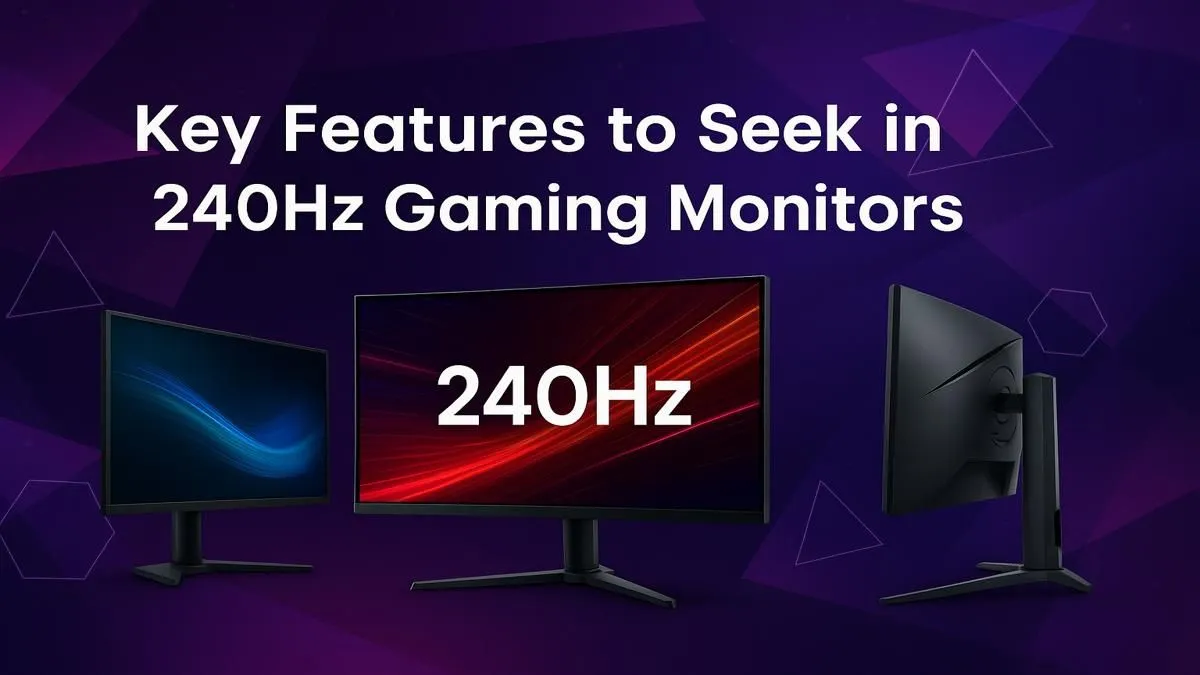
Stuck on 144Hz while your opponents in Valorant or Apex Legends seem to see the future? A 240Hz monitor isn't just a number… it's a competitive edge. This insane refresh rate delivers buttery-smooth visuals, letting you track targets and react faster than ever. But with so many options, what features truly matter? This ultimate buying guide breaks down everything you need to know to make the right choice in South Africa. 🚀
Why 240Hz is the New Competitive Standard
For years, 144Hz was the gold standard for serious gamers. But as GPUs get more powerful, the ceiling has been raised. The jump to 240Hz offers a tangible advantage by displaying twice as many frames per second as a 144Hz screen. This means you get motion that's incredibly fluid, with significantly less ghosting and blur.
In fast-paced shooters, this translates to seeing an enemy peek a fraction of a second sooner or tracking a fast-moving target with pinpoint accuracy. It's the kind of split-second advantage that separates a win from a loss. Exploring the latest gaming monitors reveals just how popular this refresh rate has become for pros and aspiring champs alike.
Key 240Hz Gaming Monitor Features to Look For
Not all 240Hz screens are created equal. Beyond the refresh rate, several critical 240Hz gaming monitor features determine your overall experience. Understanding them is key to a smart purchase.
Response Time: The Enemy of Ghosting
Response time, measured in milliseconds (ms), is how quickly a pixel can change colour. A slow response time on a high-refresh-rate monitor creates "ghosting" or motion blur, which undermines the clarity you're paying for.
- 1ms GTG (Grey-to-Grey): This is the industry benchmark for a crisp, blur-free image.
- MPRT (Moving Picture Response Time): This is a different metric that often seems lower, but GTG is the more reliable indicator for gaming performance.
Always prioritise a monitor with a 1ms GTG response time to get the full benefit of that 240Hz refresh rate.
Panel Technology: Colour vs. Speed
The type of panel inside the monitor impacts everything from colour accuracy to viewing angles. The choice often comes down to your primary use case.
- IPS (In-Plane Switching): The best of both worlds. Modern IPS panels offer vibrant, accurate colours and wide viewing angles without sacrificing speed. They are now a top choice for 240Hz gaming.
- VA (Vertical Alignment): Known for their deep blacks and excellent contrast, making them great for cinematic games and movies. Their response times can sometimes lag behind IPS.
- TN (Twisted Nematic): The original speed kings. While they have the fastest response times, they often suffer from poor colour reproduction and limited viewing angles.
For most gamers, a 240Hz IPS panel is the perfect all-rounder, delivering both speed and visual fidelity across our range of different PC monitors.
Adaptive Sync: G-Sync & FreeSync Explained ⚡
Ever seen your screen "tear" during intense action? That's your GPU and monitor falling out of sync. Adaptive Sync technology solves this.
- NVIDIA G-Sync: Requires an NVIDIA GPU and often comes at a premium.
- AMD FreeSync: Works with AMD GPUs and is more widely available. Many FreeSync monitors are now "G-Sync Compatible," offering tear-free gaming for NVIDIA users too.
Ensure the monitor you choose has the right Adaptive Sync for your graphics card to guarantee a smooth, tear-free experience.
Check Your Rig's Power! 🔧
Before you buy, run your favourite game and check your average FPS. A 240Hz monitor is only worth it if your PC can consistently push 200+ frames per second. If not, you might be better off with a 1440p 165Hz monitor for a sharper image.
Is a 240Hz Monitor Worth It For You?
So, should you pull the trigger? If you primarily play competitive esports titles like CS2, Valorant, or Apex Legends and your rig has the horsepower, the answer is a resounding yes. The fluid motion and reduced input lag provide a clear competitive advantage.
For gamers who prefer immersive, story-driven titles, the benefit is less pronounced. Here, you might find that the vibrant colours and deeper blacks of immersive curved monitors at 165Hz offer a better balance of performance and visual splendour. This ultimate buying guide for 240Hz monitors is about finding the perfect fit for your playstyle and budget.
Ready to See the Difference?
Now that you know the essential 240Hz gaming monitor features, find the perfect screen to elevate your gameplay. Shop the best monitor deals at Evetech for performance that leaves lag in the dust.