Watching a professional League series is easier once you know what the teams are trying to control. League of Legends esports is not a string of random fights: it is five players coordinating champion choices, map information, objectives and timing under formal competition rules.
Quick Answer
League of Legends esports is organised five-versus-five competition in which teams draft champions, defend their base and contest map objectives. Professional events use scheduled series, rules, coaches and preparation, so the outcome depends on teamwork and decisions as well as individual mechanics. South African viewers should use an event's official schedule for match times and convert it to local time.
🧩 The match beneath the action
Two teams each choose five champions in a draft before the game begins. The choices can create strengths and weaknesses: one composition may excel at a coordinated team fight, another may pressure side lanes, and another may look for quick picks around limited vision. A draft is therefore a plan for the map, not merely a selection of favourite characters.
During a match, gold gives teams access to stronger items, but it is only one part of the story. Towers open routes, neutral objectives give temporary or lasting advantages, and vision wards affect what a side can safely attempt. A team can be behind on eliminations while still holding a useful map position or setting up the next major objective.
Commentary often focuses on the decisive fight because it is exciting. New viewers can learn more by noticing what happened just before it: which team had vision, which players were missing from the map, whether a key ability was unavailable, and which objective was about to appear. Those details explain why a fight made sense at that moment.
📶 Why a stable connection matters in South Africa
Watching a broadcast does not demand the same network conditions as playing, yet a stable connection still makes live viewing less frustrating. For players, response time, packet loss and the route to the selected server matter more than a large headline download figure alone. A household member downloading a game update can disturb a match if the local network has not been managed sensibly.
South African routing to an overseas service may not behave like a connection to a nearby local server. Fibre, fixed wireless and LTE can each have different busy-hour patterns. Test during the time you normally play, use a wired connection where practical, and keep Wi-Fi interference in mind before deciding that a game's servers are the only cause of an unstable match.
The best gaming PC deals page is a sensible place to compare systems when a current machine cannot deliver consistent frame pacing at the settings you choose. Frame rate is not the only concern, however: display refresh, input devices, a dependable network adapter and background tasks all shape how a competitive game feels.
🔌 Teams, leagues and event formats
An esports season may include regional leagues, international tournaments, qualification stages and knockout series. The exact names, eligibility conditions and formats vary by organiser and can change between events. Rather than assuming a format from an older clip, use the official competition page for the current rules, roster information and fixture list.
Series can be one game or a best-of format. In a longer series, teams may adjust draft priorities after seeing what an opponent values, and coaching staff can prepare plans between games. That adaptation is one reason a match can look completely different after the first game without either team suddenly forgetting how to play.
For someone hoping to compete, a campus club, community organiser or established local group can be a better first step than treating an international broadcast as an immediate entry route. Ask about roster size, server selection, age rules, schedules and codes of conduct. Good team communication and dependable attendance matter just as much as a memorable solo highlight.
✅ Hardware for a consistent game
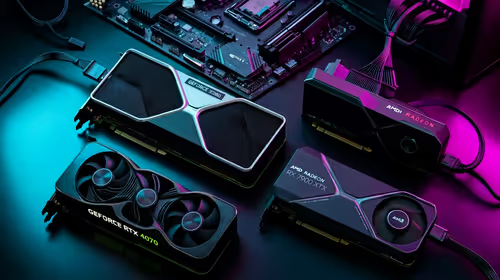
League of Legends can run on a wide range of PCs, but competitive comfort is about steadiness. A system that maintains a predictable frame rate at your selected settings can make camera movement and ability timing easier to read than one that alternates between smooth and stuttering play. Check the game's current official requirements before making a purchase decision.
A responsive display, comfortable mouse and keyboard, and a tidy local network are practical supporting pieces. A gaming laptop may suit a player moving between home, campus and a residence, while a desktop can make later upgrades easier. The gaming laptop deals section helps compare portable options without pretending that one format suits every player.
Avoid judging a machine by one component name alone. Consider the games you play, the display you already own, the resolution and refresh rate you target, and whether the PC needs to handle study or creative work as well. A balanced choice is more useful than chasing an isolated specification.
How to follow a series with more confidence
Before the opening game, glance at the teams, the tournament stage and the match format. During the draft, listen for the role each champion is expected to play. During the game, watch objective timers, gold changes, tower pressure and vision control. Afterward, a replay or analyst segment can clarify why a particular rotation or draft choice mattered.
Use official channels for schedules because a social post may be late, cropped or written in another time zone. South Africa uses a consistent local time zone, but an event listing can be in the host region's time. Convert the stated fixture time carefully rather than guessing from a previous broadcast.
Frequently Asked Questions
What is League of Legends esports?
It is organised competition where two five-player teams draft champions and play for map objectives and the opposing base. Strategy, communication and mechanics all influence the result.
How is a professional match different from ranked play?
Professional matches operate under formal event rules and scheduled series, with preparation, coaching and opponent analysis. Draft planning and coordinated map play have much more structure.
Where should South African viewers check match times?
Check the competition's official schedule, then convert the stated time to South African time. Verify the date and event stage rather than relying on an old social post.
Does faster internet automatically make a player more competitive?
No. Stable routing, low packet loss, reliable local equipment and a sensible server choice matter alongside enough connection capacity.
What should a new viewer watch during a game?
Follow objective timers, gold, vision and team positioning. These elements often explain the important decision before the visible fight begins.
Ready to build a steadier gaming setup?
Explore Evetech gaming PCs and laptops around the games, display and workspace you use every day.