



PCIe 5.0 vs PCIe 4.0 for Video editing in 4k in SA
PCIe 5.0 vs PCIe 4.0 for video editing in 4k is mainly about fit, features, compatibility, cost, and upgrade path, not one automatic winner. SA buyers should match the choice to the setup.
Read moreM.2 NVMe vs U.2 NVMe for SA MMO and live-service games buyers depends on fit, comfort, compatibility, cooling, upkeep, and MMO and live-service games. SA buyers should compare the trade-offs before treating either option as automatically better.
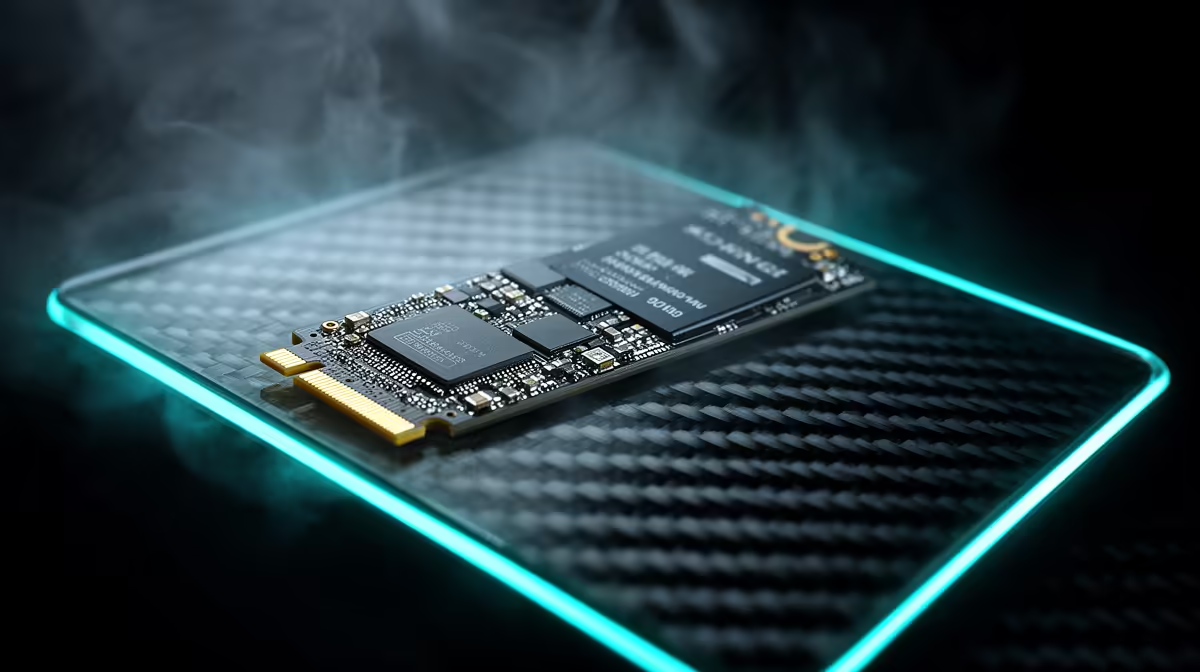
For MMO and live-service games, M.2 NVMe is the right choice for almost every SA gaming PC. U.2 NVMe is mainly a workstation or enterprise storage format; it rarely improves game fps and usually adds cost, adapter complexity, and case-cable clutter.
Modern M.2 PCIe 4.0 drives such as Samsung 990 PRO, Kingston KC3000, or WD Black SN850X-class SSDs can read around 5,000-7,400 MB/s. PCIe 5.0 M.2 drives can go higher, but gaming load times often change by only 0-3 seconds compared with a good PCIe 4.0 drive. U.2 can be fast and durable, but its strengths are sustained server-style workloads, not World of Warcraft, Final Fantasy XIV, Lost Ark.
For MMO and live-service games, storage affects loading, patching, and asset streaming more than raw fps. Once the game is loaded, the GPU and CPU decide whether you hit 80-144 fps in normal play, with raids dropping lower.
A sensible 1TB M.2 NVMe drive often sits around R1,200-R2,500, while 2TB models often sit around R2,000-R4,500 depending on speed and cache. U.2 drives may need a compatible board, cable, adapter, or drive bay, so the total cost can climb quickly without improving the gaming experience.
M.2 also fits cleanly on mainstream B650, B760, Z790, and X670 boards. That matters for Evetech-style gaming PCs because the build stays tidy, airflow stays open, and upgrades remain simple.
Use U.2 only if the PC doubles as a heavy workstation with large datasets, repeated writes, or many terabytes of always-on storage. For normal MMO and live-service games, a 2TB M.2 NVMe boot and games drive is easier to recommend. Add a second M.2 drive later if the library grows.
No. U.2 does not raise fps in normal gaming. It may help with sustained storage workloads, but the graphics card, CPU, and RAM decide frame rate.
Usually not for gaming alone. A good PCIe 4.0 1TB or 2TB drive already loads games quickly, and the extra money is often better spent on the GPU or monitor.
Choose 1TB as the minimum for a gaming PC and 2TB if you rotate large games or edit video. Many new games exceed 100GB, so 500GB fills too quickly.
PCIe 5.0 vs PCIe 4.0 for video editing in 4k is mainly about fit, features, compatibility, cost, and upgrade path, not one automatic winner. SA buyers should match the choice to the setup.
Read more
Wi-Fi 7 vs Wi-Fi 6e for competitive esports comes down to router support, latency goals, device compatibility, and coverage. SA buyers should match the choice to the real network setup.
Read more
ATX 3.1 vs ATX 3.0 for mMO and live-service games buyers - what changes is mostly about compatibility, budget, upgrade path, and setup fit. SA buyers should check device support and real needs before expecting a clear win from either option.
Read more
LGA 1851 vs LGA 1700 can affect Twitch and YouTube streaming when gaming and encoding share CPU resources. For SA creators, the real-world difference depends on encoder choice, memory support, motherboard cost, thermals, and upgrade plans.
Read more
X870E vs X670E for aaa single-player gaming is mainly about fit, features, compatibility, cost, and upgrade path, not one automatic winner. SA buyers should match the choice to the setup.
Read more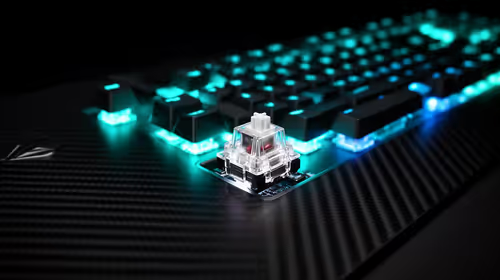
Hall Effect switches vs Mechanical switches for mMO and live-service games is mostly about compatibility, budget, upgrade path, and setup fit. SA buyers should check device support and real needs before expecting a clear win from either option.
Read more
A fake 113GB GTA VI ISO reportedly used empty padding around a small malware payload. SA gamers should delete unofficial builds, keep Windows security active and wait for official channels.

Wi-Fi 6E vs Wi-Fi 6 matters for 4K video editing when files move across a network. The real-world difference between Wi-Fi 6E and Wi-Fi 6 for video editing in 4K depends on NAS access, cloud uploads, router range, and SA creator workflows.

The difference between PCIe 5.0 and PCIe 4.0 for SA gamers is mostly bandwidth headroom. Compare GPU slot needs, NVMe speed, motherboard support, and upgrade timing before paying extra for a newer platform.

Gaming PC stuck pixel checks in South Africa should confirm the monitor fault first. Use colour tests, screenshot comparison, cable swaps, display menu checks, and clear photos before deciding on support.

Shokz OpenFit Air 2 earbuds weigh 7.2g each and use a redesigned dual-driver open-ear layout. SA buyers should choose them for comfort and awareness, not maximum isolation.

AMD's current driver now lists a Radeon RX 9050 4GB, while product coverage details a narrowed memory system. SA buyers should weigh the low VRAM ceiling against current local Radeon options.

Samsung Display has demonstrated a 16-inch 2.5K OLED laptop panel running at 300Hz. SA buyers should wait for a named notebook, full panel specifications and a local price before planning an upgrade.

Microsoft says some Windows 11 game crashes after recent updates are linked to RGB-related drivers. Affected SA gamers should confirm the update and driver before using the published registry workaround.

Minisforum's M2 Pro pairs Core Ultra X7, Arc B390 graphics and 32GB onboard memory in 1.8 litres. SA buyers should weigh its fixed memory and $1,439 launch offer against local mini PCs.

Smart monitors can add apps and convenience, but they also add privacy settings and unwanted-software risk. SA buyers should audit the operating system before paying for extras.

Lenovo says Legion Go failures linked to BIOS N3CN42WW are not user error. Affected SA owners should stop retrying the update, preserve proof and open a support case.
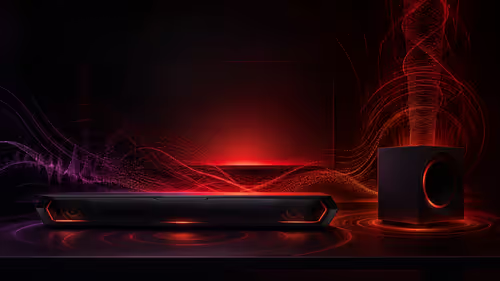
The ROG Gjallar gaming soundbar is now listed in the US at $599.99. SA buyers should compare its 2.1.2 audio, wireless bass and built-in chat controls with simpler local options.