Quick Answer
The Asetek Gen8 V2 pump maintains stable coolant flow without user intervention for the most part, but you can optimise its performance by running the pump at 60 to 70% speed through your motherboard's AIO_PUMP header, mounting the radiator so hoses exit from the bottom of the pump block to prevent air pockets, and checking for unusual gurgling sounds in the first week of operation that would indicate a trapped air bubble needing to be worked out.
Understanding the Asetek Gen8 V2 Pump Design 🔧
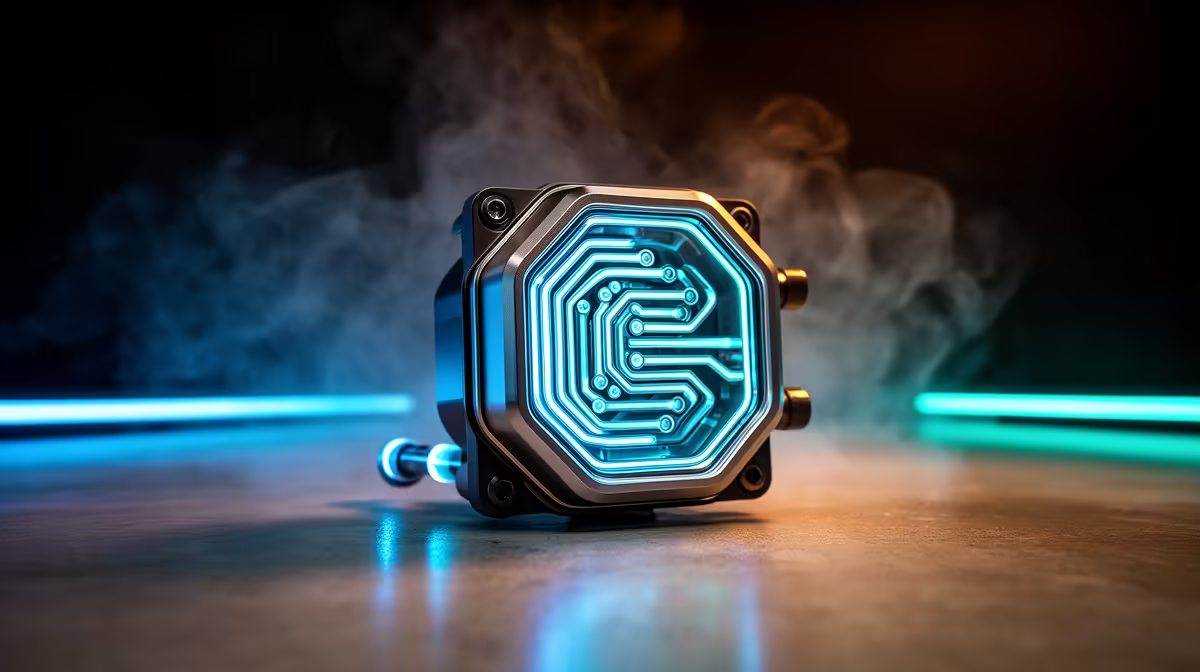
Asetek is an OEM pump manufacturer whose Gen8 V2 design underpins a large number of retail AIOs from brands including Corsair, Fractal Design and Antec, even though the outer pump block styling differs per brand. The Gen8 V2 uses a ceramic bearing shaft and redesigned impeller geometry, producing flow rates Asetek rates at improved consistency over the product lifespan. The pump is self-contained and sealed; the coolant loop is not user-serviceable or refillable. SA summer ambient temperatures in coastal cities like Durban and Cape Town regularly exceed 30 degrees Celsius, but the Asetek design handles this without modification.
Pump Speed Settings for Stability 🖥️
Connecting the pump cable to the CPU_OPT or AIO_PUMP header allows the motherboard to control pump speed via PWM signal. For Asetek-based AIOs, running the pump at a constant 60 to 70% delivers consistent flow with reduced noise compared to full speed, without measurable temperature impact under normal gaming loads. Dropping below 50% is not recommended as flow rate reduction becomes detectable in thermal performance. At 100% pump speed the noise increase is unnecessary unless you are overclocking a Ryzen 9 9950X beyond 200W package power.
Long-Term Maintenance and Lifespan Indicators ⏱️
A properly functioning Asetek Gen8 V2 loop is virtually maintenance-free for its rated lifespan, typically five to six years. Watch for two failure indicators: rising CPU temperatures over weeks without a thermal paste explanation (suggesting reduced pump output), and continuous gurgling after the first week (indicating a persistent air pocket). If CPU idle temperatures increase by more than 5 degrees Celsius compared to initial benchmarks, remount the pump block with fresh thermal paste before assuming pump failure. Thermal paste on high-core-count platforms like the Ryzen 9 9950X degrades faster than on lower-TDP CPUs.
Log Your Baseline CPU Temps on Day One ⚡
Screenshot your CPU idle and load temperatures within the first 48 hours after installation using HWiNFO64. Save this as your baseline reference. If temperatures drift more than 5 to 7 degrees Celsius upward over the following months, you have a documented starting point to diagnose whether the pump, paste or airflow is the cause.
FAQ
Can I refill or top up coolant in an Asetek Gen8 V2 AIO?
No. The loop is a sealed closed system with no user-accessible fill port. If the coolant level drops to a point affecting performance, which is rare but can occur due to micro-permeation over years, the unit requires replacement rather than servicing.
Does mounting orientation affect Asetek pump performance?
Yes. Asetek recommends that the pump block be mounted with the hoses exiting from the bottom or side rather than from the top of the block, to prevent air accumulation near the pump impeller. Check the installation guide for your specific branded unit to confirm the recommended orientation.
What causes gurgling sounds in a new Asetek AIO?
Small air bubbles trapped during shipping or installation are the standard cause. Running the system at idle for 15 to 30 minutes and gently tilting the case through different angles allows bubbles to migrate to a non-critical part of the loop. Persistent gurgling beyond 24 hours of use warrants checking the radiator mount orientation.
Shopping for a reliable closed-loop cooler?
Evetech stocks a range of AIO coolers built on proven pump designs, suitable for everything from mid-range Ryzen builds to flagship overclocking setups.