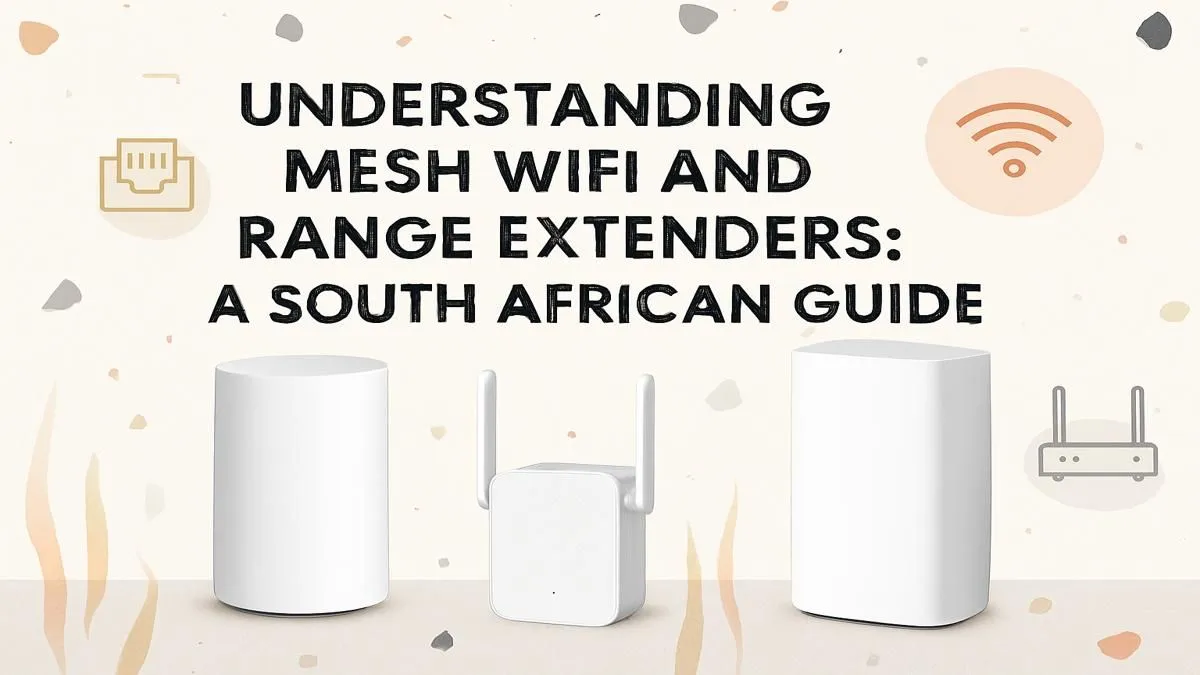
Is your WiFi signal weaker than Eskom's promises? You've got fast fibre, but the signal dies the second you step onto the patio. Or maybe your gaming session upstairs feels like you’re connecting via dial-up. You're not alone. The battle for whole-home coverage is real, and the big question for many South Africans is: Mesh WiFi vs Range Extender? Let's settle the debate and find the perfect fix for your digital dead zones. ⚡
Understanding the WiFi Range Extender
Think of a WiFi range extender as a simple signal booster. It captures the existing wireless signal from your main router and rebroadcasts it to a wider area. It’s a straightforward solution for targeting a specific dead spot in your home, like a single upstairs bedroom or the braai area.
For many, this is the most budget-friendly first step. You can browse a solid selection of wireless range extenders that won't break the bank.
The Pros and Cons
- Pro: Affordability. Extenders are significantly cheaper than a full mesh system, often costing just a few hundred ZAR.
- Pro: Simplicity. Plug it in, connect it to your network, and you're mostly done.
- Con: Performance Hit. This is the big one. Most extenders create a new network (e.g., "MyWiFi_EXT") and effectively cut your potential bandwidth in half. This is because the device has to receive and transmit data on the same channel.
- Con: Clunky Handoff. As you move through your house, your phone or laptop has to disconnect from the main router and connect to the extender's network, causing a brief but noticeable interruption.
Demystifying the Mesh WiFi System
A mesh WiFi system is a more modern and intelligent solution. It replaces your single router with a team of "nodes" that work together. One node connects to your modem, and the others are placed strategically around your home. They all communicate with each other, blanketing your entire property in a single, powerful, and seamless WiFi network. 🚀
This approach ensures you have a strong connection everywhere, managed under one network name (SSID). It's the ultimate set-it-and-forget-it solution, built on the foundation of a powerful core wireless router that acts as the main hub.
The Pros and Cons
- Pro: Seamless Coverage. Walk from the lounge to the garden without ever dropping your connection. Your device automatically connects to the strongest node without you noticing a thing.
- Pro: Consistent Speed. Mesh systems use smart technology (and often a dedicated backhaul channel) to pass data between nodes without the significant speed loss you see with extenders.
- Con: Higher Initial Cost. A mesh system is an investment, typically costing more upfront than a single extender.
- Con: May Be Overkill for Small Spaces. If you live in a small flat, a mesh system might be more power than you need.
Placement Pro Tip 🔧
Whether you choose a mesh node or a range extender, placement is key. Avoid tucking it away in a cabinet or behind the TV. Place it in the open, halfway between your main router and the dead zone. Elevation helps, so try putting it on a bookshelf rather than on the floor. This gives the signal the best possible chance to travel freely.
Mesh WiFi vs Range Extender South Africa: The Verdict
So, which technology wins the day? The best choice depends entirely on your home and your needs. Let's break it down.
Performance and Roaming
For pure performance, mesh WiFi is the undisputed champion. It delivers more consistent speeds across a larger area and provides a truly seamless roaming experience. A range extender can plug a gap, but it will never match the intelligent, unified network of a mesh system. For older PCs or laptops to take full advantage of these speeds, you might also consider upgrading your PC with modern wireless adapters.
Coverage Area
If you have a large, multi-level home with thick walls (a classic South African build), a mesh system is practically essential for killing multiple dead zones. A range extender is better suited for smaller homes or apartments where you just need to push the signal into one more room.
Budget
There's no contest here. If your budget is tight and you only need to fix one annoying dead spot, a range extender is the most cost-effective solution. A mesh system is a bigger investment for a more comprehensive, long-term fix.
Which One Should You Buy?
Let's make it simple.
Get a WiFi Range Extender if...
- You live in a small to medium-sized home or apartment.
- You have only one or two specific dead zones to cover.
- Your budget is your main priority.
- Your internet needs are basic (browsing, email, some streaming).
Get a Mesh WiFi System if... ✨
- You live in a large or double-storey house.
- You suffer from multiple dead zones and inconsistent signal.
- You are a gamer, a 4K streamer, or work from home and need rock-solid reliability.
- You have many smart home devices competing for bandwidth.
Ultimately, the debate of Mesh WiFi vs Range Extender in South Africa comes down to choosing the right tool for the job. Both can solve WiFi problems, but they do it in very different ways. Assess your space, your budget, and your performance needs, and you'll find the perfect match in our complete range of wireless networking gear.