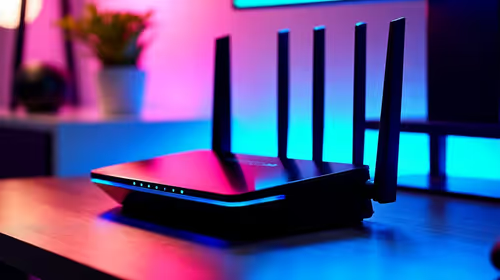
But the real frustration? The silence. Your Wi-Fi is dead, your smart home is dumb, and your CCTV cameras are blind. In South Africa, keeping your essential tech online isn't a luxury; it's a necessity. You know you need a UPS, but which one? The big, boxy traditional UPS or its smaller, sleeker cousin, the mini DC UPS? Let's plug in and find the answer.
Understanding the Traditional UPS
A traditional Uninterruptible Power Supply (UPS) is the classic workhorse we all know. It takes AC power from your wall, charges an internal battery, and then outputs AC power again. Think of it as a personal power station for your desk.
Its biggest advantage is versatility. You can plug almost anything with a standard plug into it—your PC, monitor, console, and yes, your router. It's a fantastic all-in-one solution if you want to keep your entire workstation running for a few minutes to save your work and shut down safely. However, for just a router, it's a bit like using a bakkie to deliver a pizza... it works, but it’s not very efficient. The process of converting power from AC to DC (to charge the battery) and back to AC (to power your devices) wastes energy, especially for small electronics that run on DC power anyway.
For those who need to power multiple AC devices at once, exploring a wide range of traditional UPS systems is the logical first step.
UPS Sizing for Controlled Shutdown
Now, meet the specialist: the mini DC UPS. It lives between your device's power brick and the device itself, providing direct DC power without any wasteful conversion.
Here’s how it shines:
- Hyper-Efficient: By staying in the DC power lane, it wastes far less energy. This means a smaller battery can keep your router or CCTV camera online for much longer than a traditional UPS of a similar price.
- Compact & Silent: It’s tiny, often no bigger than your router itself. With no need for cooling fans, it’s completely silent.
- Plug & Play: Installation is a breeze. You simply connect it in-line with your existing power supply.
The trade-off? It's not versatile. A mini DC UPS is designed for low-power DC devices only—perfect for a router, Fibre ONT, or a single IP camera, but useless for your PC or monitor. These are the go-to choice for anyone looking for affordable mini UPS solutions specifically to keep their internet alive.
Check Your Voltage! ⚡
Before you buy a mini DC UPS, check the power adapter of your router or CCTV camera. Look for the output voltage (V) and amperage (A). Most routers use 9V or 12V. Your mini DC UPS must match this voltage. Most models come with multiple adapter tips to ensure a perfect fit, but it's always best to check first!
Mini DC UPS vs Traditional UPS: The Head-to-Head
So, when it comes to keeping your router and CCTV powered, which one truly wins? Let's break it down.
| Feature |
Mini DC UPS |
Traditional UPS |
| Primary Use |
Router, Fibre ONT, CCTV |
PC, Monitor, Multiple Devices |
| Efficiency |
Very High (Direct DC) |
Lower (AC-DC-AC Conversion) |
| Runtime (for Router) |
Excellent (Often 4-8 hours) |
Fair (Often 1-2 hours) |
| Size & Noise |
Compact & Silent |
Bulky & Can Be Noisy (Fan) |
| Versatility |
Low (DC devices only) |
High (Any AC device) |
| Cost |
Generally Lower |
Generally Higher |
For the specific task of powering a router or a single CCTV camera through an unexpected outage, the mini DC UPS vs traditional UPS debate has a clear winner. The mini DC UPS provides longer runtime, is more efficient, and comes in a smaller, silent package designed perfectly for the job.
Which is the Best for Your Setup?
The right choice depends entirely on your needs. Ask yourself one simple question: "What do I need to keep powered on?"
Choose a Mini DC UPS if... ✅
Your only goal is to keep your Wi-Fi and/or a single security camera online during outages. You value long runtimes for these specific devices and want a simple, cost-effective, and silent solution.
Choose a Traditional UPS if... ✅
You need to power your router plus other devices like a desktop PC, a gaming console, or a TV. You need a versatile power backup for your entire entertainment or work setup, even if it's just for a few minutes.
Ultimately, both have their place in a modern South African home. Many savvy tech users even use both—a mini DC UPS for the internet connection and a traditional UPS for their PC. This ensures the internet stays on for hours, while the PC has enough time to shut down safely. 🚀
Ready to Stay Connected?
An unexpected outage doesn't have to mean disconnection. Whether you need a dedicated mini UPS for your router or a powerful traditional UPS for your whole rig, we've got you covered. Explore Evetech's full range of UPS solutions and find the perfect power backup to conquer the outages.