


PCIe 5.0 vs PCIe 4.0 for Video editing in 4k in SA
PCIe 5.0 vs PCIe 4.0 for video editing in 4k is mainly about fit, features, compatibility, cost, and upgrade path, not one automatic winner. SA buyers should match the choice to the setup.
Read moreNVMe SSD buying order for monitor upgrades should be shortlisted around the job it must do. South African buyers should compare GPU tier, VRAM, cooling, and PSU headroom, warranty path, and upgrade room before treating any pick as best.
Rank must-have compatibility and protection first, nice-to-have comfort second, and skip features that do not improve a monitor-first GPU upgrade path. For most SA buyers, a useful gaming monitor sits around R2,500-R9,000 and should be judged against 144 Hz to 180 Hz refresh, 1 ms response claims and 1080p or 1440p panels. Use examples like MSI G274QPF, AOC 24G4 or Samsung Odyssey G5 as a reference class, then confirm current Evetech stock and warranty before choosing.
For a monitor-first GPU upgrade path, start with the job the hardware must do every week. A gaming monitor should solve a clear problem: clearer motion, sharper workspace and a realistic target for the GPU upgrade that may come later. If it does not change the daily experience, keep the money for the part that does.
The useful baseline is practical rather than flashy. Check 144 Hz to 180 Hz refresh, 1 ms response claims and 1080p or 1440p panels and compare it with the PC, desk, room size and workload you already have. In school holiday, residence and shared-room gaming setups, the better buy is usually the option that fits cleanly, has local support, and leaves no awkward cable, heat or space problem behind.
Price bands help prevent overbuying. Entry-level options can be good when the workload is light, while mid-range models often give the best mix of durability and features. Premium only makes sense when the rest of the setup is already strong enough to benefit from it.
Use numbers to keep the choice honest: capacity in GB or TB, refresh in Hz, wattage in W, node count, outlet count, fan size, or port speed. A student desk in a residence room, a family gaming corner and a creator workstation do not need the same tier, even when the product name is similar.
Before ordering, confirm GPU output ports, desk depth, stand size, HDMI or DisplayPort version, refresh target and whether 1080p or 1440p fits the games played. Many bad upgrades are not bad products; they are good products bought for the wrong setup. This check matters more when the room is shared, the PC is older, or the next upgrade is already planned.
Also check how the item will be used after month one. Shared spaces need lower noise and easier cleaning. Study setups need reliability and simple controls. Gaming builds need enough headroom for future parts without paying for extreme specs that sit unused.
Check fit, warranty and the one spec that affects the actual workload. For gaming monitors, that usually means comparing 144 Hz to 180 Hz refresh, 1 ms response claims and 1080p or 1440p panels against the PC, room and daily routine before chasing extras.
Sometimes, especially for light a monitor-first GPU upgrade path, but the cheapest unit must still meet the baseline spec. If it saves a few hundred rand but adds noise, instability or replacement risk, the saving is weak.
Premium is worth paying for when it protects expensive hardware, improves a task you do daily, or gives measurable headroom such as higher Hz, more TB, better W capacity or stronger ports. If the benefit is only cosmetic, stay mid-range.
your current setup, the target spec and a maximum rand amount before comparing gaming monitors; it stops a small upgrade from becoming an oversized basket.
PCIe 5.0 vs PCIe 4.0 for video editing in 4k is mainly about fit, features, compatibility, cost, and upgrade path, not one automatic winner. SA buyers should match the choice to the setup.
Read more
Wi-Fi 7 vs Wi-Fi 6e for competitive esports comes down to router support, latency goals, device compatibility, and coverage. SA buyers should match the choice to the real network setup.
Read more
ATX 3.1 vs ATX 3.0 for mMO and live-service games buyers - what changes is mostly about compatibility, budget, upgrade path, and setup fit. SA buyers should check device support and real needs before expecting a clear win from either option.
Read more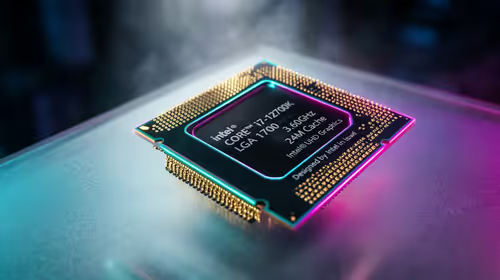
LGA 1851 vs LGA 1700 can affect Twitch and YouTube streaming when gaming and encoding share CPU resources. For SA creators, the real-world difference depends on encoder choice, memory support, motherboard cost, thermals, and upgrade plans.
Read more
X870E vs X670E for aaa single-player gaming is mainly about fit, features, compatibility, cost, and upgrade path, not one automatic winner. SA buyers should match the choice to the setup.
Read more
Hall Effect switches vs Mechanical switches for mMO and live-service games is mostly about compatibility, budget, upgrade path, and setup fit. SA buyers should check device support and real needs before expecting a clear win from either option.
Read more
A fake 113GB GTA VI ISO reportedly used empty padding around a small malware payload. SA gamers should delete unofficial builds, keep Windows security active and wait for official channels.
Wi-Fi 6E vs Wi-Fi 6 matters for 4K video editing when files move across a network. The real-world difference between Wi-Fi 6E and Wi-Fi 6 for video editing in 4K depends on NAS access, cloud uploads, router range, and SA creator workflows.

The difference between PCIe 5.0 and PCIe 4.0 for SA gamers is mostly bandwidth headroom. Compare GPU slot needs, NVMe speed, motherboard support, and upgrade timing before paying extra for a newer platform.

Gaming PC stuck pixel checks in South Africa should confirm the monitor fault first. Use colour tests, screenshot comparison, cable swaps, display menu checks, and clear photos before deciding on support.

Shokz OpenFit Air 2 earbuds weigh 7.2g each and use a redesigned dual-driver open-ear layout. SA buyers should choose them for comfort and awareness, not maximum isolation.

AMD's current driver now lists a Radeon RX 9050 4GB, while product coverage details a narrowed memory system. SA buyers should weigh the low VRAM ceiling against current local Radeon options.

Samsung Display has demonstrated a 16-inch 2.5K OLED laptop panel running at 300Hz. SA buyers should wait for a named notebook, full panel specifications and a local price before planning an upgrade.

Microsoft says some Windows 11 game crashes after recent updates are linked to RGB-related drivers. Affected SA gamers should confirm the update and driver before using the published registry workaround.

Minisforum's M2 Pro pairs Core Ultra X7, Arc B390 graphics and 32GB onboard memory in 1.8 litres. SA buyers should weigh its fixed memory and $1,439 launch offer against local mini PCs.

Smart monitors can add apps and convenience, but they also add privacy settings and unwanted-software risk. SA buyers should audit the operating system before paying for extras.

Lenovo says Legion Go failures linked to BIOS N3CN42WW are not user error. Affected SA owners should stop retrying the update, preserve proof and open a support case.
The ROG Gjallar gaming soundbar is now listed in the US at $599.99. SA buyers should compare its 2.1.2 audio, wireless bass and built-in chat controls with simpler local options.