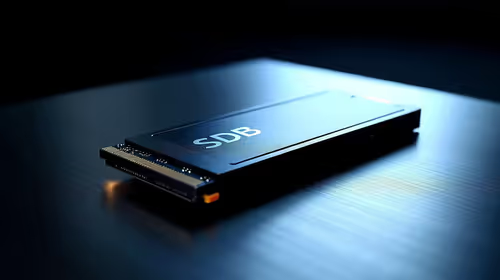
You’ve just slapped a lightning-fast NVMe SSD into your rig. Games load in a blink, Windows boots before you can grab your coffee, and life is good. But a nagging thought creeps in… don’t these things wear out? It’s a common fear holding people back. The truth is, modern NVMe SSD endurance is so immense that for most South African gamers, it’s a total non-issue. Let's crush the myths with some hard numbers. 🚀
Understanding NVMe SSD Endurance: More Than Just Speed
At its core, an SSD stores data on NAND flash memory cells. Unlike a traditional hard drive with its spinning platters, an SSD has no moving parts. However, the act of writing and erasing data very slowly degrades these memory cells over time. This degradation is the "wear" everyone talks about.
But here’s the key: manufacturers know this. They design drives to withstand an enormous amount of writing, far more than a typical user will ever perform. The main metric they use to measure this is Terabytes Written (TBW). Think of it as the total guaranteed amount of data you can write to the drive during its warranty period. For the vast majority of solid state drives available today, this number is huge.
Decoding TBW: Your SSD's Odometer
So, what do those TBW numbers actually mean for you and your PC? Let's use an analogy. If an SSD were a car, its TBW rating would be like the total kilometres the engine is warrantied for. It doesn't mean the car will explode at that exact number, but it’s the manufacturer's promise of durability.
Let’s get practical. A popular 1TB drive might have a 600 TBW rating. That means you can write 600 terabytes of data before you even approach the warranty limit.
How much is 600 TB?
- It's installing a massive 100GB game, like Baldur's Gate 3, 6,000 times.
- It’s writing 50GB of data every single day for over 32 years.
Suddenly, the concern about SSD lifespan seems a bit overblown, doesn't it? For most users, it's almost impossible to reach these limits through normal gaming and desktop use. Top brands like Kingston are very transparent about their TBW ratings, giving you complete peace of mind.
Check Your Drive's Health 🔧
You don't have to guess how much you've written to your drive. Free tools like CrystalDiskInfo (for Windows) can show you detailed health statistics, including the "Total Host Writes" or a similar metric. This tells you exactly how much data your SSD has processed, letting you see for yourself how little you actually write over time.
How SSD Lifespan Impacts Your Gaming Rig
Okay, but what about the unique demands of a gaming PC? We're constantly downloading huge games, patches, and updates. Surely that takes a toll?
Here's the secret: gaming is a read-heavy activity, not a write-heavy one.
- Installation: You write the game to the drive once. This is the biggest write operation.
- Playing: When you load a level, open your inventory, or a cutscene plays, your PC is reading data from the SSD. Reading has a negligible impact on the drive's wear.
- Patches & Updates: These are smaller writes that overwrite or add files.
Even if you install a new 150GB AAA title every month, you're only writing 1.8TB per year. For a drive with a 600 TBW rating, that's a tiny fraction of its total endurance. A massive 2TB NVMe SSD is built to handle this cycle for decades. Value-focused brands like ADATA also build their drives with impressive endurance specs, making them a smart choice for gamers on a budget.
Beyond TBW: What Else Affects Drive Health?
While TBW is the headline stat, modern drives have a bag of tricks to maximise their lifespan and ensure the NVMe SSD endurance is rock-solid. These features work silently in the background:
- Wear Levelling: The drive's controller is smart. It ensures that data writes are distributed evenly across all the memory cells, so no single part of the drive gets worn out prematurely.
- Over-Provisioning: Manufacturers set aside a small, invisible portion of the drive's storage. If a memory cell fails, the controller seamlessly swaps it with a healthy one from this reserve pool. You'll never even notice it happened. ✨
- TRIM Command: Your operating system tells the SSD which data blocks are no longer in use, allowing the drive to efficiently erase them and prepare them for new data, which improves performance and longevity.
High-performance drives from manufacturers like CORSAIR often come with advanced controllers that manage these processes exceptionally well, ensuring both speed and reliability.
The Verdict: Stop Worrying and Enjoy the Speed
For the average South African gamer, enthusiast, or content creator, the debate over SSD lifespan is settled. The technology has matured so much that you are overwhelmingly more likely to upgrade your entire PC for a faster CPU or GPU long before your NVMe SSD ever comes close to its write endurance limit.
Instead of worrying about TBW, focus on what really matters for your experience: getting the right capacity for your game library and the best performance for your budget. The speed boost is real, and the reliability is there to back it up.
Ready to Unleash True Speed?
Worrying about SSD endurance is a thing of the past. It's time to experience instant loading screens and a snappy PC. Explore our massive range of NVMe SSDs and find the perfect drive to supercharge your rig.