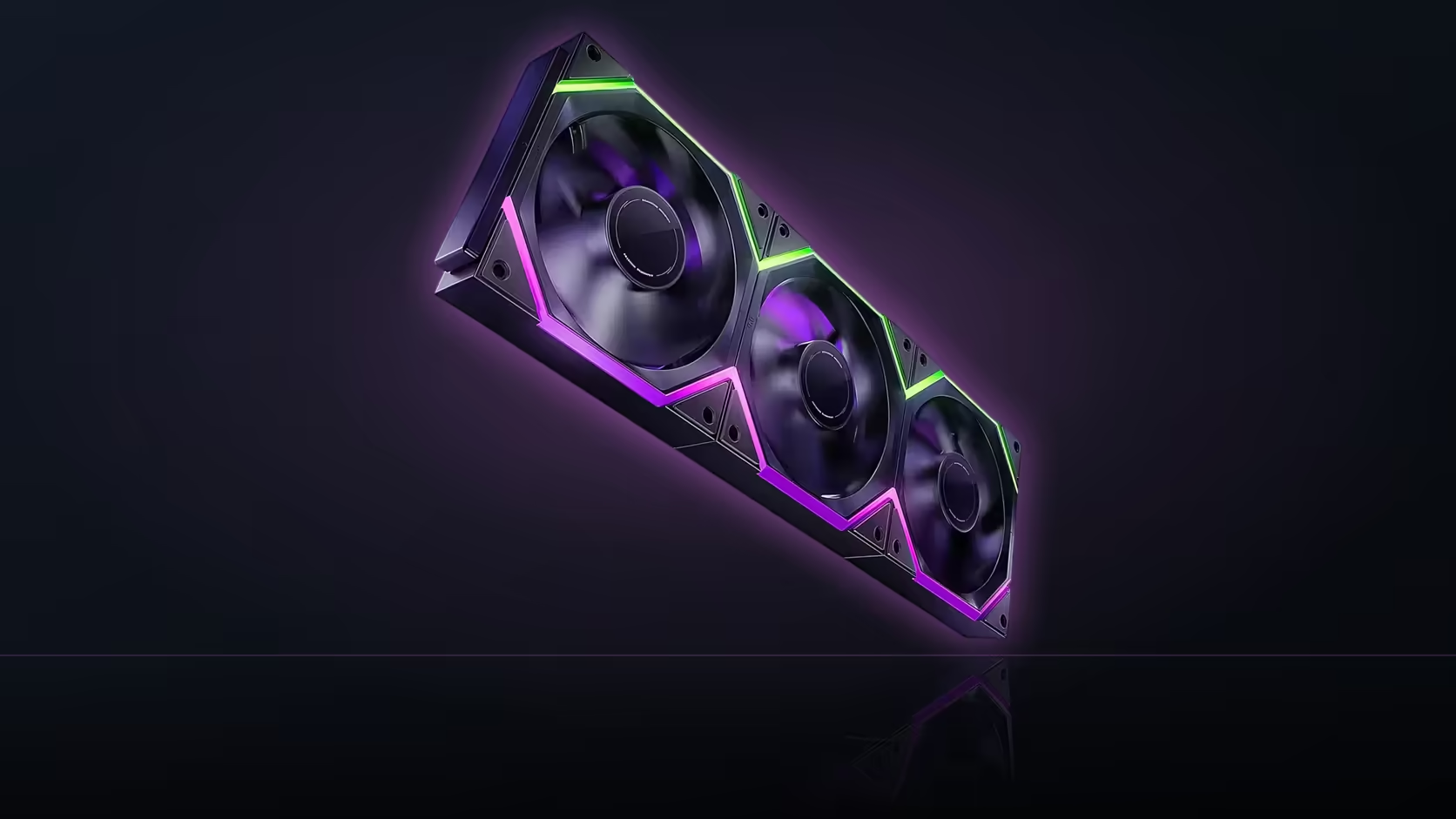
AsiaHorse builds a chained fan trio two different ways across its own range, and the two methods trade off almost opposite strengths. The Nyota Pro joins its fans through a physical interlock, while the Nyota A12 relies on linked cables between separate units, and the choice between them has more to do with how the row will be installed and serviced than with anything the fans do once spinning.
Quick Answer
The Nyota Pro chains its three fans with a modular interlock, a physical joint between the fan frames producing one continuous assembly, while the Nyota A12 uses linked PWM and ARGB connectors between fans that remain physically separate. Both approaches end in a single cable run to the board and both packs cost roughly the same bracket, R599 for the Pro versus R499 for the A12 (VAT included). Neither method changes cooling performance - both models spin through the same 800 to 2000 RPM PWM range and cap out at 61.5 CFM.
🔗 What the interlock method delivers
Joining the fan frames directly removes any visible cable between units along the row, leaving a single lead exiting the assembly. Installed, it reads as one continuous piece rather than three fans wired together, which is the main visual appeal of this approach. It also means the row is lifted, mounted, and later removed as a single unit rather than fan by fan.
🧵 What the linked-connector method delivers instead
Keeping the fans as separate units, joined only by short cables, trades that seamless look for flexibility. Each fan can be unplugged and pulled individually without disturbing its neighbours, which matters most when a case's fan bays are not perfectly adjacent or when one unit needs attention without touching the rest of the row.
Why that flexibility matters in some cases and not others
A case with fan mounts spaced apart, separated by a drive cage or a structural rib, may not accommodate an interlocked row at all, since that design assumes the fans sit directly against one another in sequence. Linked cables have no such constraint and adapt to whatever spacing the case actually has.
🔧 Servicing a single fan under each approach
With the interlock, replacing or even just inspecting one fan means releasing the joint, which usually means taking the row apart and often removing it from the case first. With linked cables, the same job is typically a matter of unplugging one lead and unmounting one fan, leaving its neighbours entirely undisturbed. For routine servicing where individual fans might need attention, the cabled approach is the less involved of the two.
👀 Which looks tidier once installed
The interlock wins here decisively: there is no cable visible between the fans at all, only the single run leaving the row. A cabled chain will always show short connecting leads between units, however neatly they are managed, which some builds specifically want to avoid and others do not mind in the slightest.
🏗️ Do either affect assembly time?
Broadly similar in practice. An interlocked row is joined first, as one step, and then mounted as a completed assembly, while cabled fans are typically mounted individually and connected together afterward. Neither is meaningfully faster or slower; they simply front-load the joining step differently.
⚙️ Performance stays out of the decision entirely
Both models list identical headline figures: up to 61.5 CFM, 800 to 2000 RPM under PWM, and 29 dBA or less. Choosing between the interlock and the linked-cable approach is purely a question of installation style, case layout, and how a row is likely to be serviced later, not a cooling decision in any respect.
🔇 The noise ceilings line up as well
Beyond airflow and speed, the two listings also match on stated noise: the A12 is quoted at under 29 dBA and the Pro at 29 dBA or less, which is the same figure stated two slightly different ways rather than a genuine gap between the models. That leaves chaining method as one of the few areas where the two ranges actually diverge, alongside the Pro's dual-zone ring and its R100 premium over the A12 three-pack. Anyone comparing the two purely on how they'll sound in a case has no real reason to prefer one over the other.
💰 Does the interlock's price show up anywhere?
AsiaHorse doesn't price the chaining method separately from the rest of the fan, so it's not possible to isolate exactly how much of the Pro's R599 covers the interlock versus the dual-zone ring versus anything else baked into that three-pack. What can be said is that the A12, using the simpler linked-cable approach, comes in R100 cheaper across the pack while matching the Pro on airflow, speed, and noise. Whether that gap reflects the interlock, the extra lighting zone, or some combination of both isn't something either listing breaks out, so treating the whole R100 as a lighting premium, a chaining premium, or a mix is really a matter of framing rather than something the specifications settle definitively.
What that means for a buying decision
Since neither listing separates the cost of chaining method from the cost of lighting, the practical choice comes down to which combination of features - dual-zone ring plus interlock, or single-zone ring plus linked cables - suits a specific build, rather than trying to work out which line item inside the R100 gap is doing the most work. Both packs remain three-pack-only regardless of chaining style, so a failed fan means a fresh pack either way, whichever chaining method a given build ends up running.
For a direct look at both chaining approaches across the range, Evetech's case fan category is the place to compare, and fan controller hardware is worth checking for anyone also weighing hub-based lighting control on top of the mechanical question.
Frequently Asked Questions
What does the interlock method give a build?
Fans joined into one physical assembly on a single cable run, the tidiest option where fan positions sit adjacent to each other.
What does the linked-connector method give instead?
Separate fans joined by cables, keeping each unit independent, which suits cases with spaced or separated fan bays.
Which is easier to service?
Linked cables usually, since one fan can be unplugged and removed without disassembling a physical joint.
Which looks tidier once mounted?
The interlock, since no cable is visible between the fans along the row at all.
Can an interlocked row be taken apart if needed?
Yes, the interlock can be released, though that means disassembling the joint rather than unplugging a single lead.
Do both methods finish with one cable run to the board?
Yes, that is the shared outcome of either approach, whatever the installation differences along the way.
Does either approach change cooling performance?
No, both models list identical airflow and speed figures, so chaining style is purely an installation and servicing question.
Weighing interlocked versus cabled fan rows for your build?
Compare both styles across Evetech's case fan range before you decide.