OLED vs IPS for Competitive Shooters: Does 0.03ms Matter?
Quick Answer
OLED can produce cleaner motion than IPS because its pixels change state fast and avoid much of the transition smear found on LCD panels. A quoted 0.03ms versus 1ms does not mean your whole system becomes 0.97ms faster.
Response claims use different test methods and often describe a best case. Refresh interval, game frame time, display processing and input delay remain part of the result.
Choose OLED when you want superb motion and contrast and accept its brightness behaviour, care routine and wear risk. A well-tested fast IPS monitor remains fully competitive and can suit long static desktop use better.
Separate Response Time From Input Lag
Pixel response describes how long a pixel takes to change between levels. Input lag describes delay before the display begins showing the new result. They are related to motion quality but are not the same number.
An OLED transition can finish far inside a 240Hz refresh window. Fast IPS transitions vary by colour and overdrive setting. Some finish in time; slower ones overlap the next frame.
The display still waits for a frame and scans it across the panel. At 240Hz, each refresh interval is about 4.2ms. That context makes a sub-millisecond response useful without turning it into the complete latency story.
Read Monitor Claims Carefully
Manufacturers may quote grey-to-grey, a selected transition or another measurement under an aggressive mode. The smallest figure rarely describes every transition.
IPS overdrive can speed pixels by pushing them beyond the target. Too much creates inverse ghosting, visible as bright trails around moving objects.
OLED needs little overdrive, which helps it stay clean across refresh rates. Sample-and-hold motion blur from your eyes tracking a held frame still exists and improves as refresh rises.
Use independent reviews that show average response, slow transitions, overshoot and total input delay.
What You See in a Shooter
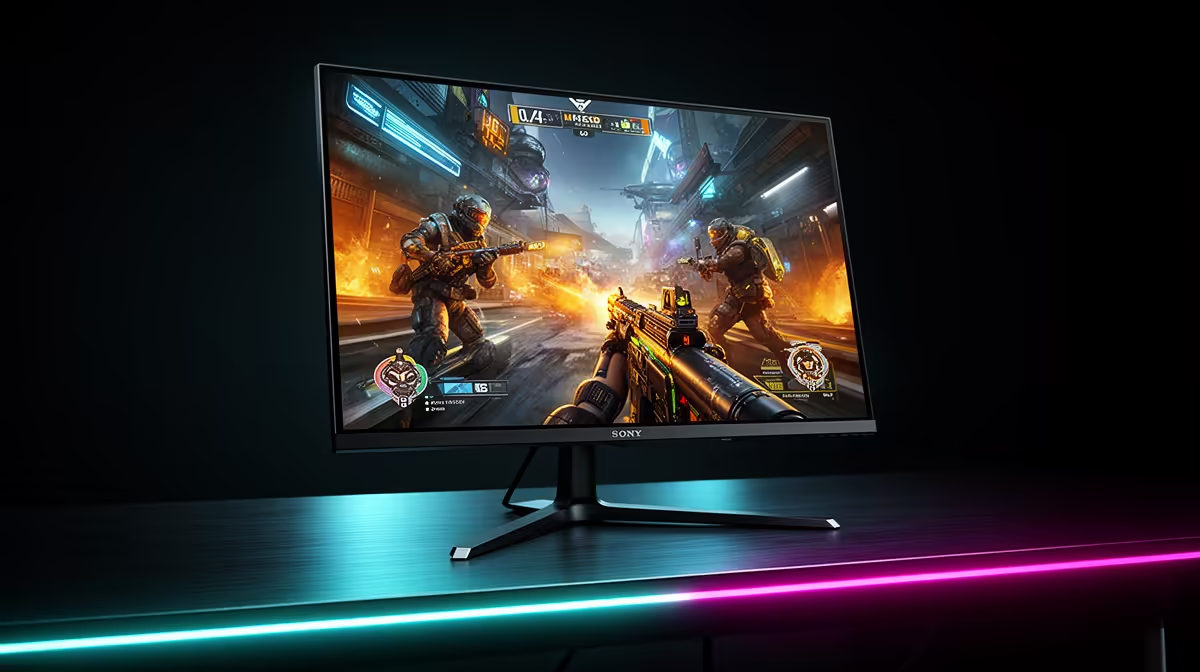
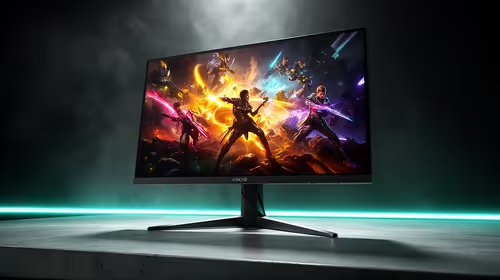
During a fast pan, OLED tends to preserve clearer edges and fewer LCD-style trails. Crosshair tracking and reading a moving opponent can feel cleaner.
The advantage grows when the IPS panel has weak tuning. Against a strong 360Hz IPS screen, the comparison becomes closer and includes refresh, resolution and how many frames the PC delivers.
Do not expect OLED to fix low base frame rate. A 240Hz panel fed 80fps gets only 80 unique rendered updates. Adaptive sync can present them cleanly, but it cannot invent native game information.
Contrast Helps, With Limits
OLED turns individual pixels off for black, producing strong dark-scene contrast. In a controlled room, shadow boundaries can look clear without a backlight halo.
Competitive visibility also depends on game lighting, gamma and your settings. Crushing dark detail for dramatic blacks can hide information. Raising every shadow can wash the image out.
Set the monitor using a known test pattern and the game's visibility controls. Avoid treating maximum black equaliser as a universal advantage.
Bright-Room Performance Differs
IPS monitors with strong backlights can sustain a bright full desktop. Reflections and screen coating still affect what reaches your eyes.
OLED brightness can change with average picture level and its protection behaviour. A bright white desktop may dim compared with a small game highlight.
Check measured full-screen and small-window brightness. Review whether the coating becomes grey or reflective under your room lighting.
Static Content and Wear
OLED pixels age as they emit light. Long exposure to static HUD elements, taskbars and desktop windows can contribute to uneven wear over time.
Modern screens use shifting, dimming and compensation routines. These reduce risk but do not make it zero.
Competitive shooters contain static HUD pieces, yet the rest of the image moves. The risk depends on brightness, hours, repeated content and panel management. Read the exact warranty for burn-in terms.
IPS does not have OLED-style emissive wear. It can have backlight uniformity issues, stuck pixels or glow, so it is not a risk-free technology.
Refresh Rate Changes the Comparison
At the same 240Hz, OLED's fast response can show a cleaner version of each scan than IPS. At 360Hz IPS versus 240Hz OLED, the faster IPS gets more scan opportunities while OLED keeps stronger pixel transitions.
There is no paper winner for every shooter. Measure the PC's native frame range and choose which strength it can use.
A 500Hz IPS display has a 2ms refresh interval. A 360Hz OLED has about 2.8ms. The OLED response can remain cleaner, while the IPS presents more frames when the PC supplies them.
Resolution and GPU Load Matter
Many OLED gaming monitors use 1440p or 4K. Competitive IPS ranges include more 1080p extreme-refresh choices.
Moving from 1080p to 1440p adds about 78 percent more pixels. That can reduce frame rate enough to outweigh a response advantage in a CPU and GPU limited setup.
Use current benchmarks for your game. A 1440p OLED may be ideal for a strong PC and mixed library. A 1080p 360Hz IPS can fit a tournament-focused machine.
Compare Panel Formats
A 27-inch 1440p OLED gives sharp text and a broad game view. Subpixel layouts can affect fine desktop text, so inspect the exact panel generation and operating-system rendering.
A 24.5-inch 1080p IPS keeps the view compact and has a long esports history. Its lower pixel load makes extreme native FPS easier.
Ultrawide OLED suits immersive games but may not fit competitive field-of-view rules. Pick the format before the panel technology.
Cost Should Buy a Visible Gain
OLED often sits above ordinary IPS pricing, although the gap varies by size, refresh and current market. Decide whether motion, contrast and HDR improve your whole game library.
Browse the current PC monitor range, compare popular monitor choices, and inspect OLED monitor options separately.
Shortlist one OLED and one proven IPS at the same resolution and refresh. Compare measured response, brightness, warranty, stand and connection requirements.
Set Up Either Panel Well
Open the operating-system display page, choose the panel's native pixel grid and set its top supported rate. Switch on variable refresh through both the screen menu and graphics controls.
For IPS, start with a balanced overdrive mode. For OLED, leave protection routines enabled and allow the maker's automatic compensation process to run.
Set brightness for the room. Use a frame cap when it improves frame-time consistency inside the sync range. Keep current game and GPU latency features configured from official guidance.
Decide by Player Profile
Choose OLED for a mixed library where fast shooters, dark single-player games and HDR all matter. It gives a broader image-quality upgrade beyond the response figure.
Choose IPS for a competition-only desk, high static desktop use, strong full-screen brightness or a tighter budget. A great IPS panel does not make you less competitive.
If you already own a clean 240Hz or 360Hz IPS screen, test OLED in person. The change should be visible in your motion and room, not only impressive on a specification sheet.
FAQ
Can players perceive 0.03ms versus 1ms?
They may see cleaner motion from faster transitions. The quoted difference is not equal to a complete system-latency reduction.
Does OLED reduce input lag?
Fast pixels reduce transition delay, while processing, scan-out and game latency still contribute. Check measured total input delay.
Is IPS still competitive?
Yes. Fast, well-tuned IPS monitors remain common and capable for serious shooter play.
Does OLED contrast help spot enemies?
It can improve dark-scene separation when settings preserve shadow detail. Poor gamma tuning can hide information on any panel.
Should you switch mainly for shooters?
Switch when cleaner motion and the rest of OLED's image quality justify the cost and care trade-offs. A response claim alone is not enough.
Compare OLED and fast IPS at the same resolution and refresh, then judge measured motion, brightness, wear terms and your native game frame rate together.