


PCIe 5.0 vs PCIe 4.0 for Video Editing in 4K in SA
PCIe 5.0 and PCIe 4.0 differ most in lane support, compatibility, and upgrade value for video editing in 4k. SA buyers should match the choice to their actual hardware and games.
Read moreEver wonder about the magic behind those perfect blacks? Our guide to OLED pixel structure breaks down everything from WRGB to QD-OLED layouts. Discover how different arrangements affect text clarity, color accuracy, and overall image quality on your display. 🖥️✨

Ever marvelled at the perfect, inky blacks and explosive colours on an OLED screen and wondered… how? It’s not magic, it’s engineering at a microscopic level. For South African gamers and creators, understanding the secret behind this tech—the OLED pixel structure—is the key to choosing a display that doesn't just look good, but performs flawlessly for your specific needs. It’s the difference between a good monitor and your next competitive edge. 🚀
Before we dive deep, let's get the basics straight. Every image on your screen is made of millions of tiny dots called pixels. Each pixel, in turn, is typically composed of smaller, single-colour lights called subpixels: one red, one green, and one blue (RGB). By mixing the brightness of these three, a single pixel can produce millions of colours.
The OLED pixel structure, or pixel layout, simply refers to how these red, green, and blue subpixels are arranged within each pixel. Unlike traditional LCDs, the layout in OLEDs can vary wildly, and this arrangement has a huge impact on everything from text clarity to peak brightness. Understanding this is vital when browsing for new PC monitors.
While there are many variations, most OLED panels you'll find today use one of two main families of pixel structure. Each has distinct pros and cons that cater to different users.
Imagine a simple, clean grid: Red, Green, Blue. Red, Green, Blue. Over and over. This is a standard RGB Stripe layout. Each pixel is a complete, self-contained unit with equally sized subpixels.
To solve the brightness and longevity puzzle, manufacturers got creative. PenTile layouts and their descendants, like LG's WRGB and Samsung's QD-OLED, use a non-standard arrangement of subpixels.
The shared downside? The subpixel arrangement isn't a neat grid. This can sometimes cause slight purple or green outlines on the edges of text, an effect known as colour fringing. While barely noticeable in games or movies, it can be visible if you're writing code or reading documents all day.
If you've got a monitor with a PenTile-style OLED pixel layout and notice text fringing, don't panic! Run the built-in 'ClearType Text Tuner' on Windows. This tool optimises how your PC renders fonts for your specific screen's pixel structure, which can significantly reduce colour fringing and make text much sharper.
Absolutely. For pure gaming and media consumption, the benefits of WRGB and QD-OLED panels are immense. The superior peak brightness makes HDR games like Cyberpunk 2077 or Alan Wake 2 look breathtakingly real. The near-instant pixel response time is a given with any OLED, so motion clarity is always top-tier across all our gaming monitors.
If you’re a hybrid user—smashing out ranked matches at night but writing reports or code during the day—the choice is more nuanced. You have to weigh the perfect text clarity of an RGB Stripe panel against the raw HDR power of a QD-OLED. For many, the immersion offered by the latest display tech, especially on immersive curved monitors, is well worth the minor compromise on static text.
Ultimately, there's no single "best" OLED pixel structure; there's only the best one for you.
Technology is always evolving, with manufacturers constantly improving their pixel layouts to minimise the downsides. Even today's versatile portable monitors are starting to feature stunning OLED screens. By understanding the core display tech, you're now equipped to look past the marketing hype and find a screen that truly fits your world. And who knows, you might just find it in the best PC monitor deals available right now.
Ready to See the Difference for Yourself? Understanding OLED pixel structure moves you from a casual buyer to an informed enthusiast. You're now ready to choose a display that perfectly matches your needs, whether it's for competitive gaming, creative work, or pure cinematic immersion. Explore our massive range of gaming monitors and find the perfect OLED screen to revolutionise your setup.
OLED pixel structure refers to the specific arrangement of red, green, and blue (and sometimes white) subpixels that form a single pixel on an OLED display.
Non-standard layouts like PenTile can cause color fringing on text, making it appear less sharp than on traditional RGB stripe layouts found in LCDs or some OLEDs.
LG's WOLED uses an RGBW (Red, Green, Blue, White) subpixel layout for higher brightness, while Samsung's QD-OLED uses a unique triangular RGB subpixel arrangement.
Not necessarily. While PenTile can be less ideal for sharp text, it is efficient for battery life and manufacturing, especially in smaller mobile displays.
No, different manufacturers and panel types use various pixel arrangements, including RGB stripe, PenTile matrix, and WRGB, each with unique pros and cons.
The white subpixel, found in LG's WOLED panels, is added to increase overall screen brightness and improve efficiency, helping to reduce the risk of burn-in over time.
PCIe 5.0 and PCIe 4.0 differ most in lane support, compatibility, and upgrade value for video editing in 4k. SA buyers should match the choice to their actual hardware and games.
Read more
ATX 3.1 and ATX 3.0 differ most in connector handling and GPU power design. For SA gamers, the choice comes down to your graphics card, PSU quality, cable clearance, and whether a newer 12V-2x6-ready unit makes sense for the build.
Read more
80+ Platinum or 80+ Titanium for cinematic should be shortlisted around the job it must do. South African buyers should compare fit, performance, compatibility, and upgrade room, warranty path, and upgrade room before treating any pick as best.
Read more
AM5 and AM4 can both work for competitive esports, but the real-world difference is platform headroom. SA players should compare CPU choices, memory speed, latency goals, monitor refresh, and future upgrade plans.
Read more
LGA 1851 and LGA 1700 differ most in CPU support, compatibility, and upgrade value for couch co-op gaming. SA buyers should match the choice to their actual hardware and games.
Read more
DLSS 4 and DLSS 3 differ most in game support, compatibility, and upgrade value for streaming on twitch and youtube. SA buyers should match the choice to their actual hardware and games.
Read more
RTX 5090 on a 1200W PSU has usable headroom when the supply is strong and the build is measured. For SA gamers, OC potential depends on CPU draw, cooling, cabling, stability targets, and how much safety margin you keep.

How to fix low FPS on gaming laptop starts with power mode, drivers, heat, and game settings. Use this South Africa-focused checklist to confirm charger use, GPU selection, RAM pressure, and cooling before changing parts or tweaking every setting.
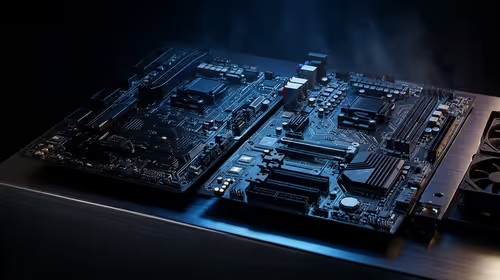
Real world difference between b850 b650 mmo live service games sits in stability, networking, storage, and upgrade room. SA players should compare LAN quality, USB layout, RAM support, and SSD slots for always-updated games.
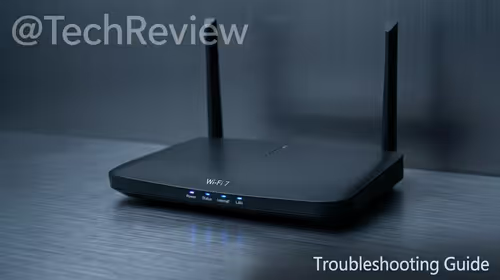
Dead Pixel on Wi-Fi 7 Router is likely a display-path or source-title issue, so check the screen, cable, driver state, and related system symptoms before blaming the device itself.

Put the headphones in pairing mode, open Bluetooth and devices in Windows 11, then add the headset. If it fails, remove the old pairing and check charge, range and drivers.

Microsoft says upcoming Windows 11 work will target memory use on 8GB PCs and improve boot and sign-in responsiveness. There is no public release date or measured uplift yet.
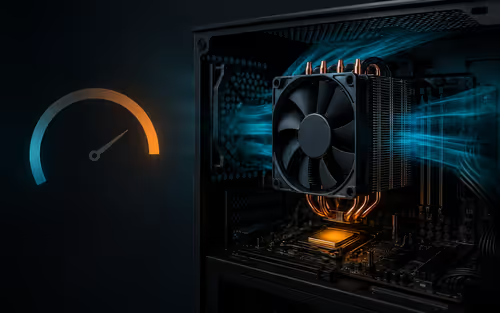
Windows 11 does not show CPU temperature in its standard Settings pages. Use your CPU maker's supported utility or a trusted monitor, then read idle and loaded temperatures in context.

The Colorful MEOW X16 Pro pairs a Ryzen 7 8745HX with a 115W RTX 5060 Laptop GPU. It is a China-only launch for now, so local RTX 5060 pricing is the practical benchmark.
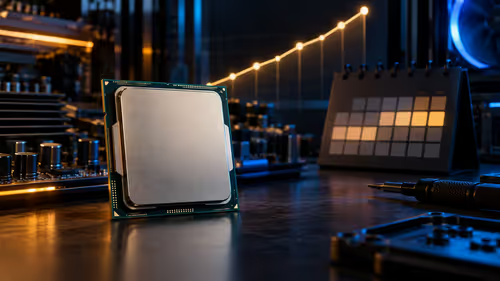
Industry reports point to another roughly 10 percent Intel processor increase from 5 October, but Intel has not published a consumer price list confirming the scope. South African buyers should treat it as a risk signal, not a guaranteed Rand change.
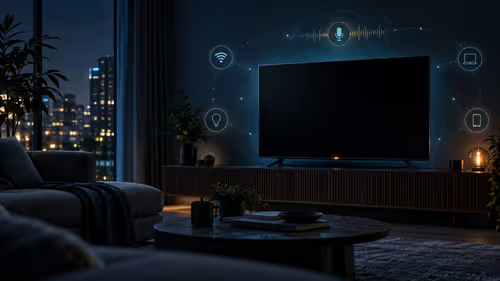
Tests reported audio capture and local-network scanning on a specific LG television with its screen off. LG says supported standby modes can keep voice and connected-device features active, so owners should review model-specific settings.
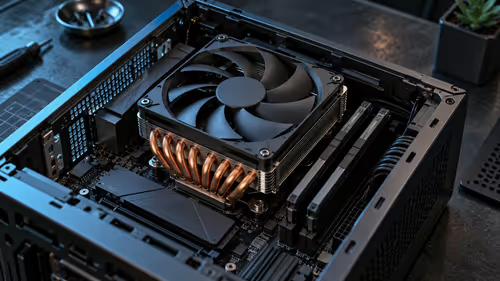
Thermalright's AXP120-X77 is a 77 mm top-down cooler with six heatpipes and a slim 120 mm fan. Local availability is not confirmed, so compact-PC builders should verify case height, memory clearance and socket support before comparing it with stocked coolers.

One-sided sound can come from balance settings, a dirty or loose connector, Bluetooth pairing data, firmware, the source device or a failed cable or driver. A short swap test isolates the cause before you reset software or replace the headset.