Quick Answer
Proper PSU positioning and cable routing can lower average component temperatures by 5 to 12 degrees Celsius in a mid-tower build. Mount a bottom-mounted PSU fan-down to draw cool air from below the case floor, and route all cables behind the back panel through grommets to keep the main chamber clear for front-to-rear airflow.
PSU Positioning: Bottom-Mount Fan Down vs Fan Up 🔧
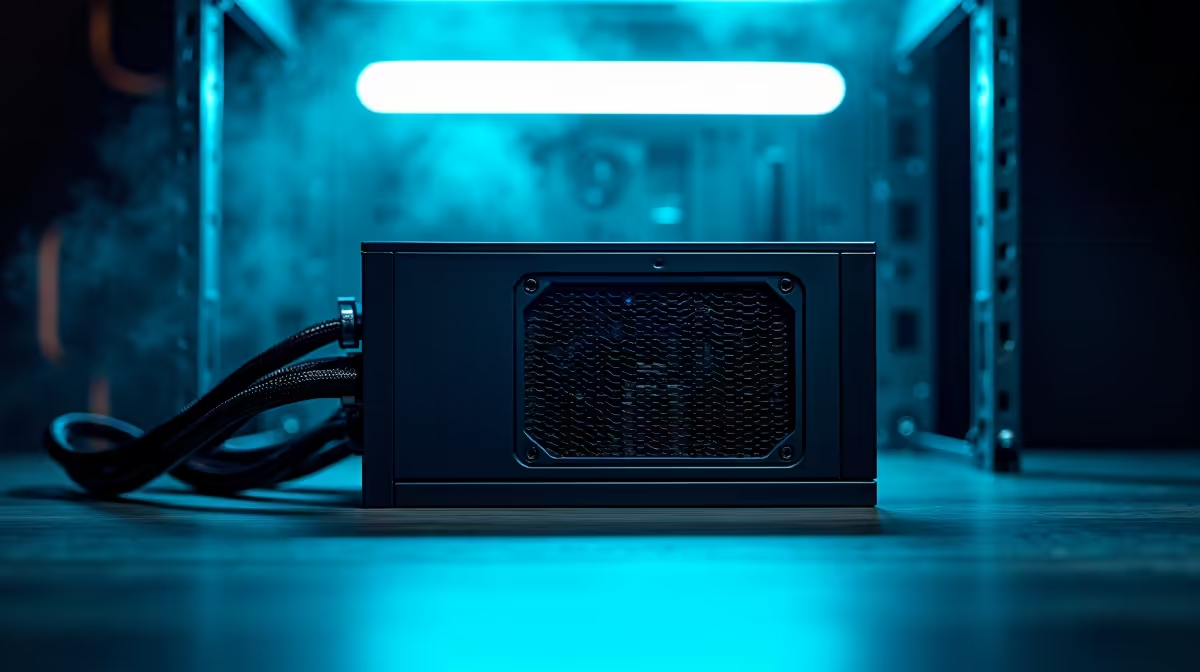
Most modern mid-tower cases place the PSU at the bottom rear. Fan facing down, the PSU draws cool air through the case floor via a dust filter and exhausts it out the rear, keeping its heat separate from the main chamber. Fan facing up, the PSU competes with CPU and GPU coolers for the same warm air. The difference under sustained load is measurable: a fan-down PSU runs 8 to 15 degrees cooler, improving efficiency and reducing noise. Bottom-mounted cases from Lian Li, Fractal Design, and Phanteks are stocked at Evetech across various price points.
How Cable Routing Directly Affects Airflow Paths 💨
Airflow inside a PC follows the path of least resistance. Cables crossing the main chamber create turbulence and restriction that raises the static pressure required for air to reach heatsinks. In a build with neglected cable management, the area directly in front of the GPU can form a low-velocity zone because bundled power cables block incoming air. This raises GPU junction temperature by 5 to 8 degrees Celsius compared to a clean build using the same fans. Routing every cable behind the back panel eliminates this restriction entirely.
Combining Modular Cables with Fan Configuration 🌀
Modular cables enable a clean interior, but the thermal benefit multiplies with a sensible fan layout. A three-fan front intake plus one rear exhaust plus two top exhaust creates positive pressure that forces air efficiently over CPU, GPU, and RAM. In South Africa, where ambient temperatures in Durban and Pretoria can exceed 35 degrees Celsius in summer, this matters more than in cooler climates. A build running at 75 degrees Celsius CPU temperature at 25-degree ambient may spike to 83 degrees at 33-degree ambient without adequate airflow. Clean cables and correct PSU orientation both contribute to keeping thermals safe year-round.
Clean the PSU Dust Filter Monthly ⚡
The mesh filter under a bottom-mount PSU collects dust rapidly in South African homes where dry conditions and open windows are common. A clogged filter forces the PSU fan to spin faster, increasing noise and internal temperature. Pull the filter out, tap it clean, and rinse it every two to three months for best performance.
FAQ
Does airflow direction matter more than total fan count?
Yes. A single correctly-directed positive pressure setup with one rear exhaust outperforms six fans with mixed directions. Always establish front intake and rear or top exhaust as the primary airflow axis first.
Is cable management worth the extra time for a sealed case?
Absolutely. Even without a glass panel, the thermal improvement from clean routing is real and measurable in monitoring software. The time investment is 30 to 60 minutes on initial build day.
How does South African climate affect thermal management?
SA summer temperatures in Johannesburg and Pretoria exceed 35 degrees Celsius in December and January. A build that is thermally adequate in Cape Town's cooler winters may need extra case fans and clean cable routing to stay stable during an SA summer gaming session.
Building a thermally optimised PC in South Africa?
Browse Evetech's range of PC cases, modular power supplies, and case fans, all stocked locally for fast delivery across South Africa.