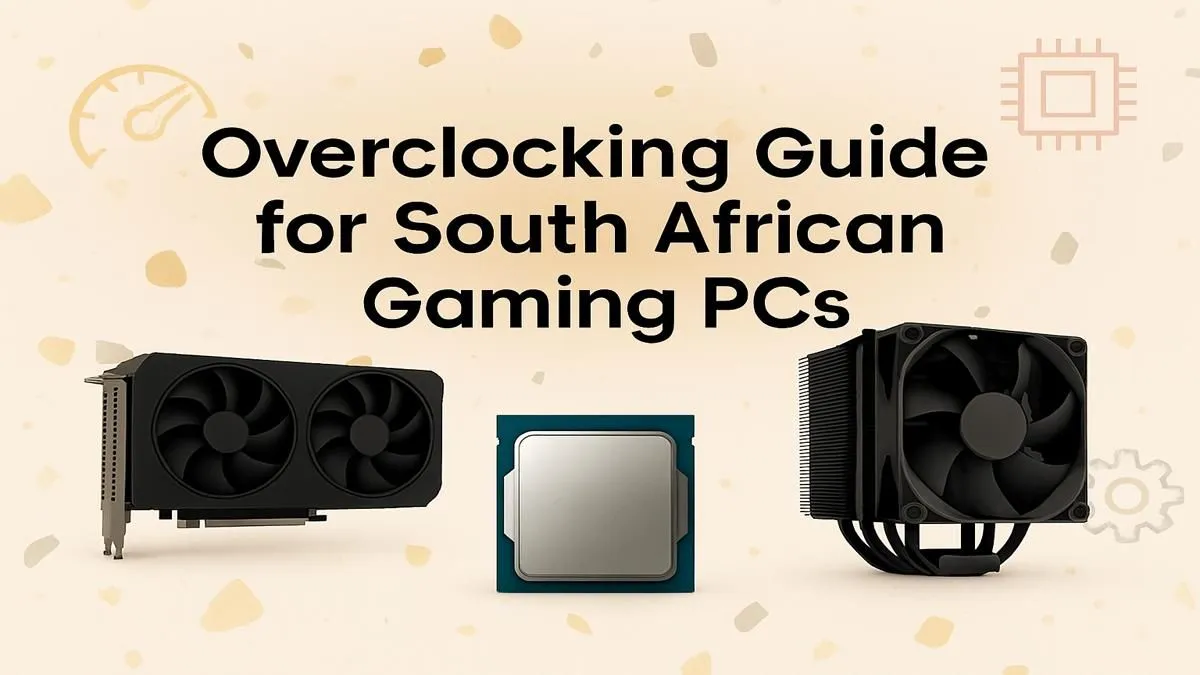
Staring at a stuttering screen while your mates are clutching the win in Apex Legends is a special kind of pain. You've got the skill, but does your rig have the speed? Before you start pricing new components, what if you could unlock extra performance for free? This overclocking guide for South Africa is your key to squeezing more frames and raw power out of the PC you already own. Let's get your machine running at its full potential. 🚀
Understanding Overclocking: The Basics
So, what is this "overclocking" magic everyone talks about? Think of your computer's processor (CPU) like a car engine. It has a factory-set speed limit, measured in gigahertz (GHz). Overclocking is simply the process of carefully increasing that speed limit, allowing it to perform more calculations per second. This translates directly to smoother gameplay, faster video rendering, and a snappier desktop experience.
Is it safe? Yes, when done correctly. Modern components have built-in safety features to prevent damage. The main risk is instability (crashes) if you push too hard, too fast. This is why this guide will focus on a safe, step-by-step approach to boosting your gaming PC performance.
Is Your Rig Ready? The Overclocking Checklist
Not all PCs are created equal. Before you dive into your BIOS, you need to make sure your hardware is up to the task. Pushing your components harder generates more heat, which needs to be managed effectively, especially in our warmer South African climate.
Here’s what you need:
- An Unlocked CPU: For Intel, you're looking for processors with a 'K' or 'KF' at the end of their model number (e.g., Core i7-14700K). For AMD, most Ryzen CPUs are unlocked for overclocking. Whether you're on team blue with these powerful Intel PC deals or team red, make sure your chip is ready.
- A Capable Motherboard: An entry-level motherboard might not have the power delivery components (VRMs) to handle the extra voltage. For Intel, a Z-series motherboard is ideal. For AMD, B-series or X-series boards are the way to go.
- Sufficient Cooling: That stock cooler probably won't cut it. A good tower air cooler or an All-In-One (AIO) liquid cooler is essential for keeping temperatures in check.
- A Quality Power Supply (PSU): Overclocking draws more power. A reliable PSU from a reputable brand ensures your system gets stable, clean energy.
Many gamers find that starting with a pre-built machine that uses these quality components is a great way to enter the world of PC tuning. You can often find fantastic value in the latest AMD Ryzen gaming PC deals that are built with overclocking in mind.
A Step-by-Step Guide to Overclocking Your PC in South Africa
Ready to get your hands dirty? 🔧 Remember to take it slow and change one setting at a time. This is the core of our overclocking guide.
Step 1: Benchmark Your Baseline
Before you change anything, you need to know your starting point. Run a benchmark tool like Cinebench R23 for your CPU and Unigine Heaven or 3DMark for your GPU. Write down your scores. This is how you'll measure your success.
Step 2: Enter the BIOS/UEFI
Restart your computer and press the 'Delete' or 'F2' key as it boots up to enter the BIOS. The interface will vary by manufacturer (ASUS, MSI, Gigabyte), but the core settings are similar. Look for an "Advanced" or "OC Tweaker" section.
Step 3: The Gentle Push - Multiplier & Voltage
The two main settings you'll adjust are the CPU Core Ratio (or multiplier) and the CPU Core Voltage.
- Increase the Multiplier: Start by increasing the multiplier by 1 (e.g., from 45 to 46, which would be 4.6GHz).
- Test for Stability: Save settings, reboot into Windows, and run a stress test.
- Rinse and Repeat: If it's stable, go back into the BIOS and increase it again. If it crashes, you may need to increase the Core Voltage slightly. Be very careful here, and only increase it in tiny increments (e.g., from 1.30v to 1.31v).
Cooling is King ❄️
Keep a close eye on your CPU and GPU temperatures during stress tests using free tools like HWMonitor or MSI Afterburner's overlay. In the South African climate, you want to ensure your CPU stays below 90°C under full load. If it gets too hot, you may need to dial back your overclock or consider a better cooling solution.
Step 4: Stress Testing for Stability 🌡️
Once you find a speed you're happy with, it's time for a longer stress test using a program like Prime95 or AIDA64 Extreme. Let it run for at least an hour. If it doesn't crash or overheat, congratulations! You have a stable overclock.
Step 5: Don't Forget the GPU!
Your graphics card offers some of the biggest performance gains. Using a tool like MSI Afterburner, you can easily overclock your GPU from within Windows. Gently increase the Core Clock and Memory Clock sliders, testing for stability with a benchmark after each adjustment. Whether you have one of the latest NVIDIA GeForce gaming PCs or a powerful rig from the Radeon lineup, a few tweaks can yield impressive results. This process works great for most modern cards, making it easy to get more performance from a wide variety of AMD Radeon gaming PCs in South Africa.
More Than Just Frames: Overclocking for Productivity
While gamers see the most obvious benefits, overclocking isn't just for play. Pushing your CPU can dramatically reduce export times in Adobe Premiere Pro, speed up renders in Blender, and shorten compile times for developers. For professionals whose time is money, the performance uplift from a well-tuned machine is invaluable. This is why many high-performance custom workstation PCs are built with overclocking capabilities right out of the box. ✨
Ready to Unleash Max Performance?
Overclocking is a fantastic way to squeeze more power from your hardware. But when you're ready for a serious leap in performance, a new rig is the ultimate upgrade. Explore our massive range of customisable gaming PCs and build the machine that will dominate for years to come.