You’ve seen the breathtaking visuals in Cyberpunk 2077: Phantom Liberty or Alan Wake 2. That stunning, hyper-realistic lighting is path tracing at its best. But while your GPU gets all the glory for rendering those beautiful scenes, there's an unsung hero working tirelessly in the background… your CPU. Underestimate the path tracing CPU impact, and you might be bottlenecking your entire rig without even knowing it. Let's dive deep.
The CPU's Hidden Role in Path Tracing
For years, we've been told that gaming is all about the graphics card. For traditional rasterization, that was mostly true. But path tracing, the advanced form of ray tracing that simulates light physics with incredible accuracy, changes the rules. It introduces a massive new workload that directly hammers your processor before the GPU even sees a single light ray.
The core of this workload is building and managing a 3D map of the entire game world. This map, a Bounding Volume Hierarchy (BVH), tells the GPU where every object, character, and surface is. The processor load from path tracing comes from creating this complex structure, a task that falls squarely on the CPU's shoulders.
What is a BVH Structure, and Why Does it Stress Your CPU? 🧠
Imagine a massive library with millions of books scattered everywhere. Path tracing is like trying to find 100 specific books instantly. Without a catalogue, it’s impossible.
The BVH structure is that catalogue. Your CPU acts as the master librarian, rapidly organising the entire scene into a logical hierarchy of nested boxes. When your GPU needs to trace a ray of light, it asks the CPU, "Where might this ray hit something?" The CPU uses the BVH to instantly narrow down the possibilities from millions to just a handful.
The bigger and more complex the game world, the bigger the BVH. The more things move or explode, the more often the CPU has to update this catalogue. This constant construction and updating is the primary source of the path tracing CPU impact, a task that requires both fast cores and, increasingly, more of them. A slow CPU means a slow librarian, leaving your powerful GPU waiting for instructions and tanking your frame rate. Making sure you have the right CPU processors is becoming more critical than ever.
Check Your CPU Load 🔧
Use a tool like MSI Afterburner with the RivaTuner Statistics Server overlay. Configure it to show per-core CPU usage while you play a path-traced game. You'll often see several CPU cores spike to 100% during intense scenes with lots of geometry or physics, revealing the true processor impact of path tracing in real-time.
Measuring the Real-World Performance Impact
So, what does this mean for your gaming experience? A CPU that can't keep up with BVH demands will lead to noticeable performance issues, even with a top-tier graphics card. You might experience:
- Stuttering and Frame Drops: Especially in dynamic scenes where the BVH needs frequent updates.
- Lower Average FPS: Your GPU is starved for data, sitting idle while the CPU struggles to build the scene hierarchy.
- Input Lag: A system under heavy, unbalanced load can feel less responsive.
As we look towards 2025, game developers are pushing path tracing even further, creating richer and more dynamic worlds. This means the demands on the CPU are only going to increase. Both modern Intel CPUs and the latest AMD CPUs feature architectures with improved multi-core performance specifically to tackle these kinds of parallel workloads.
Choosing the Right CPU for Path Tracing in 2025 and Beyond 🚀
To future-proof your gaming rig, you can no longer relegate the CPU to a secondary consideration. For a smooth, high-frame-rate path tracing experience, you need a processor that excels at both high-frequency single-core speed and robust multi-core throughput.
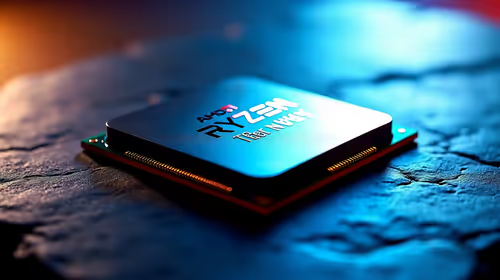
- High Core Counts: More cores allow the CPU to build and update the BVH structure in parallel without sacrificing resources for other system tasks. A powerhouse like an AMD Ryzen 9 is built to chew through these demanding, multi-threaded tasks.
- Strong Single-Thread Performance: The main game logic often still relies on a single fast core, so high clock speeds and a strong Instructions Per Clock (IPC) are vital. This is where a top-tier Intel Core Ultra 9 can truly shine, offering a balanced approach for gaming.
Ultimately, the era of simply pairing a monster GPU with a mid-range CPU is fading. A balanced system is key, and understanding the path tracing CPU impact is your first step towards building a rig that won’t just run next-gen games… it will fly.
Ready to Eliminate Bottlenecks? The future of gaming is bright... and computationally demanding. A powerful CPU is no longer a luxury, it's a necessity for flawless path tracing. Explore our wide range of CPU processors and build a balanced rig ready for 2025 and beyond.