That sinking feeling… you hit the power button, and nothing happens. No hum, no lights, just silence. Especially in South Africa, with power interruptions and power surges being a daily reality, a PC that won't boot can feel like a disaster. But don't panic or start pricing new rigs just yet. More often than not, the fix is simpler than you think. This guide will walk you through the troubleshooting steps, from the ridiculously easy to the slightly more technical. 🔌
First Steps: Checking the Obvious When Your PC Won't Boot
Before you even think about opening your PC case, let's cover the basics. It might sound silly, but these simple checks solve the "my computer is not starting" problem for a surprising number of people.
Start with the power cable. Is it firmly plugged into the back of your PC's power supply unit (PSU) and into the wall socket or multi-plug? Give both ends a firm push. Next, confirm the wall socket itself has power. Plug in a lamp or your phone charger to test it. If you're using a multi-plug, make sure its switch is on and that its fuse hasn't tripped.
Finally, check the master power switch on the PSU itself—that little rocker switch next to where the power cord plugs in. It's incredibly easy to knock it to the 'O' (Off) position by accident.
The Easiest Fix in the Book 🔧
The small I O switch on your Power Supply Unit (PSU) is the number one culprit for a PC that appears completely dead. Before you do anything else, ensure this switch is flipped to the 'I' (On) position. It has caught out even the most experienced PC builders!
Diving Deeper: Basic Internal Checks
If the external checks don't solve it, it's time to look inside. Safety first! Unplug your PC from the wall completely before opening the case.
The most common internal issue causing a PC to power on but show no display is poorly seated RAM. Simply unclip the RAM sticks from their slots on the motherboard, give the slots a quick puff of air to clear any dust, and then firmly press the sticks back in until both clips click into place. You'd be amazed how often this fixes things.
While you're in there, gently press on all the main power connectors to ensure they're secure. This includes the large 24-pin motherboard connector and the 4/8-pin CPU power connector near the processor. If you have a graphics card, check its power connectors too. Loose cables can happen during a move or even just from vibrations over time, though it's less common with the quality pre-built PC deals that feature professional cable management.
When Your PC Still Won't Turn On: Isolating the Problem 🤔
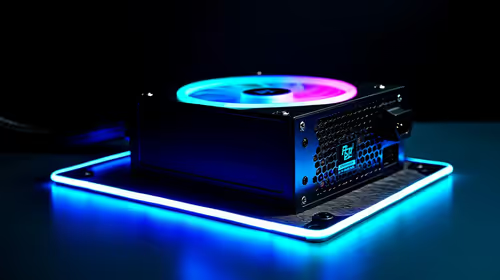
Okay, so the simple fixes didn't work. Now we need to identify the faulty component. The prime suspect after a power surge is often the Power Supply Unit (PSU). A failed PSU can prevent anything from starting. If you have a spare one, swapping it in is the easiest test. If not, you can look up the "paperclip test" for PSUs, but proceed with extreme caution as you're dealing with electricity.
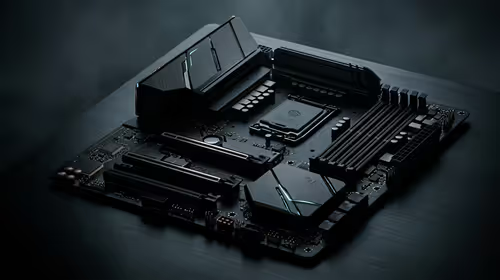
If the PSU seems fine, the issue could be the motherboard. Look for any visible signs of damage, like bulging or leaking capacitors. A dead motherboard is a serious problem, and often means it's time for a major upgrade. For many, replacing a motherboard on an older system isn't cost-effective compared to looking at great-value PCs under R20k that offer a complete modern platform. Powerful gaming rigs, especially powerful PCs over R20k, rely on a robust motherboard and PSU to function correctly.
Could it be Software? BIOS & Boot Drives
What if your PC turns on—fans spin, lights come on—but Windows never loads? This is a different kind of "PC won't boot" problem, often related to software or your storage drive.
Restart your computer and press the key to enter the BIOS/UEFI (usually DEL, F2, or F12). If you can get into the BIOS, your core components (CPU, RAM, Motherboard) are likely working. The first thing to check here is the boot priority. Make sure your computer is set to boot from the drive where Windows is installed (your SSD or HDD). If the BIOS doesn't detect your drive at all, it could mean the drive has failed or its cables have come loose. Exploring the best gaming PC deals often shows systems configured with ultra-fast NVMe SSDs for lightning-quick boot times.
Knowing When to Upgrade 🚀
You've checked the cables, reseated the RAM, and peered into the BIOS. If your PC is still giving you the silent treatment, you might be facing a dead component like a CPU or motherboard. At this point, you have to weigh the cost of a single replacement part against the age of your system. Sinking money into a 5-year-old PC might not be the wisest investment.
Sometimes, a fresh start is the least stressful and most rewarding option. It's an opportunity to get a warranty, modern performance, and the peace of mind that comes with a new, stable machine. Even affordable budget gaming PCs today offer incredible performance for their price, providing a huge leap from older hardware.
Tired of Troubleshooting? Maybe It's Upgrade Time.
If your PC won't boot after all this, it might be signalling the end of its journey. Instead of sinking more money into old tech, why not explore a fresh start? Browse our massive range of custom and pre-built PCs and find a reliable machine built to last.