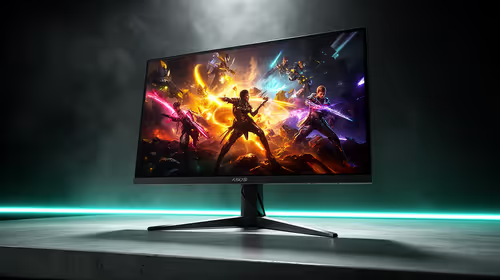
A response-time number needs boundaries before it becomes useful. This portable monitor 30ms response-time guide places pixel transitions beside separate control, frame-delivery and streaming delays, then turns the J314 specification into repeatable everyday tests.
Quick Answer
Thirty milliseconds is a pixel-response measure on this 60Hz 2K panel; it suits ordinary work and media better than response-sensitive competitive play.
The UPERFECT UBegin J314 costs R1,799 and has a 30ms response specification. That number describes one part of the 14-inch IPS panel's motion behaviour; it cannot by itself predict input timing, gaming fit or the usability of every daily task.
⏱️ Define the measurement before judging it
Response time concerns the speed of pixel-state changes. It does not necessarily equal the delay between pressing a control and seeing the result, because source processing, software, cables and the display pipeline also contribute.
Streaming introduces other variables. Network delivery, decoding and frame cadence can affect visible motion without changing the panel's 30ms figure. Diagnose the stage instead of blaming one number for every symptom.
The display's 2160x1440 resolution and 1500:1 contrast ratio describe image detail and tonal relationship. They should remain separate rows on the comparison sheet.
Use Evetech's portable display selection to compare response specifications after defining the content and sensitivity involved.
📄 Test ordinary interaction first
Open a document, browser and typical work application. Observe cursor movement, scrolling and window changes at the usual viewing distance. Use the source and connection that will form the real setup.
For media, select familiar scenes with pans, credits or quick transitions. Repeating known material makes differences easier to identify than switching between unrelated clips.
Record whether an observed effect is frequent enough to matter. A rare transition during entertainment may carry less weight than discomfort repeated through every working hour.
Do not claim a universal pass or fail. Viewer sensitivity, content and expectations differ, so the same 30ms specification can receive different decisions from different buyers.
🎮 Isolate game and input questions
If games form part of the plan, test the exact title, platform and control method. Distinguish visible pixel transition from input-to-action timing. The latter cannot be read directly from the response specification.
Avoid classifying the J314 as a broad gaming monitor from 30ms or QHD resolution. Fast-paced and casual games can create different thresholds, and the source device must also deliver the selected mode.
Type-C and Mini HDMI provide the monitor's input choices. Neither connector establishes universal console or phone compatibility. The source output, cable, power and software path remain essential.
Audio for compatible content can use the built-in dual stereo speakers with 360-degree sound. Speaker presence does not affect response time and should be evaluated separately.
🧪 Preserve one variable per comparison
Keep the source hardware, output resolution, application or clip, cable and room constant. Change only the monitor or a single setting, then write down the result.
If a connection problem interrupts the test, solve it before judging motion. A missing signal, unsupported mode or unstable cable is not evidence about the 30ms panel response.
Choose any required cable or adapter from the Evetech monitor accessory range after its function and connector ends are documented.
The 1.4kg J314 brings a 14-inch QHD screen into a mobile kit for R1,799. Its response suitability should be approved through representative interaction, media and any relevant game rather than a label applied to the number alone.
Use a symptom map during evaluation. Visible trails, control delay, dropped frames and network buffering should occupy separate rows, because they can involve panel transition, end-to-end input, source delivery or connectivity respectively.
Reproduce one symptom before adjusting anything. Save the application or game version, source mode, cable and scene, then change a single condition. This keeps a later improvement tied to the correct part of the system.
For everyday work, frequency matters. A small visual effect repeated through hours of scrolling can deserve more attention than a larger effect seen once in an unusual clip. Record both occurrence and consequence.
Gaming evaluation should include the player's own control sensitivity and title. Do not borrow a threshold from an unrelated genre or competitive setting. The monitor can be accepted for one use while remaining unsuitable for another.
After the test, keep a known scene for future checks. Software changes, a new source or replacement cable can then be compared with the original baseline without assuming the panel's 30ms specification changed.
Build a daily-use playlist that contains a long webpage, document scroll, video pan, interface animation and any game that matters. Give each item a short, repeatable observation window.
Run the sequence twice before deciding. The first pass familiarises the viewer with the material; the second can reveal whether an effect is consistent or was caused by a one-off source event.
If an issue appears only online, repeat it with comparable local material where practical. This does not prove network involvement on its own, but it helps isolate delivery variation from panel motion.
For input-sensitive work, use a separate end-to-end timing method. Do not subtract or estimate input lag from the 30ms response number, because the measurements describe different paths.
Record acceptable and unacceptable examples. A monitor can pass documents and films yet fail a particular game, and the recommendation should remain scoped to the successful uses.
Review the decision with the person who will use the screen most. Motion sensitivity is personal, so a technically consistent result may receive a different comfort verdict from another viewer.
After approval, preserve the test sequence with the successful source mode. It becomes a practical check if a software update, new cable or replacement computer later changes perceived motion.
Set a disqualifying threshold before the final trial. Define which repeated motion artefact or control behaviour would make the screen unsuitable for the primary task, then keep that rule unchanged during comparison.
This protects the decision from shifting after the viewer becomes attached to another feature such as resolution or audio.
FreeSync helps reduce tearing in casual gaming and video, while the 185-PPI IPS image emphasises clarity, text and productive vertical space. Total interaction delay also includes the source, connection, software and controller, so 30ms is not a complete latency result. Compare a known moving scene and direct input with the intended device before deciding whether the everyday visual strengths outweigh faster transitions.
Response should be compared under a stable refresh and source frame rate. A slow pan reveals trailing, text scrolling exposes readability during motion and a direct control sequence includes the rest of the input chain. FreeSync may smooth mismatched frame delivery, but it cannot transform the pixel transition figure. Keep each observation separate before assigning daily suitability.
Frequently Asked Questions
What response number belongs to the J314?
The panel carries a 30ms response specification, which concerns pixel-transition behaviour rather than the entire input-to-screen chain.
Is response time identical to input lag?
No. Input timing can include source processing, software and the display path, so a separate end-to-end test is needed.
Can one number settle everyday usability?
It cannot. Content, frequency, viewer sensitivity and task expectations determine whether the observed motion behaviour matters.
Which image properties accompany the response figure?
The monitor uses a 14-inch 2160x1440 IPS panel with a 1500:1 contrast ratio.
How should gaming be assessed?
Use the exact game, platform, control method and output mode, then evaluate pixel motion separately from input-to-action delay.
Ready to test 30ms with the tasks and content that matter?
Keep the signal path controlled, then compare portable monitors and required connection accessories through Evetech.