You’re in the final circle. It’s a 1v1. You line up the perfect headshot… and your wireless mouse dies. We’ve all been there. It’s why we religiously enable power-saving modes on our gear. But it begs the question: when considering power-saving modes vs battery lifespan, are we actually helping our hardware in the long run, or just delaying the inevitable? Let’s dive into the real impact on your precious gaming peripherals.
What Do Power-Saving Modes Actually Do? ⚡
At its core, a power-saving mode is a set of compromises. Your device's software intentionally reduces performance to sip less battery. For a gaming mouse, this usually means a few key things:
- Lowering the Polling Rate: The polling rate is how often your mouse reports its position to your PC. A high polling rate (e.g., 1000Hz or more) offers near-instant response but is thirsty for power. Power-saving might drop this to 500Hz or even 125Hz.
- Dimming the RGB: That awesome RGB glow? It consumes a surprising amount of energy. Power-saving modes will often dim or completely turn off the lights.
- Aggressive Sleep Timers: The mouse will enter a low-power sleep state much faster when left idle.
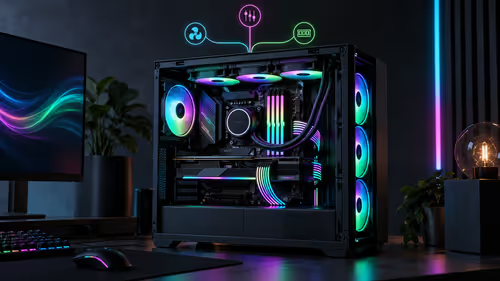
Essentially, the mode dials back the very features that make a gaming mouse a gaming mouse. Understanding how every component in a modern gaming mouse works together helps clarify this trade-off.
The Real Impact on Your Battery's Lifespan
Here’s the good news: using power-saving modes is genuinely beneficial for your battery’s overall lifespan. But maybe not for the reason you think.
The debate over power-saving modes vs battery lifespan isn't about preventing chemical decay… all lithium-ion batteries degrade over time, regardless. Instead, it’s about reducing the number of charge cycles. A battery's lifespan is finite and is often measured in how many times it can be fully charged and discharged.
By using less power, you charge your device less frequently. Fewer charge cycles mean the battery remains in its healthier, more effective state for much longer. So, while that single gaming session might be less responsive, you're extending the total number of sessions you'll get from that premium wireless mouse over the years.
Pro Battery Care Tip 🔋
Lithium-ion batteries are happiest between 20% and 80% charge. Avoid letting your gear die completely or leaving it plugged in at 100% for days on end. This simple habit can significantly prolong its usable life.
Performance vs. Longevity: When to Switch It Off
So, does this mean you should always have power-saving enabled? Not quite. The decision depends entirely on your use case.
For Competitive Gaming: Performance is King 🚀
When you’re playing ranked CS:GO or Valorant, every millisecond counts. You need the highest polling rate, the quickest response, and zero compromises. In these scenarios, you should absolutely disable power-saving modes. The slight hit to long-term battery health is a worthy trade-off for in-game performance. If you never want to think about batteries again, a top-tier wired mouse remains the undisputed champion of reliability.
For Casual Use & General Gaming: Longevity Wins
If you're just browsing, working, or playing a single-player RPG, the split-second advantage of a 4000Hz polling rate is negligible. Here, leaving power-saving on is the smart move. You won't notice the difference, but your battery certainly will. You can further optimise your setup with the right mouse accessories, like a charging dock to keep your mouse topped up conveniently.
Ultimately, understanding the real impact of power-saving modes is about making an informed choice for your playstyle. It’s not about good vs. bad; it’s about optimising for what matters most to you in the moment.
Ready to Find Your Perfect Match?
Now that you know how to maximise your gear's lifespan, find the perfect tool for your playstyle. Check out our latest gaming mouse deals and get performance you can count on, right here in South Africa.