Quick Answer
Pre-installed 140mm fans save R400 to R900 at purchase and deliver functional airflow from day one. Adding your own fans gives precise control over bearing type, noise profile, and ARGB ecosystem, but adds cost and setup time. For a first build or budget system, take the pre-installed fans and upgrade later if noise or temperatures become a concern.
What Pre-Installed 140mm Fans Actually Include 🌬️
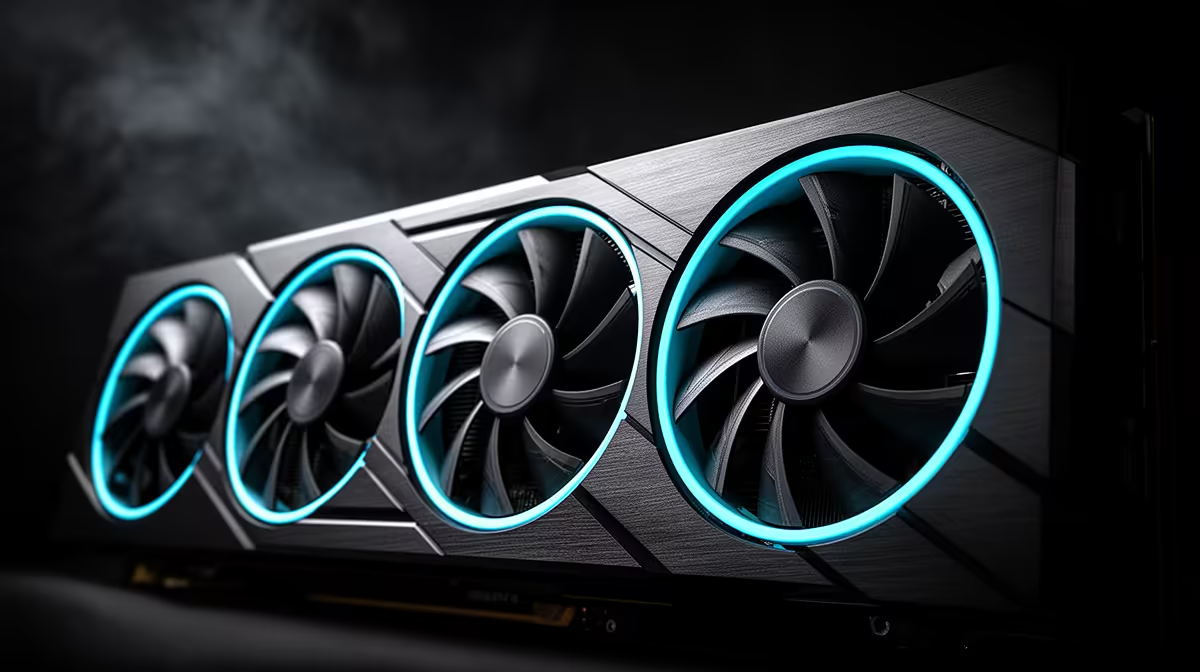
Cases in the R1,800 to R3,000 range that include pre-installed 140mm fans typically feature sleeve or fluid dynamic bearing (FDB) units with PWM connectors. Sleeve bearing fans are quieter when new but develop a slight hum after 18 to 24 months. FDB fans last significantly longer and maintain consistent noise levels, making them better value at a slightly higher unit price.
Most pre-installed fans deliver 60 to 90 cubic feet per minute at 1,200 RPM with a static pressure rating of 1.5 to 2.5mm H2O. For a build using an RTX 5070 and a 125W CPU, this is fully adequate. The limitation appears at higher wattage: a 400W GPU in a 30-degree Celsius South African summer room benefits from the additional airflow of premium aftermarket fans.
The Case for Adding Your Own 140mm Fans 🔧
Builders who prioritise acoustics or specific ARGB ecosystems benefit most from aftermarket 140mm fans. MAGLEV bearing designs deliver near-silent operation at 800 RPM. For a South African gamer who studies or works from home in the same room as the PC, the acoustics difference between a budget sleeve bearing fan and a premium MAGLEV fan at the same RPM can reach 5 to 7 dB(A), a clearly perceptible difference during quiet study sessions.
Expect to pay R250 to R600 per premium 140mm fan at Evetech. A set of four for a full replacement costs R1,000 to R2,400, a meaningful secondary spend on top of the case cost.
Mixing Pre-Installed and Aftermarket Fans 💡
A hybrid approach works well: keep pre-installed 140mm fans as intake positions where airflow volume matters more than acoustics, and add premium fans as exhausts where RPM runs higher due to proximity to GPU exhaust heat. This reduces total aftermarket spend while targeting acoustic improvement where it matters most.
For ARGB synchronisation, a case fan hub with a 5V ARGB header allows both original and aftermarket fans to sync to the same ASUS Aura or MSI Mystic Light profile, provided all fans use a compatible ARGB connector.
Fan Replacement Timing Tip ⚡
The most cost-efficient time to upgrade pre-installed fans is when one fails after 2 to 3 years of use. Replace the entire set simultaneously so all fans share the same bearing age and noise profile. Mixing a fresh 140mm fan with three-year-old sleeve bearing fans creates an audible inconsistency in the system's acoustic signature.
FAQ
Can pre-installed fans be daisy-chained to ARGB hubs?
Only if they use a standard 5V 3-pin ARGB connector. Many budget pre-installed fans use a 12V 4-pin RGB connector instead. Check the connector type before purchasing a hub, as mixing 5V ARGB and 12V RGB on the same header damages components.
Are 140mm fans worth it over 120mm for noise reduction?
Yes. At identical airflow rates, a 140mm fan runs at 20 to 25 percent lower RPM than a 120mm fan, a meaningful reduction in tonal noise. If the case supports 140mm positions, filling them is the highest-value acoustic improvement available.
How long do pre-installed sleeve bearing fans typically last?
Sleeve bearing fans develop noticeable bearing noise after 18 to 30 months of continuous operation in warm environments. In South African conditions with ambient temperatures above 28 degrees Celsius, the lower end of that range is more typical. FDB and MAGLEV fans extend this to 4 to 6 years under similar conditions.
Upgrading your case fan setup for better airflow or quieter operation?
Evetech stocks 140mm ARGB and non-RGB fans in sleeve, FDB, and MAGLEV bearing options alongside fan hubs and controllers for a complete cooling system upgrade.