Quick Answer
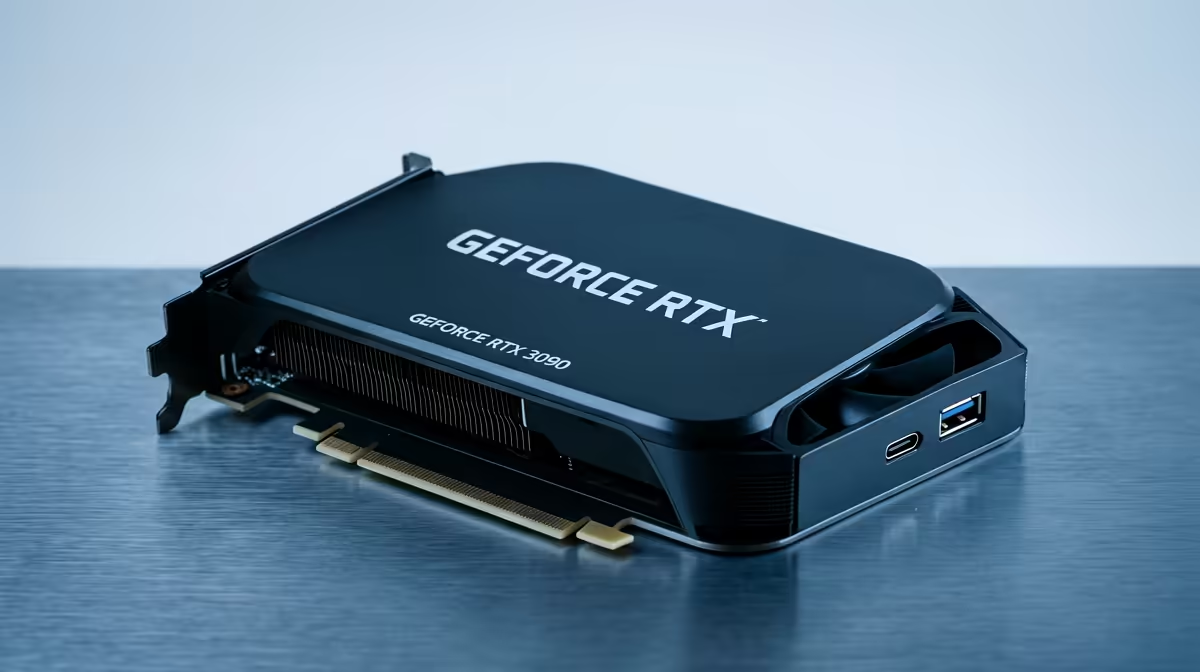
For SA office use the RTX 4080 (near R22,000-R26,000) is overkill for documents and spreadsheets but excellent for GPU-heavy professional work like 3D rendering, video editing and AI. If your office workload is light, a 4060-class card or even integrated graphics handles it for a fraction of the cost.
Pros of the RTX 4080 in a Workstation
For a professional office running CAD, Blender, DaVinci Resolve or local AI models, the 4080's 16GB VRAM and strong compute slash render and export times. It also drives multiple high-resolution monitors smoothly and future-proofs a workstation across several years. In a creative agency or engineering firm, the time saved on long renders can justify the card's price through productivity alone.
Cons and When It Is Wasted
For ordinary office tasks, email, spreadsheets, browsing and video calls, the 4080 is wasted: those workloads barely touch a GPU, and integrated graphics or a 4060-class card near R6,500 cover them with ease. The 4080 also draws around 320W, needing a 750W-plus PSU and good cooling, which raises the build cost. Spending on an RTX 4080 only pays off when professional software genuinely uses the GPU.
FAQ
Does office work need an RTX 4080?
Only GPU-heavy professional work does, such as 3D rendering, video editing or AI. Standard office tasks run fine on integrated graphics or a budget card.
What office workloads justify an RTX 4080?
CAD, 3D rendering in Blender, 4K video editing, GPU-accelerated data science and local AI inference all benefit from the 4080's compute and 16GB VRAM.
What PSU and cooling does an RTX 4080 workstation need?
A 750W or higher PSU and good case airflow, since the card draws around 320W under sustained professional load. That keeps the workstation stable over long renders.
Match the GPU to your real software; reserve the RTX 4080 at Evetech for GPU-heavy professional work and pick a budget card for light office tasks.