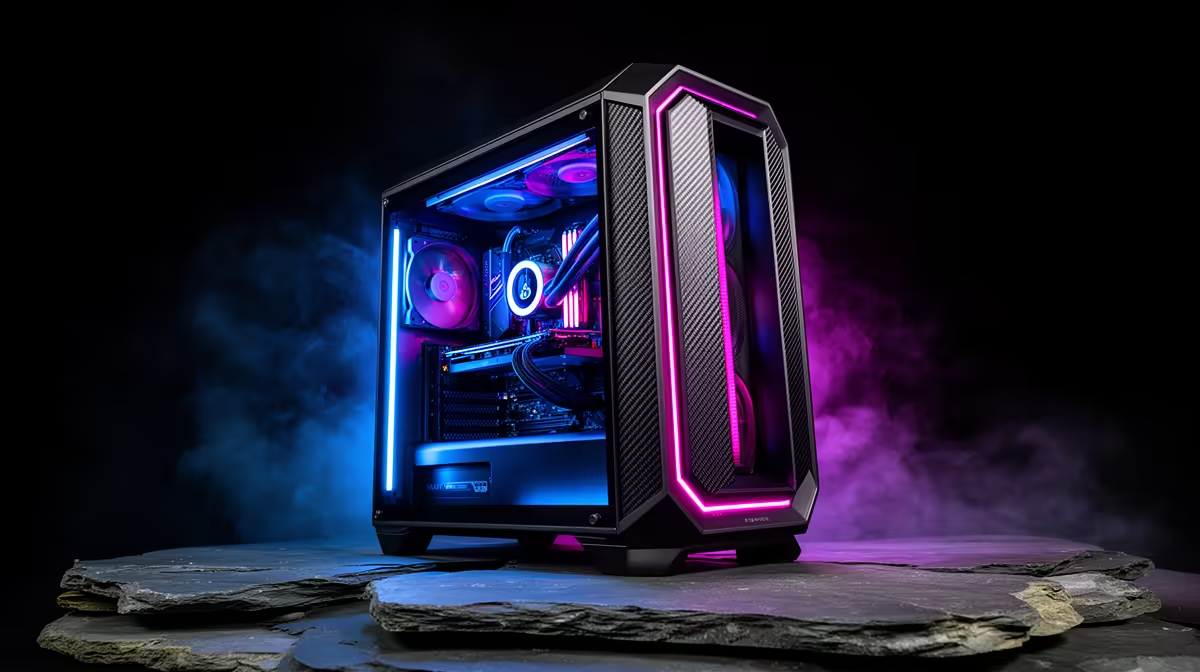
A faster tower cannot show its full value through a poor screen or controls that fight your hands. The R50K gaming setup split should balance PC performance with the monitor and peripherals needed to experience it.
Quick Answer
Treat R50,000 as a complete gaming-station ceiling. Put more into the tower when you already own a monitor and controls suited to its performance. Split the budget when the existing screen cannot show the frame rate, resolution, colour, or motion clarity the new PC is built to deliver.
Start with named current configurations in the gaming PC deals. Cross-check their platform balance against the machines people are choosing from the PC best sellers. Do not assume R40,000 and R10,000 produce fixed component tiers; verify the complete baskets at July 2026 prices.
Begin with the games and display target
List the games you play, the resolution, desired frame-rate range, image settings, and any streaming or creator work. A competitive 1080p player, a 1440p all-rounder, and a 4K single-player fan need different balances.
The monitor sets the visible target. A 60Hz 1080p screen cannot present 180 distinct frames each second. A high-refresh 1440p panel asks more of the graphics card. A 4K display raises GPU demand and may favour image quality over extreme refresh.
Check whether your current monitor supports the chosen input, refresh rate, adaptive sync, and low-latency mode. Inspect panel condition and viewing size. If it already matches the target, keep it and put the budget where the measured workload benefits.
If it does not, price the screen and tower together. A balanced system can improve every session even when the tower contains a lower GPU tier than the all-in-PC option.
What the larger tower budget can buy
More tower budget may allow a stronger graphics card, faster or higher-capacity processor, more memory, additional storage, better cooling, or a platform with useful expansion. The best place depends on the workload.
For GPU-limited games at high resolution, the graphics card often deserves the largest share. Confirm case clearance, PSU capacity, power connectors, monitor inputs, and CPU support. A premium card attached to an unsuitable display may leave part of its benefit unseen.
For simulation, strategy, competitive high-frame-rate play, compilation, or content creation, CPU performance can carry more weight. Choose from current results in your actual applications rather than a broad core-count rule.
Memory capacity should cover the game plus browser, chat, capture, or editing workload without heavy paging. Storage should fit the active library and leave free working space. Neither should be expanded for status while the graphics or processor target remains underfunded.
What the peripheral share should solve
A monitor upgrade is the strongest reason to split. Match resolution and refresh to the GPU's sustainable output in the games you care about. Consider panel type, response behaviour, adaptive sync, HDR capability, ports, size, stand adjustment, and warranty terms for the exact model.
A keyboard matters when the current one has unreliable switches, poor layout, excessive latency for the use, or discomfort. Expensive materials do not guarantee better play. Choose the switch behaviour, size, connection, and key layout you prefer.
A mouse should fit your hand and grip, track reliably on the chosen surface, and avoid unwanted cable or wireless problems. Low mass can suit quick aiming, while shape and button placement may matter more during long sessions.
Audio and a microphone belong in the split when communication, positional cues, or shared-room use is weak. Test equalisation and microphone placement before replacing working gear. A close modest mic can beat a costly one across the desk.
Do not let the R10,000 side become a decorative shopping list. Two solved problems beat several upgrades you cannot feel.
Build three dated baskets
Basket one puts the ceiling into the tower and reuses every peripheral. Basket two chooses the target monitor first, then builds the strongest balanced PC from the remainder. Basket three keeps the current screen and replaces only a failing or limiting keyboard, mouse, or audio device.
Use exact product names and current July 2026 prices. Include the operating system, Wi-Fi or Bluetooth needs, delivery conditions, cables, monitor arm, surge protection, and other required pieces. Do not compare a bare tower with a ready desk.
For each basket, write the expected gain in one sentence. Examples include reaching a stable 1440p target, reducing export time, improving motion clarity, or fixing a mouse that loses tracking. If the sentence is vague, the item has not earned the budget.
Compare complete-system support and assembly requirements as well. A prebuilt can reduce integration work, while a component build gives you control over every model. Value includes whether you can test and support the finished system.
Keep the PC balanced inside either split
Choose the GPU and CPU together around target performance. Confirm motherboard firmware, cooler capacity, memory generation and layout, storage slots, case airflow, and PSU connectors. A larger budget does not forgive compatibility mistakes.
Avoid overspending on the motherboard when its extra ports and expansion will sit unused. Do not undersize it when the workstation needs several drives, capture devices, fast networking, or high sustained CPU load.
Use a quality PSU with enough supported capacity and the correct native cable path. Never reuse modular cables from another unit. Leave space around the GPU and intake fans.
Test the completed system on the intended monitor. Set native resolution and refresh, enable supported variable refresh, install current official drivers, and run representative games. The desk and tower need to work as one system.
When the full R50,000 tower makes sense
Keep the whole ceiling on the PC when the current monitor already matches the performance target, the controls are dependable, and the applications scale with better hardware. This may suit someone using a strong 1440p or 4K display bought earlier.
It can also make sense when the tower supports paid work and peripherals already meet professional needs. Faster rendering, compiling, local modelling, or multitasking may earn more than a cosmetic desk refresh.
Even then, leave a safe path for backup, power protection, and cooling. A parts total that consumes every rand can omit the items that keep the machine usable.
When R40,000 plus peripherals makes sense
Split when the current display is a hard ceiling, the mouse or keyboard has a real fault, or audio prevents communication. Competitive players may gain more from a clear high-refresh screen and reliable input than from a GPU tier whose extra output remains invisible.
The exact split need not be R40,000 and R10,000. Cost the monitor and required peripherals first, then assign the remainder to a balanced tower. Current named products should decide the ratio.
Avoid replacing all peripherals merely because the budget headline includes them. Reuse the pieces that fit, and move their unspent allocation back into the PC or keep it for a later upgrade.
FAQ
Should I spend the full R50,000 on the PC?
Do so when the current monitor and controls already match the performance target. Otherwise, price the complete desk because a display or input limit can hide part of the tower's value.
Is R40,000 plus R10,000 on peripherals the best split?
It is one scenario, not a rule. Build dated baskets from exact named products. The right ratio depends on the monitor target, current peripherals, games, work, and complete-PC balance.
Which peripheral should get the budget first?
Choose the one that limits the experience. The monitor often leads when resolution or refresh is mismatched. Replace a keyboard, mouse, or headset first when it has a proven reliability, comfort, or communication problem.
Build three complete July 2026 baskets around your real display target, then choose the split that fixes the biggest visible or measurable limit.