



PCIe 5.0 vs PCIe 4.0 for Video editing in 4k in SA
PCIe 5.0 vs PCIe 4.0 for video editing in 4k is mainly about fit, features, compatibility, cost, and upgrade path, not one automatic winner. SA buyers should match the choice to the setup.
Read moreShort version: good wireless headsets keep 2.4GHz latency under 20ms for gaming. For the spec choice carries through to long-term ownership and resale. Latency, ANC, mic, and battery numbers walked through.
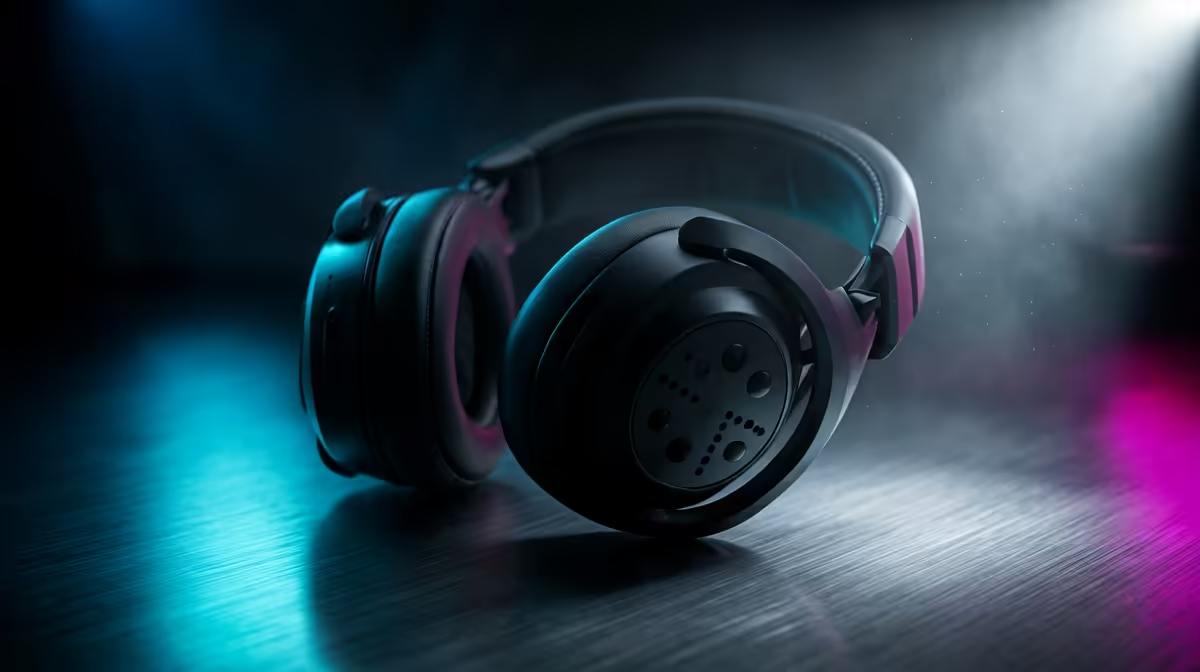
Beamforming microphones on modern gaming headsets reduce background noise by steering the pickup pattern toward your mouth and suppressing audio from other directions. In real conditions, effective beamforming cuts ambient room noise by 10 dB to 18 dB, reducing keyboard clatter, TV noise, and nearby conversation, though a close-positioned boom mic still outperforms any beamforming array in a genuinely noisy environment.
Beamforming uses an array of two or more microphone capsules on the headset frame, typically near the top of the earcup or along the headband. By measuring the tiny time difference between the same sound arriving at each capsule, the DSP calculates the direction of your voice and amplifies sounds from that angle while attenuating others. Some premium headsets add AI-based noise suppression on top, which further distinguishes voice from non-voice patterns using trained models.
Beamforming performs best when you face forward consistently. Turning your head changes the angle at which your voice reaches the capsule array and the beam may not track fast enough on budget implementations. Position your workstation so you face it directly. Application-level noise suppression in Discord, Microsoft Teams, or Zoom stacks on top of hardware beamforming: enable both for best results. South African remote workers in shared family homes and co-working spaces will find this combination most effective. In companion apps like Razer Synapse, find the mic enhancement or ambient reduction slider and increase it progressively until background noise is suppressed without your voice sounding hollow.
Beamforming struggles in two specific situations: very loud noise sources directly beside you, and impulsive noise like a door slamming or dog barking. For these cases, a directional boom mic positioned 3 cm from your lips will outperform any beamforming array because proximity dominates over directionality. If you regularly make professional calls from a busy household, consider a headset with a detachable boom option for calls and beamforming for casual gaming without the arm. Alternatively, pair a beamforming headset with Discord's Krisp or NVIDIA RTX Voice noise cancellation software for a combined hardware-plus-software noise rejection approach.
In Discord, go to User Settings, Voice and Video, and enable Krisp noise suppression under Input Sensitivity. Combined with your headset's own beamforming, this two-layer approach removes most background noise that either system alone would miss. It runs locally on your CPU with negligible added latency.
Yes. Beamforming is a mic hardware and DSP function that operates regardless of whether the headset connects via cable, Bluetooth, or 2.4GHz wireless. Wireless headsets process the beamforming onboard before transmitting the audio signal.
Light beamforming with moderate noise suppression sounds transparent to the listener. Aggressive settings at maximum intensity can introduce a slight thinning or gating artefact. Test your mic using a recording app and have someone report back before relying on it for professional calls.
Use the built-in mic test in Windows sound settings or your companion app. Record a clip while a TV or music plays in the background at normal household volume. Your voice should come through clearly with background noticeably attenuated. This takes under two minutes and confirms settings before any professional session.
Need a headset that handles noisy SA environments without fuss? Evetech carries beamforming and boom mic headsets suited for both competitive gaming and professional remote work calls.
PCIe 5.0 vs PCIe 4.0 for video editing in 4k is mainly about fit, features, compatibility, cost, and upgrade path, not one automatic winner. SA buyers should match the choice to the setup.
Read more
Wi-Fi 7 vs Wi-Fi 6e for competitive esports comes down to router support, latency goals, device compatibility, and coverage. SA buyers should match the choice to the real network setup.
Read more
ATX 3.1 vs ATX 3.0 for mMO and live-service games buyers - what changes is mostly about compatibility, budget, upgrade path, and setup fit. SA buyers should check device support and real needs before expecting a clear win from either option.
Read more
LGA 1851 vs LGA 1700 can affect Twitch and YouTube streaming when gaming and encoding share CPU resources. For SA creators, the real-world difference depends on encoder choice, memory support, motherboard cost, thermals, and upgrade plans.
Read more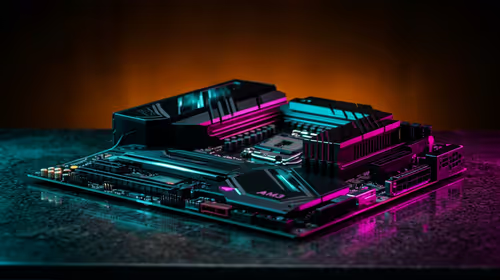
X870E vs X670E for aaa single-player gaming is mainly about fit, features, compatibility, cost, and upgrade path, not one automatic winner. SA buyers should match the choice to the setup.
Read more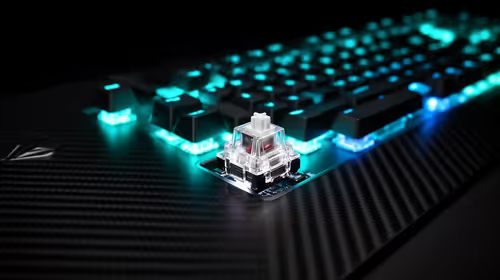
Hall Effect switches vs Mechanical switches for mMO and live-service games is mostly about compatibility, budget, upgrade path, and setup fit. SA buyers should check device support and real needs before expecting a clear win from either option.
Read more
A fake 113GB GTA VI ISO reportedly used empty padding around a small malware payload. SA gamers should delete unofficial builds, keep Windows security active and wait for official channels.

Wi-Fi 6E vs Wi-Fi 6 matters for 4K video editing when files move across a network. The real-world difference between Wi-Fi 6E and Wi-Fi 6 for video editing in 4K depends on NAS access, cloud uploads, router range, and SA creator workflows.

The difference between PCIe 5.0 and PCIe 4.0 for SA gamers is mostly bandwidth headroom. Compare GPU slot needs, NVMe speed, motherboard support, and upgrade timing before paying extra for a newer platform.

Gaming PC stuck pixel checks in South Africa should confirm the monitor fault first. Use colour tests, screenshot comparison, cable swaps, display menu checks, and clear photos before deciding on support.

Shokz OpenFit Air 2 earbuds weigh 7.2g each and use a redesigned dual-driver open-ear layout. SA buyers should choose them for comfort and awareness, not maximum isolation.

AMD's current driver now lists a Radeon RX 9050 4GB, while product coverage details a narrowed memory system. SA buyers should weigh the low VRAM ceiling against current local Radeon options.

Samsung Display has demonstrated a 16-inch 2.5K OLED laptop panel running at 300Hz. SA buyers should wait for a named notebook, full panel specifications and a local price before planning an upgrade.

Microsoft says some Windows 11 game crashes after recent updates are linked to RGB-related drivers. Affected SA gamers should confirm the update and driver before using the published registry workaround.

Minisforum's M2 Pro pairs Core Ultra X7, Arc B390 graphics and 32GB onboard memory in 1.8 litres. SA buyers should weigh its fixed memory and $1,439 launch offer against local mini PCs.

Smart monitors can add apps and convenience, but they also add privacy settings and unwanted-software risk. SA buyers should audit the operating system before paying for extras.

Lenovo says Legion Go failures linked to BIOS N3CN42WW are not user error. Affected SA owners should stop retrying the update, preserve proof and open a support case.
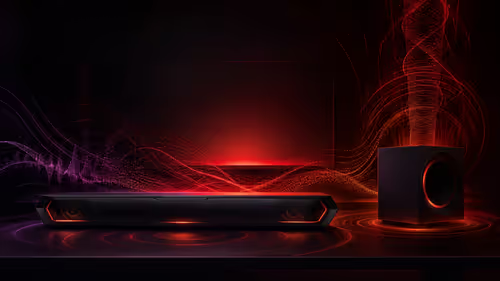
The ROG Gjallar gaming soundbar is now listed in the US at $599.99. SA buyers should compare its 2.1.2 audio, wireless bass and built-in chat controls with simpler local options.