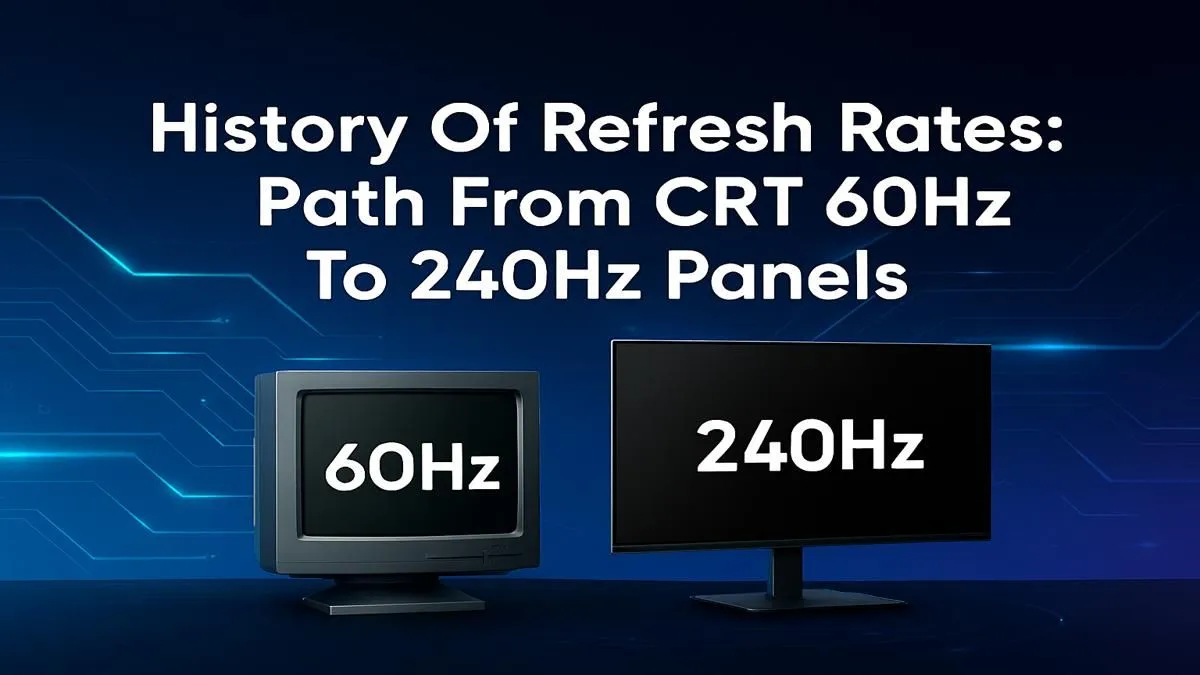
Remember those bulky, beige CRT monitors? The ones that flickered so much you'd get a headache after a solid session of Quake? We've come a long way. The journey from a blurry 60Hz screen to the buttery-smooth 240Hz panels we have today is more than just numbers... it's a complete evolution in how we experience games. Let's take a look at the fascinating history of refresh rates and see why it matters for your next rig.
The CRT Era: When 60Hz Was King 👑
Before sleek, flat panels dominated our desks, the Cathode Ray Tube (CRT) monitor was the only option. These chunky beasts painted images on the screen line-by-line with an electron gun. The speed at which it could repaint the entire screen is the refresh rate, measured in Hertz (Hz). For decades, 60Hz was the standard.
Why 60Hz? It was largely tied to the frequency of the AC power grids in many parts of the world. This synchronisation helped reduce screen flicker, but as anyone who gamed back then will tell you, eye strain was a real thing. The history of refresh rates begins here, with a standard born from electrical engineering, not gaming performance. These early screens were one of the fundamental building blocks of any PC setup, including the humble PC monitor.
The LCD Revolution and the 60Hz Plateau
When Liquid Crystal Display (LCD) monitors arrived, they were a revelation. They were thinner, lighter, and produced a much sharper, more stable image without the CRT's inherent flicker. But for a long time, one thing didn't change: the refresh rate. Most early LCDs were locked at 60Hz.
During this period, the focus shifted from refresh rates to resolution. We went from 1024x768 to Full HD (1920x1080), and the visual clarity was incredible. For many casual users and even gamers, 60Hz was "good enough." The competitive advantage of higher refresh rates wasn't widely understood yet, so the technology stagnated for a bit while pixels got smaller and colours got brighter.
Quick Tech Tip: Hz vs. FPS
Refresh Rate (Hz) is your monitor's hardware limit—how many times it can physically redraw the screen per second. Frame Rate (FPS) is how many frames your graphics card is producing. For the smoothest experience, you want your FPS to be at or near your monitor's Hz!
The High-Refresh-Rate Arms Race 🚀
Everything changed when the first 120Hz monitors hit the market, followed quickly by 144Hz panels. For competitive gamers, this was massive. Suddenly, the motion on screen was twice as smooth. In fast-paced shooters like CS:GO or Valorant, this meant:
- Less Motion Blur: Tracking fast-moving targets becomes significantly easier.
- Lower Input Lag: You see what's happening fractions of a second sooner.
- Smoother Gameplay: The entire experience just feels more responsive and fluid.
This leap marked a pivotal moment in the evolution of monitor refresh rates. It was a massive leap forward for anyone looking at all the gaming monitors available, creating a clear divide between standard office displays and true gaming panels.
Pushing the Limits: 240Hz and Beyond ✨
Today, the race continues. We now have 240Hz panels as a common standard for esports, with 360Hz and even 500Hz+ displays appearing for the pro scene. Does the average South African gamer need a 360Hz monitor? Probably not. The law of diminishing returns is very real.
The jump from 60Hz to 144Hz is dramatic and noticeable to almost everyone. The jump from 144Hz to 240Hz is smaller, but still a clear advantage for highly competitive players. Anything beyond that is for the absolute elite who need every possible millisecond of advantage. This is especially true for the immersive experience offered by today's best curved gaming monitors, where high refresh rates combine with a wide field of view for an unmatched feeling of presence.
The story of monitor refresh rates is one of constant innovation, driven by our demand for smoother, faster, and more responsive gaming. What started as an electrical standard has become a key performance metric that defines a great gaming experience.
Ready to Upgrade Your View?
The history of refresh rates shows how far we've come, and your gameplay deserves to keep up. Explore our massive range and find the best PC monitor deals in South Africa for performance that leaves lag in the dust.