


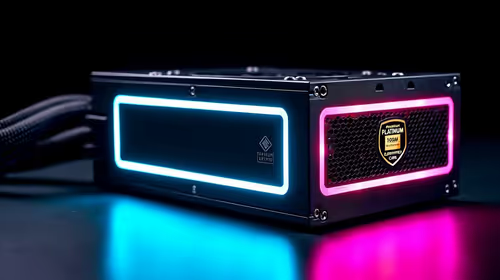
80+ Gold vs 80+ Platinum for Couch co-op gaming in SA
80+ Gold vs 80+ Platinum for couch co-op gaming is about PSU efficiency, heat, fan behaviour, quality, and wattage headroom, not direct FPS. SA buyers should compare the whole build.
Read moreRyzen motherboard audio codecs decoded! Uncover the tech behind crystal-clear sound, from Realtek ALC1220 to the latest ALC4080. Learn how onboard audio impacts your gaming, streaming, and music production. 🎧 Is a dedicated sound card still necessary? Let's find out! 🔊
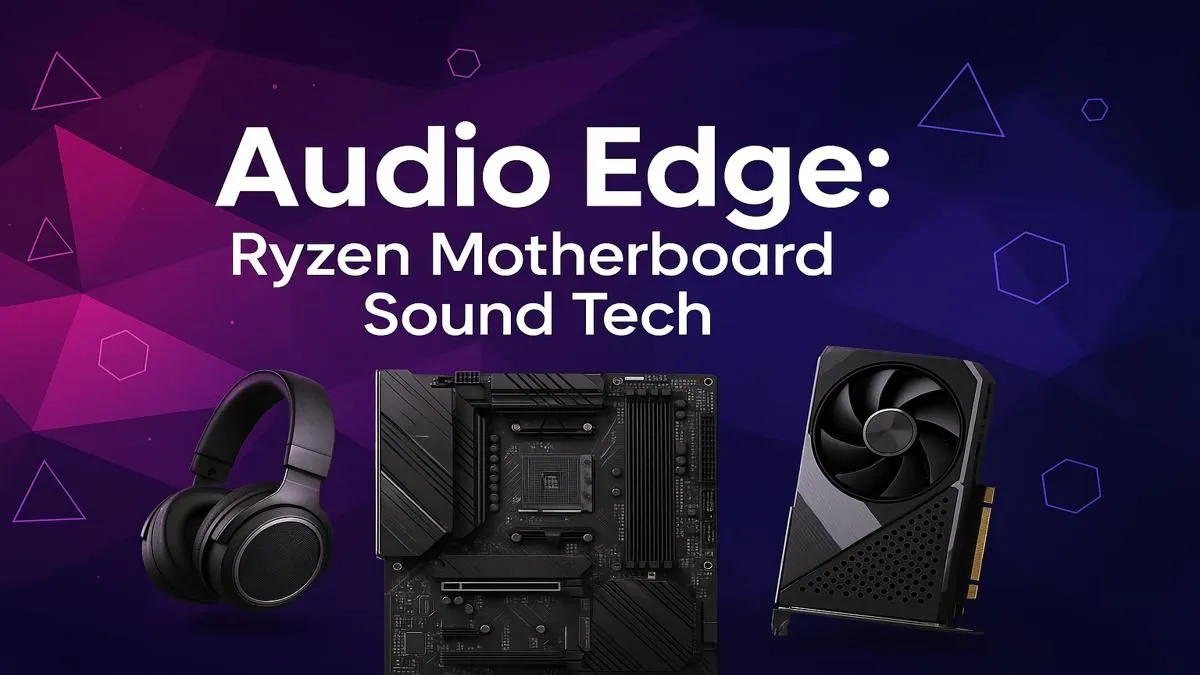
You've just dropped a fortune on a shiny new Ryzen CPU and a beastly graphics card. Your rig is ready to pump out frames at lightning speed. But what about the sound? Too often, gamers overlook one of the most crucial components for immersion: the onboard audio. The quality of your Ryzen motherboard audio codecs can be the difference between hearing that subtle footstep behind you... or getting sent back to the lobby. Let's dive in. 🚀
Think of an audio codec as a tiny, dedicated translator on your motherboard. Its job is to take the digital audio data from your game or music (the 1s and 0s) and convert it into an analogue signal that your headphones or speakers can actually play. The name itself is a portmanteau of COder-DECoder.
A better codec performs this translation with more accuracy and less unwanted electrical noise. For a Ryzen gaming rig, a high-quality audio codec means clearer in-game voice chat, more detailed soundscapes, and more precise positional audio. It’s an unsung hero that directly impacts your entire gaming experience.
When you browse through motherboards, you'll mostly see chips from Realtek, labelled with "ALC" followed by a number. Higher numbers generally mean better quality and more features. Here’s a quick breakdown of what you'll find on many AMD motherboards today.
This is a common entry-level codec. It’s perfectly fine for general use—YouTube, Discord calls, and casual gaming. However, discerning ears might notice a flatter sound profile and a bit more background hiss compared to its premium siblings. It gets the job done, but it’s not designed to wow you.
The ALC1200 is a significant step up and represents the sweet spot for most gamers. It offers a much better Signal-to-Noise Ratio (SNR), meaning cleaner audio with less interference. You'll find this capable chip on a huge range of popular and well-priced boards, including many tried-and-true AMD B550 motherboards, delivering excellent audio performance without breaking the bank.
Welcome to the top tier of onboard sound. The ALC4080 and its variants connect via a USB interface on the motherboard instead of the older High Definition Audio (HDA) bus. This modern approach helps to isolate the audio signal from other motherboard components, drastically reducing potential electrical noise. This results in incredibly clean, high-fidelity sound. Expect to see these advanced Ryzen motherboard audio codecs featured on premium platforms like the latest AMD X870 motherboards and future enthusiast-grade AMD B850 motherboards, setting a new standard for integrated audio. ✨
't forget to install the audio drivers and bundled software from your motherboard's manufacturer! Utilities like Nahimic Audio, DTS:X Ultra, or Sonic Studio III can add powerful virtual surround sound, equalisers, and other enhancements. These tools can make even a mid-range codec sound significantly more immersive and are essential for optimising your in-game audio.
Beyond just the codec model, a few other factors contribute to great motherboard audio.
Honestly, for about 95% of gamers in South Africa, the answer is no. The quality of modern Ryzen motherboard audio codecs, especially the ALC1200 and ALC4080, is simply outstanding. The money you would spend on a separate sound card (often R1,500+) is almost always better invested in a superior GPU, a faster SSD, or a top-tier gaming headset.
A dedicated card only makes sense for a niche audience: audiophiles with very expensive, high-impedance headphones or music producers who need specialised inputs and ultra-low latency. For everyone else, great onboard audio is more than enough to deliver a breathtakingly immersive experience.
Ready to Hear the Difference? Understanding audio codecs empowers you to choose a motherboard that delivers on all fronts. Don't let subpar sound hold your R20,000 graphics card hostage. Explore our full range of AMD motherboards and find the perfect foundation for your next-level Ryzen build.
Yes, significantly. The motherboard's audio codec (e.g., Realtek ALC4080), DAC quality, and circuit isolation all directly impact audio clarity, noise levels, and fidelity.
Currently, the Realtek ALC4080 is considered one of the best onboard audio codecs, offering a superior signal-to-noise ratio and features over its popular predecessor, the ALC1220.
For most gamers, modern onboard audio on mid to high-end Ryzen motherboards is excellent. It provides immersive, high-fidelity sound without needing a dedicated sound card.
Ensure you have the latest audio drivers. Use high-quality headphones or speakers, and for the biggest fidelity jump, consider an external DAC/amp for your setup.
For audiophiles or creators needing multiple inputs, a sound card may be useful. For gaming and general use, the onboard audio vs sound card debate often favors modern motherboard tech.
Higher-end X670E and B650E motherboards from brands like ASUS, MSI, and Gigabyte often feature the best optical audio (S/PDIF) outputs, paired with top-tier audio codecs.
80+ Gold vs 80+ Platinum for couch co-op gaming is about PSU efficiency, heat, fan behaviour, quality, and wattage headroom, not direct FPS. SA buyers should compare the whole build.
Read more
80+ Platinum or 80+ Titanium for competitive should be shortlisted around the job it must do. South African buyers should compare fit, performance, compatibility, and upgrade room, warranty path, and upgrade room before treating any pick as best.
Read more
The real world difference between IPS and OLED for AAA single-player gaming is immersion versus versatility. OLED lifts contrast and dark scenes, while IPS can suit bright rooms, mixed PC use, and SA buyers watching total setup cost.
Read more
HDMI 2.1 vs HDMI 2.0 for SA MMO needs a workload-first comparison. For SA buyers, judge real performance, platform fit, warranty path, power needs, and upgrade timing before choosing either side.
Read more
USB4 and Thunderbolt 4 differ for competitive esports through dock, display, and capture consistency. Use this real world difference between usb4 and thunderbolt 4 for competitive guide to keep SA tournament desks tidy without assuming better ping.
Read more
Magnetic switches vs Mechanical switches depends on Competitive esports needs, platform limits, and budget fit. Compare compatibility, latency, upgrade path, and real setup constraints before choosing for an SA build.
Read more
B850 motherboard FPS drops needs a methodical troubleshooting pass. Review drivers, thermals, power settings, background apps, cables and game settings before replacing parts in an SA gaming setup.

Gaming PC FPS drops in South Africa often come from drivers, thermals, background apps, power plans, or in-game settings. Check one change at a time and use the same scene before buying upgrades for your local setup.

Difference between PCIe 5.0 and PCIe 4.0 explained for PC builders starts with bandwidth, lanes, and support. SA builders should match the motherboard, GPU, NVMe drive, and budget before choosing a platform.
Windows 11 mechanical keyboard setups rarely cause display banding directly. Fix color banding by checking HDR, colour depth, GPU range, monitor profiles, and any new RGB utility conflicts.

Steam Big Art Mode enlarges library artwork in Big Picture Mode and on Steam Deck, while the same beta adds configurable screensavers. Both features are optional and currently require the Steam beta client.

Diablo 4 HDR settings work best after Windows and the display are calibrated, then the game's black point, brightness and white point are adjusted in that order. Use visible shadow detail and controlled highlights, not copied values from another screen.

The best HOTAS for Elite Dangerous is a separate stick-and-throttle set with enough analogue axes for pitch, roll, yaw and thrust, plus local support. Evetech's captured flight-simulation sample lists the complete Logitech X56 at R4,999.
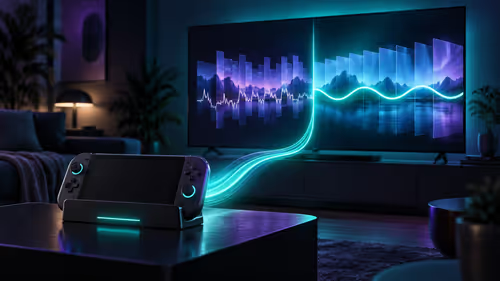
Nintendo Switch 2 docked VRR arrives with system version 23.0.0 and also requires a dock update. The connected TV or monitor and the running software must support VRR before the output can follow changing frame rates.

NVIDIA lists 550W required system power for the RTX 5060 reference specification, based on a high-end test system. A quality 550W unit can be enough, but CPU draw, transient load, connectors and ageing decide real headroom.
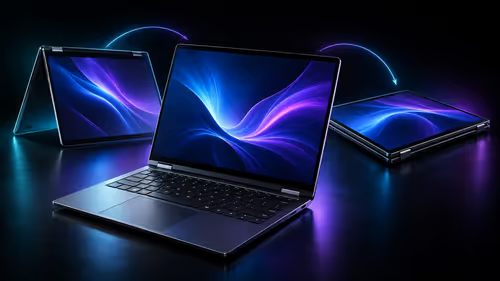
The VAIO T combines a 13.3-inch display with a multi-flip mechanism for laptop, tablet and outward-facing viewing modes. Orders begin in Japan on 18 September; South African availability is unconfirmed.

OpenRGB's master branch now carries changes labelled for 1.0 final, including translation and platform work, but the official tags page still lists 1.0rc3.1 as the newest packaged release. Stable users should wait for the signed release channel.
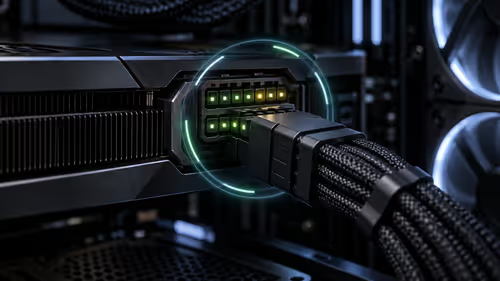
The Cooler Master GPU Shield Adapter monitors current on individual 12+4-pin contacts, adds visual and audible warnings, and can reduce system power during a severe abnormality. Local availability is unconfirmed.