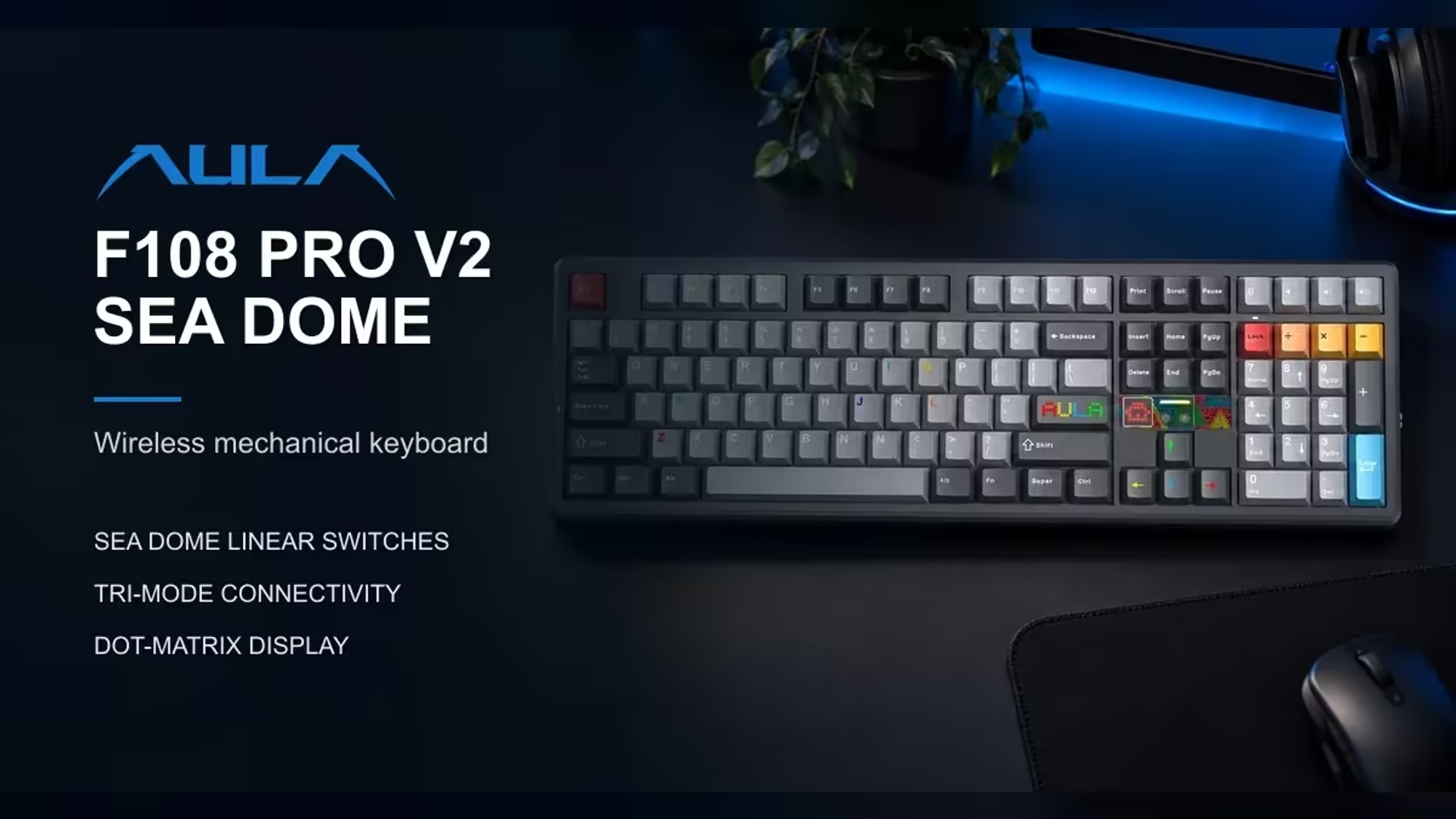
Two editions of one keyboard, two different switches, and a spec sheet that only disagrees on a handful of lines. The AULA F108 PRO V2 ships with either LEOBOG Sea Dome or LEOBOG Panda linears, and the choice decides how the whole board feels under your fingers for years. This guide reads those lines properly, so choosing between Sea Dome and Panda linear switches becomes a decision about your hands rather than a coin toss.
Quick Answer
Sea Dome is the lighter switch: it registers at 32gf and travels 3.7mm in total. Panda asks for 38gf to register and stops at 3.3mm. Both need 45gf to bottom out and both register 1.8mm into the press, so the difference lives in how hard the start of each keystroke feels and how much stroke remains underneath. Pick Sea Dome for a feather-light touch and Panda for a firmer, shorter press; at Evetech the F108 PRO V2 costs R1,099 in Dark/Light Grey and R949 in Black/Grey/White.
⚖️ Reading the force figures side by side
Every mechanical switch spec sheet has two force numbers, and they describe different moments in a keystroke.
Actuation force: the start of the press
Actuation force is the push needed to make the key register. On the Sea Dome it is 32gf, give or take 3gf. On the Panda it is 38gf, with the same tolerance. That gap sounds small on paper, but your fingers notice it quickly. A 32gf switch registers with barely more than the weight of a relaxed hand, which means you can type fast with almost no effort. The trade-off is that a finger resting a little too heavily can also send a keystroke you never meant.
The Panda's higher starting force builds in a small safety margin. Fingers can rest on the keycaps without much risk, and each press feels a touch more deliberate.
Bottom-out force: the end of the press
Here the two switches agree. Both are rated at 45gf when the key hits the bottom of its travel. So if you are someone who types by slamming every key to the floor, the final impact feels similar on both editions. The difference you will feel is in the ramp between the start and the end: the Sea Dome climbs from a lower starting point to the same finish, so its spring feels like it builds more over the stroke.
📏 Travel: where the two switches really split
Force is one axis. Distance is the other, and this is where the Panda earns its reputation for feeling short.
Both switches register at 1.8mm of pre-travel, within 0.3mm either way. That means the moment a key fires is the same depth on both editions of the board. What changes is what happens after that point:
- Sea Dome: 3.7mm of total travel, so there is a generous stretch of stroke below the point where the key registers.
- Panda: 3.3mm of total travel, so the key reaches the bottom sooner after it fires.
A longer stroke feels smoother and more cushioned if you type with a light touch that rarely bottoms out. A shorter stroke feels snappier, because your finger lands on the floor of the switch quickly and can lift off again. Neither is better in the abstract; it depends on whether you float over the keys or press them all the way down.
🧪 Housing plastics and what they change
Beyond force and distance, the spec sheet lists what each switch is made of. The two recipes are close to mirror images of each other.
The Sea Dome uses a PC (polycarbonate) top housing, a PA (nylon) stem and a POM bottom housing. The Panda flips that around: a PA top, a POM stem and a PA bottom. Materials play a part in sound and smoothness, but they are only one factor alongside the spring, the travel and the board itself. On this keyboard both switches sit in a gasket-mounted build with seven layers of sound-dampening material, which does a lot of the work of softening the stroke no matter which switch you pick.
Both are rated by AULA for about 60 million keystrokes, so longevity is not a reason to favour one over the other.
🎯 Matching a switch to how you actually use a keyboard
Here is a practical way to decide, based on habits rather than preference charts.
You probably want the Sea Dome if...
- You type long documents or code for hours and want every keystroke to take as little effort as possible.
- Your touch is light and you rarely drive keys to the bottom.
- You like a softer, longer feel with plenty of cushion underneath.
You probably want the Panda if...
- You rest your fingers heavily on the home row and keep triggering stray keys on light boards.
- You prefer a firmer start that confirms each press.
- You like a stroke that ends quickly so fingers can move on.
For games, both register at the same depth, so the difference is feel rather than speed. Players who hold movement keys for long stretches often like the easier start of the Sea Dome; players who worry about accidental presses in tense moments may lean towards the Panda.
Colourway decides the switch
On these two editions the colour and the switch come as a pair. Pick the two-tone grey board and Sea Dome linears come fitted; pick the black, grey and white one and you get Panda linears. If you have your heart set on one look, you are also choosing its switch, so decide which matters more to you.
Not a permanent decision
Every socket on the F108 PRO V2 is hot-swappable. If you pick the Sea Dome and later find it too light, you can pull the switches and fit a firmer set without a soldering iron. The reverse works too. That flexibility takes some of the pressure off the choice: think of the included switch as a starting point rather than a lifetime commitment.
Both editions share everything else. Each keeps its number pad on a full-size frame, links up over a USB-C lead, the 2.4GHz dongle or Bluetooth, and carries the same audio-reactive dot-matrix display. Evetech backs whichever edition you choose with a 1 Year Local Warranty. You can weigh them against the wider range in Evetech's gaming keyboards category, or see what local shoppers keep choosing on the keyboard best sellers page.
Frequently Asked Questions
Which switch registers with less effort?
The Sea Dome, at 32gf. The Panda needs 38gf before a key registers, so it feels a little firmer at the start of each press.
Do both switches fire at the same depth?
Yes. Both list 1.8mm of pre-travel with a tolerance of 0.3mm, so keys register at the same point on either edition.
Why does the Panda feel shorter?
Its total travel is 3.3mm against 3.7mm on the Sea Dome, so the key reaches the bottom sooner after it registers.
Which edition is better for heavy-handed typists?
Usually the Panda. The higher starting force means resting fingers are less likely to trigger keys by accident.
Can I buy one colour and use the other switch?
Not straight out of the box, because colour and switch come paired. But the hot-swap sockets let you fit a different set of switches afterwards.
Are the switches equally durable?
AULA rates both at about 60 million keystrokes, so durability does not separate them.
Light Sea Dome or firmer Panda?
Compare both F108 PRO V2 editions with the rest of Evetech's full-size and compact gaming keyboards before you choose your switch.