Quick Answer
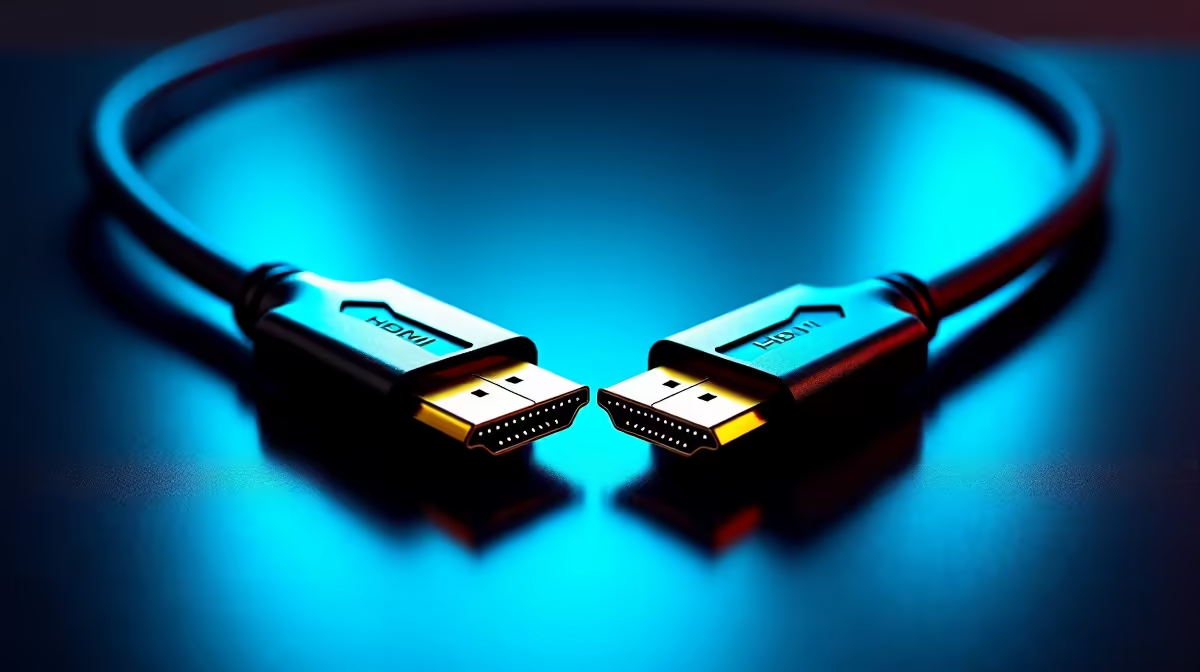
Short HDMI cables (under 2 metres) present almost no signal quality risk at any HDMI version, including HDMI 2.1. A 5 metre HDMI 2.0 cable carrying 18 Gbps is viable but requires a Premium Certified cable rated for that bandwidth at 5 metres. Generic or uncertified 5 metre cables often fail to sustain 18 Gbps and silently drop your display to 4K/30Hz.
Why Length Matters at High Bandwidth 🔧
HDMI signal travels as a differential electrical signal, and copper wire has resistance and capacitance that increase with length. At HDMI 1.4 speeds (10.2 Gbps), signal margins are generous enough that most cables handle 5 metres without issue. At HDMI 2.0 speeds (18 Gbps), the higher data rate leaves less tolerance for signal degradation, and a 5 metre run in a cable not built for 18 Gbps will cause bit errors that force the devices to negotiate down to HDMI 1.4 speeds.
Practical Guidance for South African Setups 🏠
For a gaming PC on a desk with a monitor 60 to 90 cm away, a 1 to 1.5 metre HDMI 2.0 cable at R150 to R220 is the correct choice. Signal quality at this length is flawless even with budget Premium Certified cables. For a media player or gaming console in a TV cabinet connecting to a wall-mounted TV across a lounge, a 3 to 5 metre run is typical. South African homes with standard 2.7 metre ceiling heights and TVs mounted 1.5 to 1.8 metres from the floor can require 4 to 5 metre cable runs when routing behind the wall cavity or through a TV mounting bracket's internal cable channel. At this length, a Premium Certified HDMI 2.0 cable (R400 to R650) is essential to maintain 4K/60Hz.
When to Choose Active or Fibre HDMI Instead 💡
If your run exceeds 5 metres, a passive HDMI 2.0 cable is not the right tool regardless of price. At 7 to 10 metres, an active HDMI 2.0 cable (with a signal booster chip, typically R800 to R1,200) maintains 18 Gbps reliably. At 10 metres and beyond, or for HDMI 2.1 (48 Gbps) over distances above 3 metres, an active optical HDMI cable (fibre inside a standard HDMI connector, R1,500 upwards) is the correct solution. These are used in permanent South African home theatre installations where the AV source is in a different room from the display.
Test the Cable at Full Resolution Before Routing Permanently ⚡
Before you route a 5 metre HDMI cable through a wall cavity or ceiling, run it loosely and confirm 4K 60Hz at the display. A cable that fails the test on a desk will not pass it inside a wall. Returning a cable that is already glued inside a cable raceway is far more difficult than swapping a test cable on a desk.
FAQ
Do all 5 metre HDMI cables carry a Premium Certified label if they are 18 Gbps capable?
No. Premium Certification requires the manufacturer to pay for independent testing through the HDMI Forum's programme. Some reputable brands produce compliant 18 Gbps cables without seeking the Premium Certified label. In these cases, look for an explicit 18 Gbps specification in the product listing. When in doubt, the Premium Certified label is the safest confirmation.
Can I extend a short HDMI cable with a coupler to reach 5 metres?
A passive coupler (joining two cables) adds signal degradation at the join point. For 4K/60Hz, using two cables with a passive coupler at 3 metres total or more is risky. An active HDMI extender or a longer single cable is preferable.
My 5 metre cable runs at 4K/60Hz most of the time but occasionally drops to 30Hz. Why?
Intermittent drops on a borderline cable happen because temperature, cable position, and minor physical stress at the connectors affect signal margin. A cable that passes 18 Gbps at room temperature may fail slightly under heat or when kinked. Replace it with a confirmed Premium Certified cable to resolve the intermittent behaviour.
Need a reliable 5 metre HDMI cable for a lounge or home theatre setup?
Evetech stocks Premium Certified HDMI 2.0 cables at 3m, 5m and other lengths, all locally stocked for fast delivery across South Africa with warranty support.