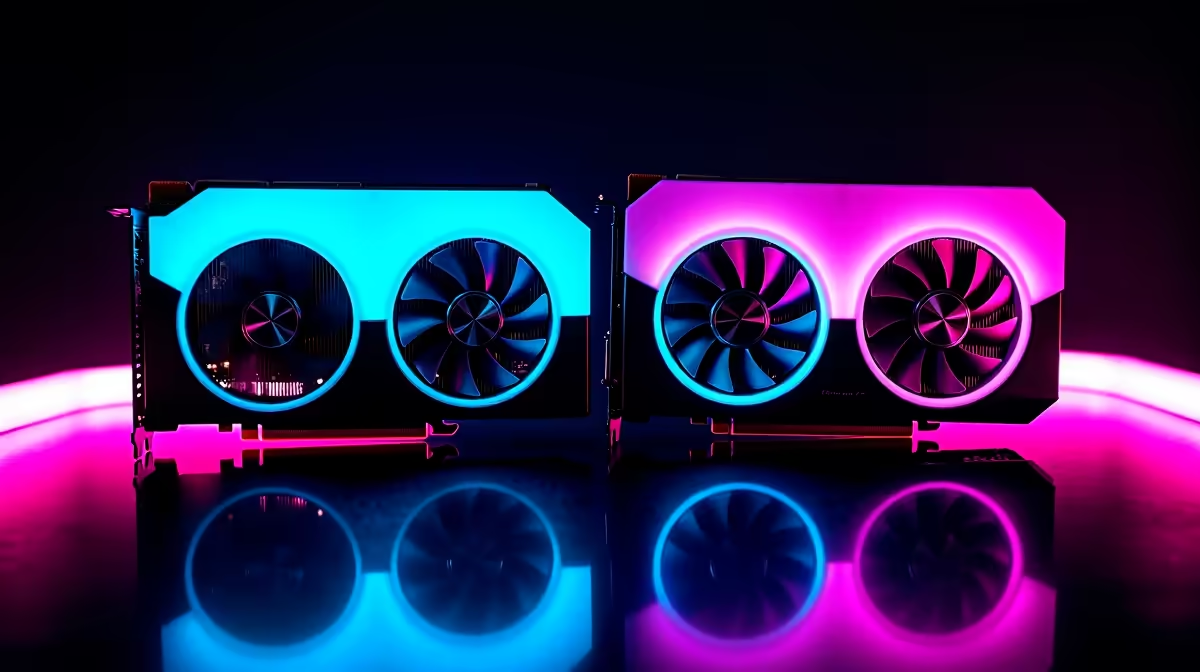
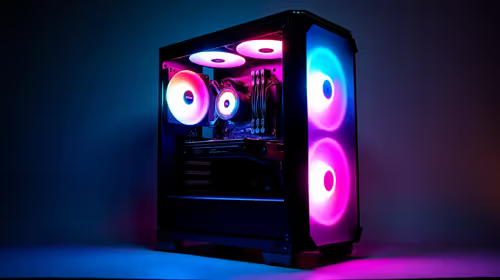
Single-card versus dual-card for AI workloads is a different calculation from gaming, where dual GPUs are largely dead. For AI, a second card can genuinely help, but only under specific conditions, so the SA buyer's answer hinges on your models and software.
Quick Answer
For most SA buyers running AI workloads, a single powerful GPU with lots of VRAM is the better choice, simpler, cheaper to power and cool, and faster for models that fit in one card's memory. Go dual-card only if your models exceed a single GPU's VRAM and your software supports multi-GPU, or you run many parallel jobs. A single RTX 5090 with 32GB VRAM outperforms two smaller cards for most workloads that fit its memory.
When a single card wins, and when dual helps
VRAM is the deciding factor in AI. A single card with a large memory pool runs any model that fits entirely in its VRAM faster and more simply than splitting across two cards, which adds communication overhead and software complexity. The RTX 5090's 32GB handles a wide range of models alone. Dual-card pays off when a model is too large for one card's VRAM and your framework supports model parallelism, or when you run many independent inference or training jobs in parallel and can dedicate a card to each.
Building for AI sensibly
For most AI hobbyists and professionals, a single high-VRAM card, a Ryzen 9 or Threadripper CPU, 64GB system RAM, and a fast NVMe SSD make a clean, powerful workstation. Confirm your AI framework actually uses multiple GPUs before buying a second card, many workloads see no benefit. If you do go dual, you need a motherboard with the PCIe lanes and slot spacing, a 1500W-plus PSU, and a high-airflow case. Start single, scale to dual only when a real VRAM or throughput limit forces it.
AI framework supports multi-GPU before buying a second card, many workloads run faster on one high-VRAM card than split across two.
FAQ
Single or dual GPU for AI workloads?
For most buyers, a single high-VRAM card, it is simpler, cheaper to run, and faster for models that fit its memory. Go dual only if models exceed one card's VRAM and your software supports it.
Does a second GPU always speed up AI?
No, only if your framework supports multi-GPU and the model needs it, or you run many parallel jobs. Otherwise a second card adds cost and complexity for no gain.
What single card is best for AI in SA?
A high-VRAM card like the RTX 5090 with 32GB handles a wide range of models alone, outperforming two smaller cards for workloads that fit its memory. Pair it with 64GB system RAM.
Start with one high-VRAM card and 64GB RAM, scale to dual only when a real VRAM or throughput limit demands it, at Evetech.