Quick Answer
The two most effective solutions for cable and space issues in E-ATX builds are a fully modular PSU with a custom-length cable kit, and a case with a rear cable channel of at least 40mm depth. These two elements alone resolve 80 percent of the cable routing and space conflicts that E-ATX builds generate compared to standard ATX builds.
Why E-ATX Builds Have Unique Cable Challenges 🔌
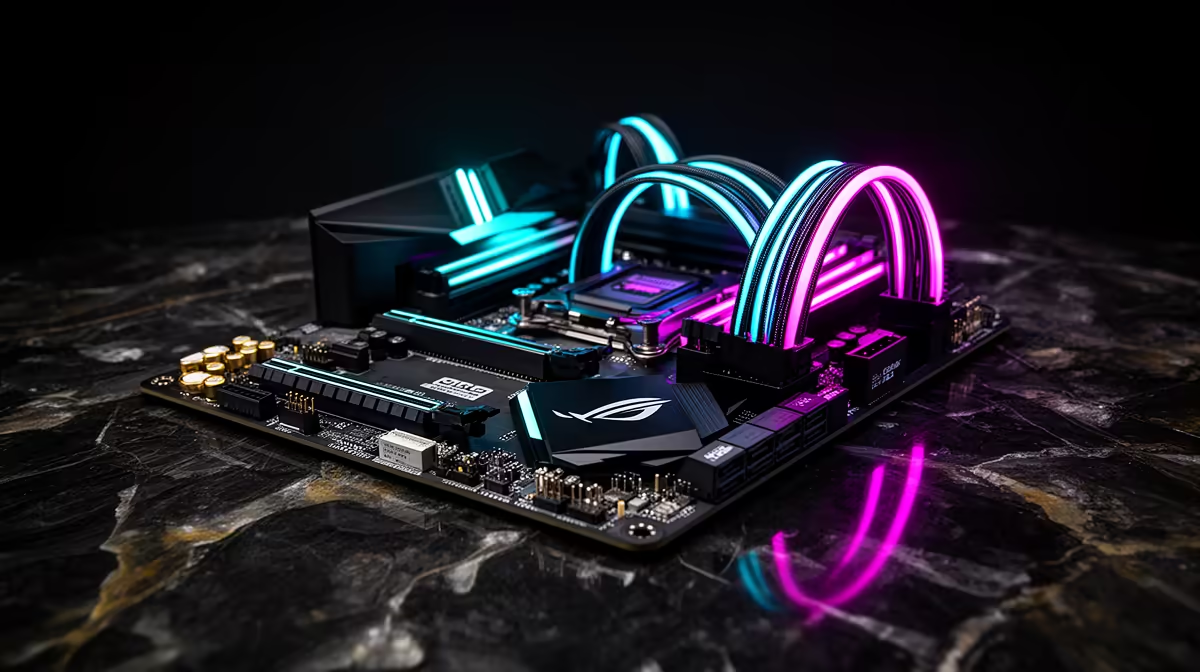
An E-ATX motherboard is up to 85mm wider than an ATX board, which increases cable run lengths throughout the chassis. The 24-pin ATX power connector in a standard ATX build has a run of 25 to 35cm. In an E-ATX build it can reach 45 to 55cm, requiring longer cables or an extension. The EPS12V CPU power connector at the top of the board can be 20 to 30cm further from the PSU bay entry point than on an ATX board, making the default cable length on most PSU cable kits insufficient. GPU power cables spanning PCIe 8-pin or 16-pin (12VHPWR) connectors must also route further across the board to reach GPU power inputs.
The Cable Management Approach That Works 🛠️
Start with a fully modular PSU that allows you to attach only the cables you need and select cable lengths per run. A 1200W to 1600W fully modular PSU at R3,500 to R7,000 is non-negotiable for a clean E-ATX workstation build. Next, order a custom or aftermarket cable kit with the run lengths your E-ATX board requires. A 650mm EPS12V cable, a 700mm 24-pin cable, and two 650mm PCIe power cables cover the extended runs without bundling excess length in the rear channel. Route each cable bundle separately through grommeted pass-throughs in the motherboard tray, binding each run with flat Velcro ties rather than zip ties.
Space Optimisation in the Drive Bay Area 💡
E-ATX cases often sacrifice some drive bay positions to accommodate the wider motherboard tray. If the case provides four 3.5-inch bays and four 2.5-inch trays, prioritise NVMe storage over SATA drives to reduce cable count entirely. Each NVMe M.2 drive eliminates one SATA power cable and one SATA data cable, which is significant in an already cable-dense E-ATX build. Reserve 3.5-inch HDD bays for archive storage only and route the SATA cables last, after all power and data cables are managed, to fill remaining cable routing space without crossing primary cable runs.
Measure Before You Order Cables ⚡
Before ordering custom cable kits for an E-ATX build, dry-fit the motherboard in the case without any cables attached and physically measure the route from each cable connection point to the nearest cable pass-through. Add 80mm to each measured length for routing slack and panel clearance. This ensures your custom cable kit arrives with cables long enough to route cleanly.
FAQ
How thick should the rear cable channel be for an E-ATX build?
A minimum of 35mm, and 40mm to 45mm is preferable. The increased cable count and longer runs in an E-ATX build mean more bundled cable volume behind the tray. A 25mm channel adequate for ATX builds will cause the side panel to bulge or refuse to close flat in an E-ATX build with a full cable set.
Can I use a standard ATX power supply in an E-ATX case?
Yes. Power supplies use a standard ATX form factor regardless of the case size. The key is selecting a wattage appropriate for the platform and ensuring cable lengths are sufficient for the extended runs an E-ATX board requires.
What is the best way to manage GPU power cables in a 4-slot wide GPU build?
Route the GPU power cables from the PSU along the bottom of the case behind the GPU, entering the graphics card through the bottom of the PCIe zone. Use a single 12VHPWR cable from a PSU that natively supports the connector rather than adapting two 8-pin cables, which reduces both cable bulk and heat at the connector.
Building a large E-ATX workstation and need the right foundation?
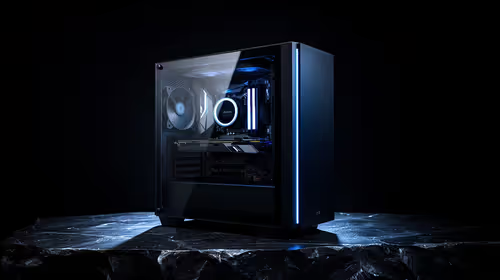
Evetech stocks full-tower cases with deep cable channels, E-ATX board support, and the expansion clearance that demanding workstation builds require. Browse the full range today.