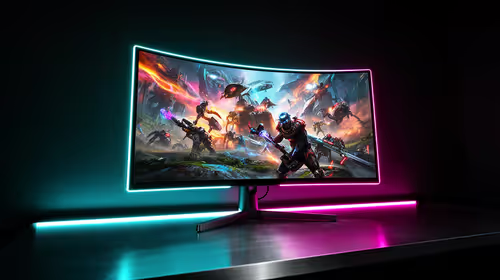
You’re in the final circle in Apex Legends. It’s a frantic 1v1. You track your opponent, your crosshair perfectly placed... but as they strafe, they become a blurry mess for a split second. You miss the shot. That frustrating ghosting effect is motion blur, the silent enemy of competitive gamers. But what if you could eliminate it? That’s the promise of a sub-1ms response time, and it’s more than just marketing speak… it’s the science of visual clarity.
Understanding Response Time: More Than Just a Number
When you see "response time" on a spec sheet for one of our PC monitors, it usually refers to the GtG, or "Grey-to-Grey," time. Think of each pixel on your screen as a tiny, colour-changing light. Response time measures how quickly a single pixel can shift from one shade of grey, to another, and back again.
Why grey? Because it's a tougher, more realistic test than switching from pure black to pure white. A monitor with a sub-1ms response time can perform this change in less than a thousandth of a second. This incredible speed is the foundation for eliminating motion blur and achieving a crystal-clear picture, even in the fastest-moving scenes.
The Science of Eliminating Motion Blur 🚀
So, how does a fast response time actually clean up your image? It all comes down to pixel persistence.
On a slower monitor, the pixels can't change colour fast enough to keep up with the new frames your graphics card is sending. The old image lingers for a fraction of a second, overlapping with the new one. This creates a smearing or "ghosting" effect that we perceive as motion blur. It’s why a fast-moving character can look like they have a faint trail behind them.
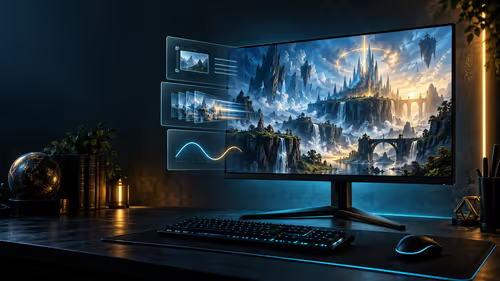
A monitor that boasts a sub-1ms response time ensures each pixel transitions almost instantly. The old frame vanishes completely before the new one appears. The result? Every single frame is sharp and distinct. For gamers, this means cleaner target tracking, easier snap-aiming, and a significant competitive advantage. You see the enemy exactly where they are, not where they were a few milliseconds ago. It’s this level of precision that defines modern gaming monitors.
Who Really Needs a Sub-1ms Response Time?
Is this lightning-fast tech essential for everyone? Let's break it down.
The Competitive Edge Seeker
If you live and breathe fast-paced, competitive titles like Valorant, CS:GO, or Warzone, the answer is a resounding yes. In these games, where victory is decided in milliseconds, eliminating motion blur is non-negotiable. A clear view of your opponent during a rapid flick or strafe is the difference between winning a round and staring at a respawn screen. For these players, a sub-1ms response time is a vital piece of hardware.
The Immersive Story Gamer
Are you more at home exploring the vast worlds of Baldur's Gate 3 or Starfield? Here, a sub-1ms response time is less of a necessity and more of a luxury. While it will certainly make for a smoother experience, you might prioritise other features like colour accuracy, contrast, or the sheer immersion provided by curved monitors. The good news is that you no longer have to choose; many modern panels offer both incredible speed and beautiful visuals.
The Content Creator & Streamer
For video editors, graphic designers, and streamers, colour accuracy and screen real estate are often king. However, many creators are also gamers. A popular setup in South Africa is a dual-monitor rig: one for colour-critical work and a second, high-refresh-rate monitor for gaming. Some even use compact portable monitors to display stream chats or toolbars without cluttering their main display.
Tuning Your Monitor's Engine 🔧
Most gaming monitors have an "Overdrive" or "Trace Free" setting in their on-screen menu. This pushes more voltage to the pixels to speed up their transition time. While effective, setting it too high can cause "inverse ghosting" (a bright or coloured trail). For a perfect balance, start with the 'Normal' or 'Medium' setting and test it in-game before cranking it to the max.
Beyond Speed: Crafting the Perfect Visual Experience ✨
A sub-1ms response time is a cornerstone of a great gaming display, but it works best as part of a team. To build the ultimate setup, you also need to consider:
- Refresh Rate (Hz): This is how many times your screen updates per second. A high refresh rate (144Hz, 240Hz, or even higher) provides smoother motion, but it needs a fast response time to keep the image sharp. The two specs work hand-in-hand.
- Resolution: This determines the sharpness and detail of your image. While a fast response time is available on 1080p panels, pairing it with the incredible detail of today's stunning 4K and 5K monitors creates a truly top-tier visual experience, provided your GPU can keep up.
- Panel Technology: TN panels are traditionally the fastest, but modern IPS and VA panels have closed the gap significantly, offering superior colour and contrast without compromising much on speed.
- Your Setup: Don't forget the ergonomics! A great monitor deserves a great position. Investing in the right monitor accessories, like an adjustable arm or stand, can improve comfort and performance during long gaming sessions.
Ultimately, eliminating motion blur with a sub-1ms monitor isn't just about a number on a box. It's about removing a barrier between you and your game, allowing for faster reactions and a more immersive, clear, and competitive experience.
Ready to Banish Motion Blur for Good?
A monitor with a sub-1ms response time can truly transform your gaming. See your opponents with perfect clarity and gain the competitive edge you've been looking for. Explore our incredible monitor deals and find the perfect panel to conquer the competition.