Two display standards competing for the same job confuses people into thinking one has simply replaced the other. HDMI 2.1b and DisplayPort 2.1b are both current, both capable, and the choice between them for a 4K or 8K setup comes down to what your specific panel accepts, not which standard is technically newer.
Quick Answer
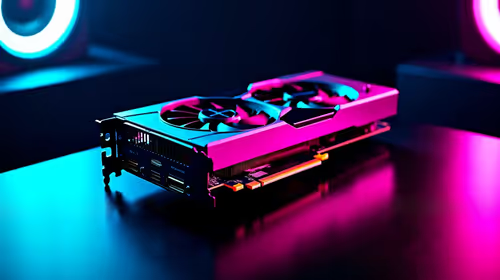
Both 2.1b revisions carry enough bandwidth for 4K at high refresh rates and 8K at more modest refresh rates without leaning heavily on compression. The practical choice between them comes down to your monitor's input, since certified cables and confirmed support matter more than which standard is theoretically superior. The card used as the example throughout this guide is R119,999.
📋 What the "2.1b" revision actually adds
Both standards, at this specific revision, raise the bandwidth ceiling meaningfully over their immediate predecessors, which is what makes driving demanding resolutions and refresh rates comfortable without heavy reliance on compression schemes that can introduce visible artefacts under certain content. This matters most for fast-motion content and colour-critical work, where compression artefacts are easiest to notice.
Both standards remain backward compatible with earlier revisions of themselves, so a 2.1b-capable card still works correctly with an older HDMI 2.0 or DisplayPort 1.4 monitor, simply running at that older, lower ceiling rather than failing to connect.
🔌 Certification is the detail that actually matters
An uncertified cable claiming support for either standard will often negotiate down silently to a lower bandwidth mode rather than failing outright, which is a genuinely confusing failure mode because the picture still works, just capped below the refresh rate or resolution the hardware could otherwise reach. Buy cables carrying explicit certification for the standard and bandwidth figure you need, rather than trusting a version number printed on cheap packaging alone.
This applies to both standards equally. Neither HDMI nor DisplayPort is immune to the uncertified-cable problem, and the fix is identical either way: check for a stated bandwidth figure in Gbps, not just a version number.
🖥️ Matching the standard to your actual monitor
Professional and ultrawide monitors lean toward DisplayPort as their primary high-bandwidth input, while televisions and consoles lean toward HDMI almost exclusively. If your setup mixes a PC monitor with a television used as a secondary or gaming display, expect to use both standards simultaneously rather than standardising on one across the whole desk.
Write down each monitor's input type against the matching output on the card before assuming compatibility, rather than discovering the mismatch once the cables are already bought. Browse gaming monitors if you are shopping for a panel to match a specific standard, and the cable range for certified leads once your ports and inputs are confirmed.
🎞️ Compression and why avoiding it matters for fast motion
Where bandwidth genuinely runs short of what a resolution and refresh rate combination needs, both standards can fall back on compression schemes designed to preserve most of the visible quality while reducing the data actually transmitted. For static or slow-moving content this is close to invisible; for fast-motion gaming and for colour-critical editing work, compression artefacts are more likely to show, particularly in scenes with fine detail moving quickly across the frame.
Running a panel 1 or 2 steps below its absolute maximum resolution and refresh rate combination, by choosing a setting the standard supports natively rather than at its outer limit, avoids this trade-off entirely. Check your monitor's own specification for the exact combinations it lists as supported without compression, since that detail is usually stated for higher-end panels aimed at buyers who would notice the difference.
📺 Where television support genuinely lags PC monitor support
Even where a television advertises HDMI 2.1 support, the actual bandwidth ceiling and feature set implemented varies considerably between manufacturers and models, more so than on PC monitors built specifically around a single, well-documented standard. Confirm a television's actual supported combinations from its own detailed specification page rather than the general "HDMI 2.1 compatible" marketing line on the box, since that line alone does not guarantee support for every resolution and refresh rate combination the standard technically allows.
This gap between advertised and actual support is one of the more common sources of disappointment when connecting a high-end card to a television rather than a dedicated monitor, and it is worth checking before assuming a television's badge alone settles the question. Compare the full graphics card range to confirm your specific card's exact output revision before pairing it with either a television or a monitor.
Frequently Asked Questions
Do I need to replace working older cables when I upgrade my card?
Only if they are not rated for the new card's full output. A cable that is genuinely certified for the older standard will still work, simply capped at that standard's lower ceiling rather than failing outright.
Is DisplayPort better than HDMI at the 2.1b revision?
At this revision they carry broadly comparable bandwidth. The practical decision usually comes down to what your monitor's input supports rather than one standard being categorically superior.
Will an older monitor work with a 2.1b-capable card?
Yes, through backward compatibility. The connection runs at the older monitor's supported ceiling rather than failing, so an older 4K 60Hz monitor still works correctly on a newer output.
Why did my picture work but refuse to reach the refresh rate I expected?
An uncertified cable is the most likely cause. It can negotiate down to a lower bandwidth mode silently rather than failing to connect at all, which produces exactly this symptom.
Can I run a card's full resolution and refresh rate through a splitter?
Rarely at full settings. A splitter, distinct from a hub feeding independent monitors, generally duplicates one signal to multiple displays rather than adding bandwidth, so treat it as a mirroring tool rather than a way to add capability to a multi-monitor setup.
Does a television's HDMI 2.1 badge guarantee full-bandwidth support?
Not reliably. Actual supported resolution and refresh rate combinations vary between television models far more than they do on PC monitors, and it is common for only one HDMI input on a given set to actually carry the full-bandwidth mode rather than all of them equally.
Do I need different cables for HDMI versus DisplayPort at this revision?
Yes, the two use different connectors and are not interchangeable, so match the cable type to each specific port and monitor input pair rather than assuming one cable type covers both.
Ready to match the right standard to each screen on your desk?
Check every monitor's input against your card's exact output list before buying cables.