Quick Answer
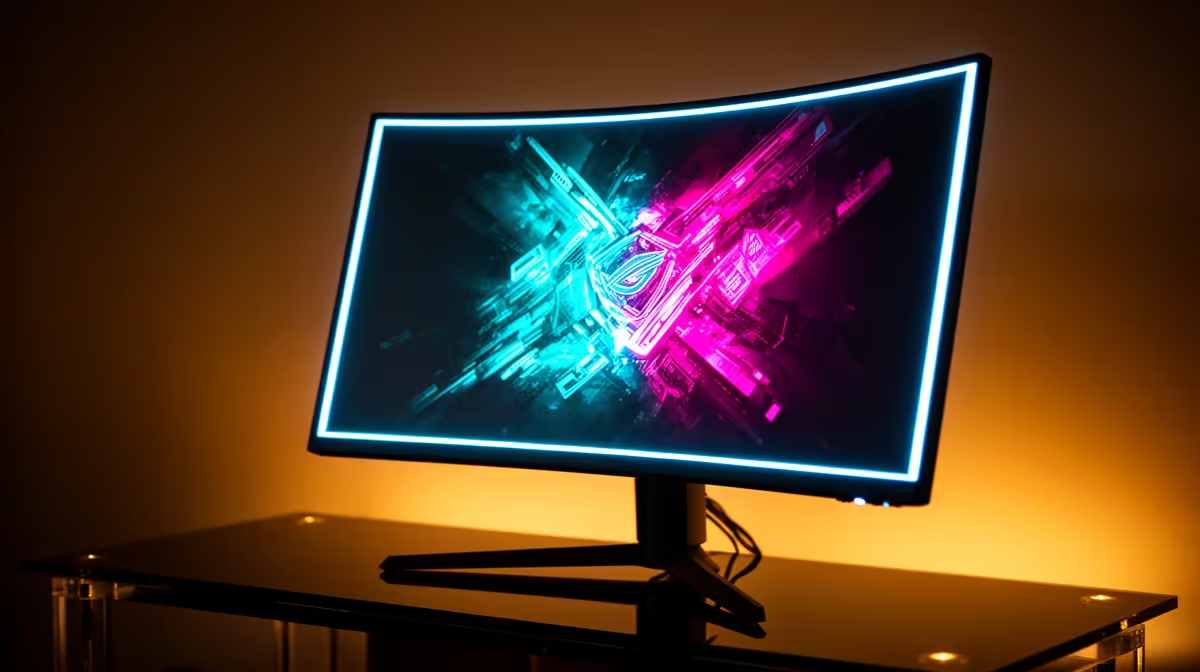
A 31.5-inch curved gaming monitor suits competitive play best when paired with a GPU capable of sustaining 165 Hz or more at your chosen resolution. FHD on a 31.5-inch panel keeps GPU demands low and frame rates high; 1440p improves visual detail but requires a more capable GPU. Choose 1500R or 1800R curvature based on your viewing distance.
Panel Types and Why Fast-VA or IPS Matters 🖥️
For competitive gaming at 31.5 inches, the panel technology determines whether you benefit from the large screen or fight against its weaknesses. Older standard VA panels offer excellent contrast (3000:1 or higher) and black depth, but suffer from slow pixel response times that cause smearing on fast-moving objects. Fast-VA panels address this with optimised pixel voltage control, reducing GtG (grey-to-grey) response to 1 ms claimed, making them viable for competitive play while retaining the superior contrast of VA technology. IPS panels at 31.5 inches deliver more consistent colour accuracy and wider viewing angles, making them strong choices for players who also create content or edit images between sessions.
Resolution Choice: FHD vs QHD at 31.5 Inches 🎮
FHD (1920 x 1080) at 31.5 inches gives approximately 70 ppi, which shows individual pixels at close viewing distances. This is the resolution of choice for maximum frame rates with mid-range GPUs: an RTX 4060 or RX 7600 handles most competitive FPS titles at 200-plus fps on FHD, fully utilising a 250 Hz panel. QHD (2560 x 1440) at the same size produces 93 ppi, a significant sharpness improvement. Enemy models and map details are visibly crisper, which helps in tactical games where spotting at range matters. The trade-off is GPU demand: sustaining 165-plus fps at 1440p in CS2 or Apex Legends requires an RTX 4070 or RX 7900 XT, adding R3,000 to R5,000 to the GPU portion of the build.
Key Features to Look for in SA 💰
Target: 165 Hz minimum refresh rate (250 Hz if your GPU supports it), 1 ms GtG response time, FreeSync Premium for AMD GPU users or G-Sync Compatible for NVIDIA, and HDMI 2.0 plus DisplayPort 1.4 ports to support both PC and console inputs. For South African lounge and bedroom gaming setups where ambient light varies, an HDR400 or HDR600 certification adds visible impact in dark-scene games. A height-adjustable and pivot-capable stand is worth prioritising because 31.5-inch monitors are heavy and ergonomic positioning matters more as screen size increases.
Confirm GPU Bandwidth Before Buying 1440p at 31.5 Inches ⚡
QHD at 165 Hz over DisplayPort 1.4 requires 17.8 Gbps of bandwidth, which is within DP 1.4's 25.9 Gbps ceiling. HDMI 2.0 supports only 18 Gbps, which can cause issues at 1440p above 144 Hz. If you use HDMI to connect your PC, either ensure the monitor has HDMI 2.1 or use DisplayPort for 1440p at 165 Hz and above.
FAQ
Is a 31.5-inch curved monitor too large for a small desk?
Most standard desks are 60 cm deep, placing you 50 to 60 cm from the screen. At that distance a 31.5-inch panel fills the majority of your field of view, which is immersive but can feel overwhelming. A desk depth of at least 70 cm is recommended for comfortable long-session use at 31.5 inches.
Do 31.5-inch curved monitors work well for console gaming?
Yes. Most models include HDMI 2.0 or 2.1 inputs that accept PS5 and Xbox Series X output at 4K/60 Hz or 1080p/120 Hz. The 1500R curvature enhances immersion for cinematic single-player console games significantly.
How do 31.5-inch curved monitors compare to ultrawide for esports?
31.5-inch standard curved (16:9) monitors are generally preferred for competitive esports because most tournament titles support 16:9 at full frame rate. Ultrawides (21:9) are sometimes letterboxed in competitive titles, eliminating the width advantage.
Building a competitive gaming setup around a 31.5-inch curved monitor?
Evetech stocks curved gaming monitors in this size from fast-VA and IPS panels with high refresh rates. Browse current availability to complete your SA gaming rig.