Quick Answer
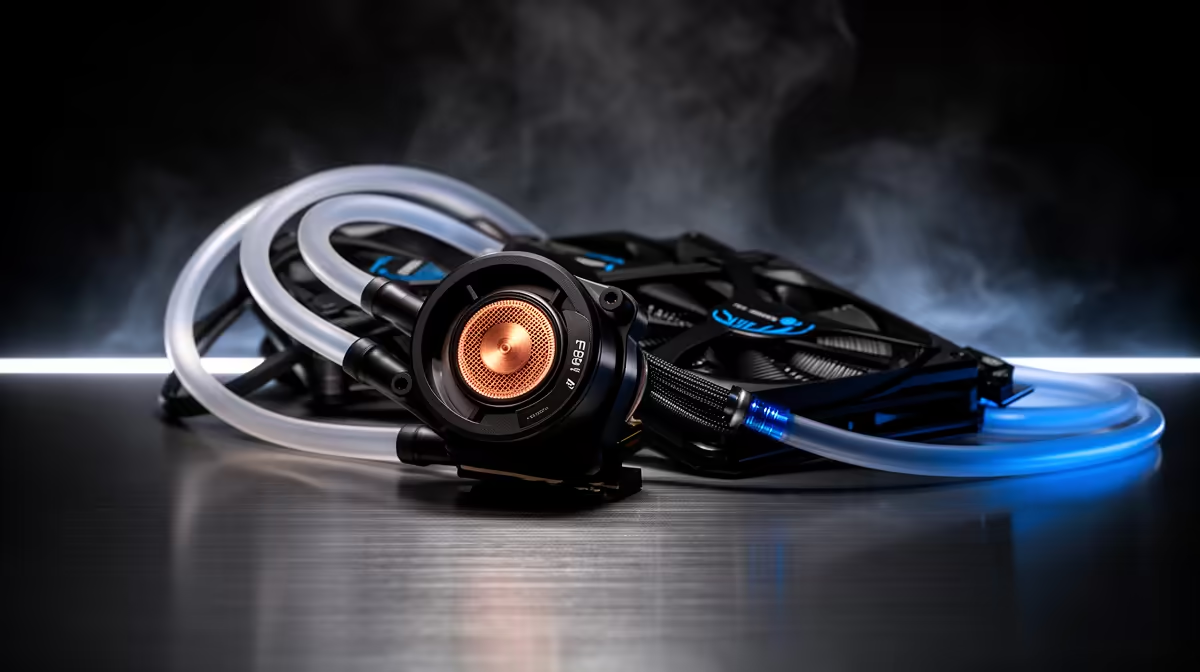
A 360mm AIO liquid cooler is the right choice for any high-end gaming PC using a CPU with 150 W TDP or higher, including the Ryzen 9 9950X, Core Ultra 9 285K, or overclocked mid-range CPUs. It outperforms most air coolers in sustained thermal loads while keeping noise acceptable at gaming workloads.
Choosing the Right 360mm AIO for Your Platform 🔧
The first filter is socket compatibility. Current 360mm AIOs cover AM5 (Ryzen 7000/9000) and LGA1851 (Intel Core Ultra 200-series) as primary targets, and most include both bracket sets in the box. The second filter is pump quality. Units using Asetek Gen8 or equivalent pump platforms have proven low failure rates over 50,000-plus operating hours. Third is fan quality: look for high-static-pressure fans rated at 2.5 mm H2O or above, which move air efficiently through the dense radiator fin stack. A complete 360mm AIO at R1,800 to R4,500 from brands stocked at Evetech covers this spec range from solid mid-tier to premium LCD-equipped models.
Installation, Case Fit and Mounting Orientation 🖥️
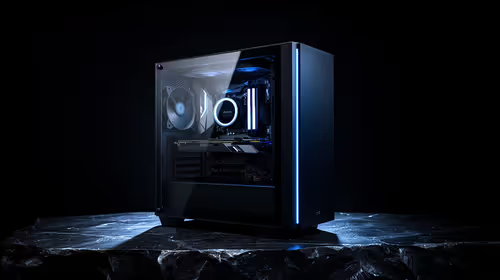
Mounting a 360mm radiator requires a case with a 360mm-compatible top or front panel. Most full-tower cases and mid-towers above R1,500 provide this. The preferred orientation for high-end CPU builds is top exhaust: hot air from the radiator exits the case directly rather than recirculating. Front intake is acceptable but warms the CPU slightly before reaching other components. Ensure at least 25 mm of clearance between the radiator and any tall RAM modules; low-profile DDR5 kits (under 35 mm) are the safest pairing for top-mounted 360mm radiators. Cable routing for three fan cables plus the pump cable adds up; daisy-chain compatible AIOs simplify this significantly.
Noise, Longevity and Maintenance 🌡️
At typical gaming loads (CPU at 40% to 60% utilisation), a 360mm AIO runs fan speeds of 800 to 1,200 RPM, which is near-silent. Under sustained all-core stress, fans ramp to 1,800 to 2,200 RPM and become audible; this only occurs during long renders or heavy creative workloads. AIO radiators do not require coolant maintenance on consumer units; the sealed loop is factory-filled. Replace the unit if you notice pump grinding noise, which indicates bearing wear, typically only after four to six years of continuous use. In South Africa, warranty coverage on 360mm AIOs ranges from 3 years on budget units to 6 years on premium lines.
Bleed Air from the Radiator on First Boot ⚡
After installing a new AIO, run the system at full CPU load for 20 minutes to allow any residual air bubbles to migrate to the reservoir section. A slight gurgling sound in the first hour is normal and disappears as air disperses. Letting the pump run at high speed initially helps circulate and settle the coolant for optimal transfer.
FAQ
Is a 360mm AIO better than a 240mm AIO for a Ryzen 9 9900X?
Yes, by a meaningful margin under sustained load. The larger radiator surface drops water temperature 5 C to 8 C lower, translating to 5 C to 10 C cooler CPU junction temperatures under all-core workloads.
What does a 360mm AIO cost in South Africa in 2026?
Entry-level 360mm AIOs start around R1,500 to R1,800; mid-tier models with better fans and pump platforms range from R2,200 to R3,200; premium LCD-equipped options reach R3,800 to R5,000.
Can I use a 360mm AIO in an mATX build?
Rarely. Most mATX cases support a maximum of 240mm radiators. Check the case specification carefully; a full-tower or large ATX mid-tower is the reliable choice for 360mm AIO compatibility.
Ready to cool your high-end CPU properly?
Shop the full range of 360mm AIO liquid coolers at Evetech, with stock for AM5 and LGA1851 platforms.