Quick Answer
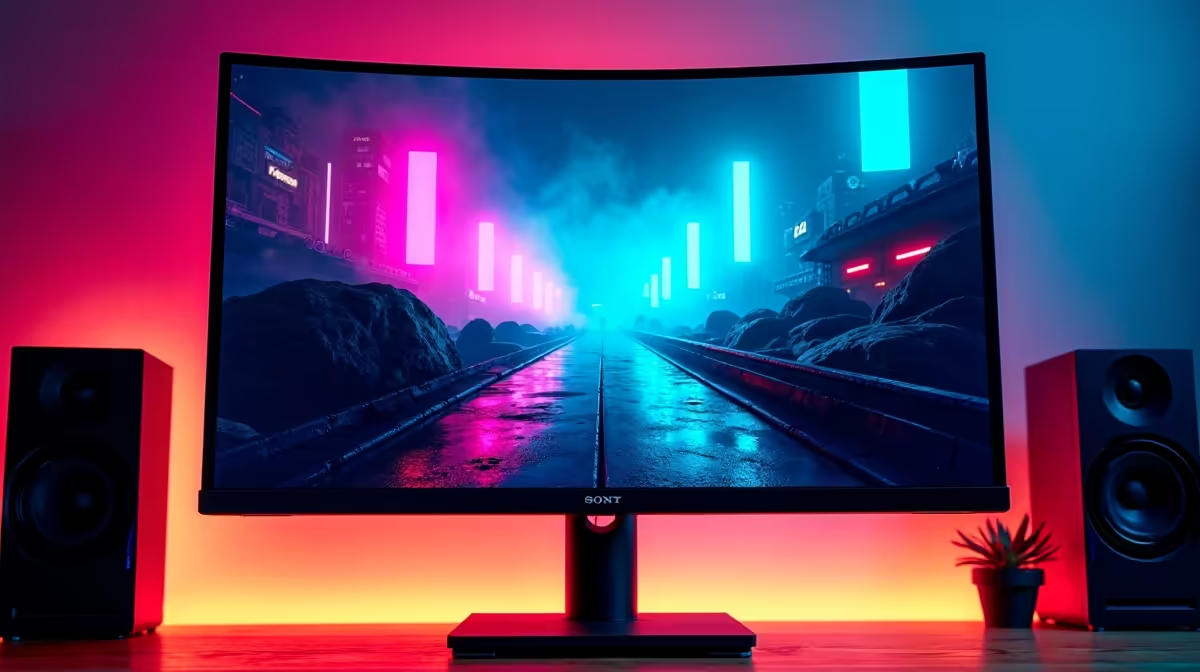
FreeSync Premium Pro is AMD's top-tier adaptive sync standard, combining variable refresh rate (VRR), low framerate compensation (LFC), and mandatory HDR support with less than 1% luma flickering. Paired with a high refresh rate display (144Hz and above), it eliminates screen tearing and delivers HDR gaming that is actually calibrated, not just labelled.
What Separates FreeSync Premium Pro from Standard FreeSync 🚀
Regular FreeSync simply enables VRR over DisplayPort or HDMI. FreeSync Premium adds a 120Hz-minimum requirement and LFC, which doubles the refresh rate when frame rate drops below the monitor's minimum VRR threshold. FreeSync Premium Pro adds mandatory HDR compliance: the monitor must meet measured brightness, colour accuracy, and flicker standards while HDR and VRR run simultaneously. This matters because many lower-tier monitors apply inconsistent brightness in HDR mode during fast VRR transitions. In practice, titles like Forza Horizon 5 and Cyberpunk 2077 with HDR enabled look consistent at both 60 fps and 144 fps, with no brightness pumping between frames.
High Refresh Rate Requirements and GPU Pairing 🖥️
To benefit from FreeSync Premium Pro at 144Hz to 240Hz, your GPU needs to deliver frame rates within the monitor's VRR range (typically 48Hz to 144Hz). An RTX 4070 or RX 7800 XT handles most modern titles at 1440p within this window. At 240Hz, targeting the full refresh rate requires an RTX 4080 Super or RX 7900 XTX. NVIDIA GPUs support FreeSync Premium Pro monitors via G-Sync Compatible mode. HDR content requires DisplayPort 1.4 or HDMI 2.1 to carry the 10-bit signal without compression.
Real-World HDR Gaming at High Refresh Rates 🎮
HDR and 144Hz-plus together change how games look and feel. Sunlit outdoor areas and neon cityscapes gain genuine highlight detail that SDR cannot reproduce. For South African gamers who invest in an RTX 5070 or RX 9070 XT, pairing it with a FreeSync Premium Pro monitor priced between R6,000 and R14,000 is the most balanced upgrade path.
Check HDMI Version for HDR at High Hz ⚡
HDMI 2.0 can carry HDR but maxes out at 144Hz at 1080p and drops to 60Hz at 4K. If your GPU or console uses HDMI and you want both HDR and high refresh rate at 1440p or 4K, verify the monitor has HDMI 2.1. DisplayPort 1.4 on PC handles this more reliably.
FAQ
Does FreeSync Premium Pro work with NVIDIA GPUs?
Yes, on monitors that carry both FreeSync Premium Pro and G-Sync Compatible certification. NVIDIA drivers support AMD's adaptive sync protocol over DisplayPort and HDMI. Check the monitor's spec page for G-Sync Compatible confirmation.
What is low framerate compensation and why does it matter?
LFC kicks in when your GPU frame rate drops below the monitor's minimum VRR threshold, typically around 48Hz. The monitor multiplies the refresh rate (rendering each frame twice at 96Hz instead of 48Hz), keeping the image smooth during GPU-intensive scenes.
Do I need FreeSync Premium Pro for console gaming?
PS5 and Xbox Series X support VRR over HDMI 2.1 but do not use the FreeSync Premium Pro brand. Any FreeSync Premium Pro monitor with HDMI 2.1 will work with console VRR, but the HDR compliance benefits are more relevant for PC use.
Want a monitor that combines adaptive sync and HDR properly?
Evetech stocks FreeSync Premium Pro certified gaming monitors across 1080p, 1440p, and 4K, shop the range online or visit the Evetech store.