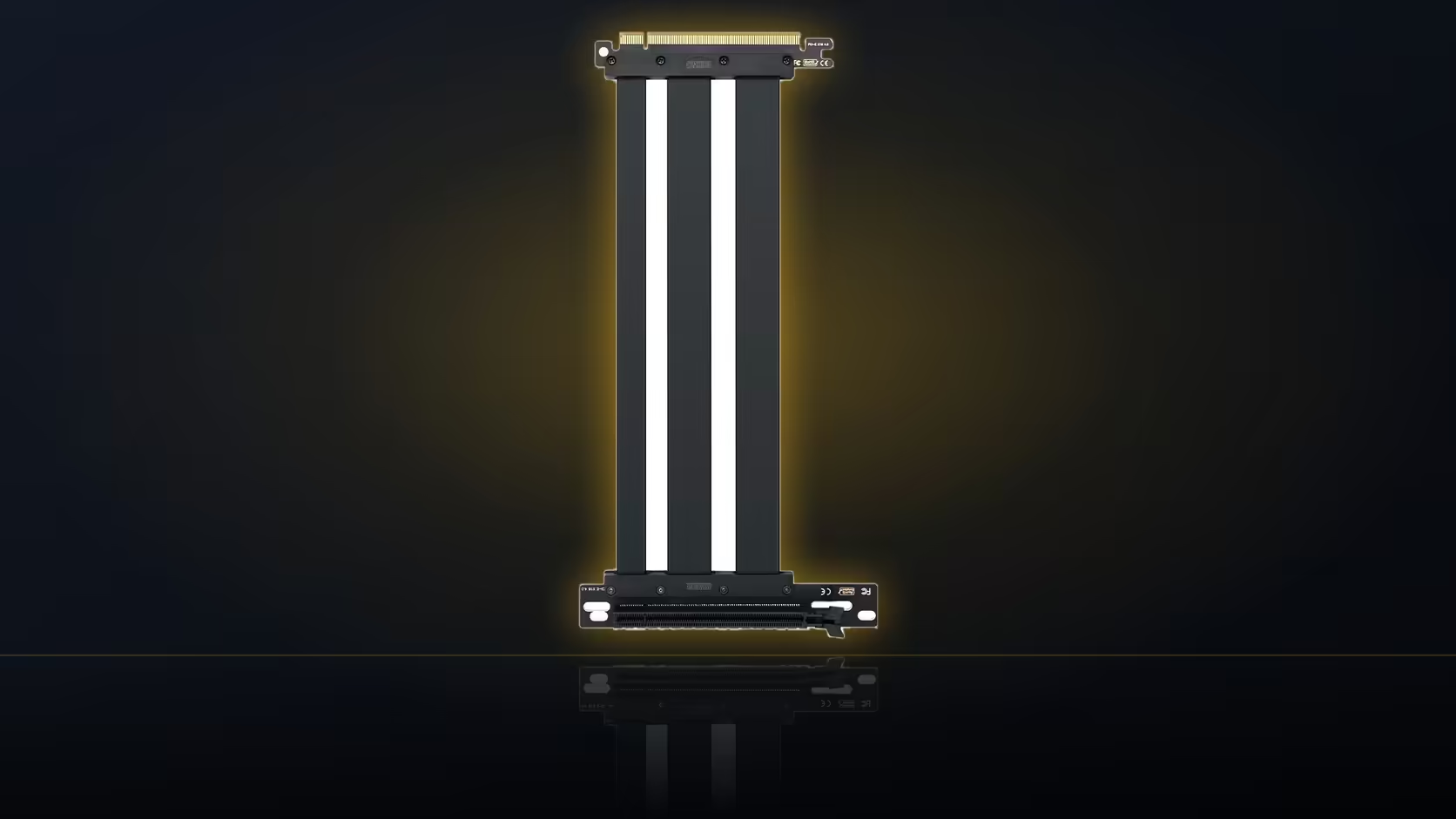
A riser cable solves a problem that sounds simple until you actually try to plan around it: it has to bridge two positions that were never designed to relate to each other. One end is fixed by the people who laid out the motherboard. The other is fixed by whoever designed the case and its bracket. The cable's job is to connect two decisions made by completely different companies, with no coordination between them.
Quick Answer
The riser spans the motherboard's fixed x16 slot position and the case's separately determined bracket position for a vertical mount. At R1,299 including VAT, the AsiaHorse cable covers up to 200mm between those two points, but neither end is something the cable itself has any control over.
🔩 Two positions, two different decision-makers
The board slot's location is entirely a motherboard design choice. Every manufacturer places their x16 slots according to their own layout priorities, balancing them against chipset placement, RAM slots, and cooling clearance, and none of that is done with vertical mounting in mind as a primary concern. Once you own the board, that position is fixed; there is no adjusting it.
The bracket position, by contrast, is a case and accessory decision, made entirely separately by whoever manufactures the chassis or the bracket itself. It reflects where that company decided a vertical card should sit relative to the side panel, the front intake, and the rest of the interior layout.
These two positions were never designed with each other in mind, because they come from different products made by different companies for different purposes. The riser cable is what has to reconcile them, and its fixed 200mm length is what decides whether that reconciliation is even possible for a given board-and-case pairing.
📏 Why the distance between them varies so much
Because neither position is standardised in relation to the other, the actual distance a riser needs to span differs considerably from one build to the next. A compact mid-tower with a bracket mounted close to the board slot might need barely half the cable's available length. A larger case with the bracket positioned higher and further across the interior can push right up against, or past, what 200mm can cover.
This is why a generic answer to "will this riser fit my build" does not really exist. The honest answer always depends on the specific board and the specific case, measured together rather than assumed from either one in isolation.
What sets the slot position, specifically
Nothing about the slot position is adjustable after the fact. It sits exactly where the board manufacturer placed it, and short of choosing a different motherboard entirely, that is fixed for the life of the build. Some boards do offer a second x16 slot, usually running at a reduced electrical configuration, and that second position can sometimes sit meaningfully closer to a typical bracket location than the primary slot does.
What sets the card position, specifically
The card's final position is determined jointly by the case's vertical mounting design and the specific bracket fitted to it. Some brackets allow a degree of adjustment in height or depth, and that small amount of play is sometimes exactly what turns a route that measured too long into one this cable actually reaches. Others are fixed, offering only the one position the case was designed around.
🔀 Using a second slot to shorten the route
Where a board offers more than one x16 slot, choosing the one physically closer to the bracket position can meaningfully shorten the route the riser has to cover, sometimes enough to turn an impossible fit into a comfortable one. This is worth checking before assuming a build will not work, since it is a free option available on many boards.
The catch is that secondary x16 slots are often wired differently to the primary one, typically running at reduced lane counts once other slots or storage are populated. That difference rarely matters for a graphics card's actual performance in most builds, but it is worth confirming against your specific motherboard's manual before relying on it, since board layouts vary considerably between manufacturers and even between models from the same maker.
🧩 Bracket adjustment as the other lever
On the case side, some brackets built for vertical mounting include a degree of adjustment, whether that is a slotted mounting pattern allowing a small shift in height, or a choice between two or three fixed positions. Checking whether your specific bracket offers this before assuming the route is fixed can be the difference between a comfortable fit and a route that falls just short.
Do this homework before the riser is even in the cart. Graphics card accessories covers the slot-side options worth comparing, and case accessories shows what a given bracket allows to adjust, since both decisions change what length cable you actually need.
⚠️ When the two positions simply do not meet
Sometimes, even with a nearer slot chosen and a bracket adjusted as far as it goes, the gap separating the board slot from the bracket position exceeds what a single 200mm cable can span. AsiaHorse offers this riser in one length only, so there is no longer variant to fall back on within this specific product. In that situation, the honest options are reconsidering the bracket, choosing a different case altogether if the build has not been finalised, or accepting that vertical mounting is not achievable for that particular pairing without a different cable entirely.
Frequently Asked Questions
What sets the board slot position?
The motherboard layout, fixed by the manufacturer and not adjustable once the board is chosen and installed.
What sets the card's final position?
The case's vertical mounting design together with the specific bracket fitted, both determined independently of the motherboard.
Why does the required cable length vary so much between builds?
Because the two positions are set by different products from different manufacturers, with no coordination between them on distance.
Can choosing a different board slot help?
Yes, if the board offers a second x16 slot nearer the bracket, though it may be wired differently and is worth checking first.
Do brackets allow position adjustment?
Some do, offering a small range of height or depth adjustment, which is worth checking before ordering the riser.
What if the two positions are simply too far apart?
This riser is sold in one 200mm length only, so the route needs shortening through slot or bracket choice, or a different cable is needed.
Trying to reconcile your board slot and bracket position?
Explore Evetech's case range for models with documented vertical mounting distances.