Quick Answer
For an RTX 5060 PC, 1440p is the better long-term choice if your monitor budget reaches R3,500 to R6,000. The card handles 1440p with DLSS 4 active comfortably, delivering 80fps to 120fps in demanding titles. Buyers prioritising competitive gaming above 200fps or on tighter budgets should choose 1080p.
What the RTX 5060 Achieves at Each Resolution 📡
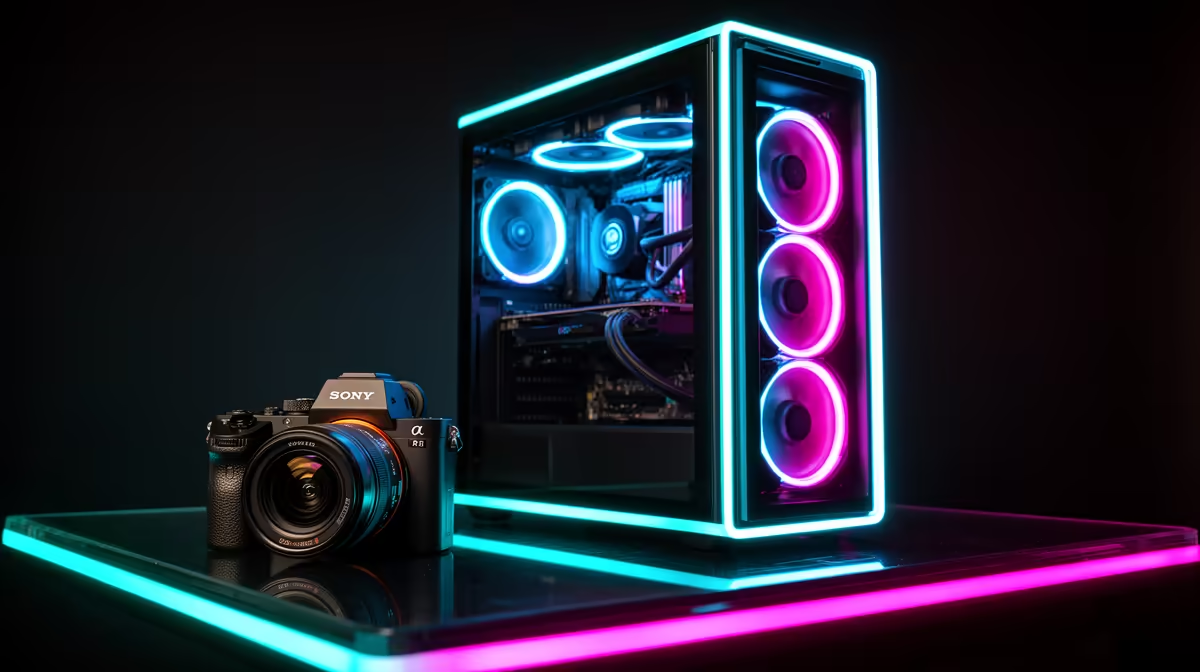
NVIDIA's RTX 5060 on Blackwell architecture carries 8GB of GDDR7 VRAM. At 1080p ultra settings, Cyberpunk 2077 returns well over 100fps with DLSS 4 enabled, and competitive titles like Valorant and Counter-Strike 2 push 200fps to 300fps, ideal for 240Hz monitors. At 1440p the card works harder: native ultra settings produce 55fps to 80fps in demanding titles, but DLSS 4 Quality mode restores this to 100fps to 130fps with image quality that rivals native rendering. Multi Frame Generation, exclusive to Blackwell, multiplies output frames using AI and is most impactful at 1440p where the frame budget benefit is greatest.
Monitor Cost at 1080p vs 1440p for SA Buyers 💰
A quality 1080p 144Hz IPS gaming monitor costs between R2,500 and R4,000 locally: fast pixel response, good colour, and FreeSync or G-Sync Compatible certification. The sweet spot for 1440p 144Hz IPS monitors sits between R3,500 and R6,000, and the extra spend buys noticeably more screen real estate and sharper image clarity at typical viewing distances of 50cm to 70cm. Text, UI elements, and game environments all look more defined at 1440p, especially on 27-inch and larger screens. At 24 inches or below, the pixel density difference is less dramatic and the 1080p case becomes stronger. Weigh the monitor premium against the rest of your build: if stepping up to 1440p means compromising on a more capable GPU, 1080p with a fast 144Hz panel is the smarter call.
How DLSS 4 Changes the Resolution Calculation 🖥️
DLSS 4 at 1080p can push frame rates that already exceed 144fps into territory offering diminishing returns unless you own a 240Hz monitor. At 1440p, DLSS 4 is far more impactful: it transforms a card delivering 70fps native into one outputting 120fps to 150fps with strong visual fidelity. This shifts the resolution equation significantly compared to previous GPU generations. An RTX 5060 running 1440p with DLSS 4 Quality mode enabled consistently outperforms the same card at native 1080p in overall visual experience, provided the monitor is capable. This makes 1440p the more future-focused choice for buyers who intend to keep their setup for three or more years.
Match Your Refresh Rate to Your Use Case ⚡
Competitive gamers prioritising maximum fps should pair their RTX 5060 with a 1080p 240Hz monitor where the card's raw performance advantage is greatest. Gamers who value visual quality over raw frame rate will get more from a 1440p 144Hz or 165Hz panel with DLSS 4 Quality mode enabled. Both are legitimate choices the RTX 5060 supports well.
FAQ
Does the RTX 5060 have enough VRAM for 1440p gaming in 2026?
The 8GB GDDR7 on the RTX 5060 is adequate for 1440p gaming with current titles at standard texture settings. Some future titles with very high-resolution texture packs may approach this limit, but for the current game library 8GB at 1440p is not a limiting factor.
Will a 1440p monitor work at 1080p if I want higher frame rates in older games?
Yes. A 1440p monitor can run at 1080p resolution natively via the GPU's output settings. The image will not be as sharp as a native 1080p panel due to integer scaling differences, but the flexibility to switch resolutions per game is a genuine advantage of owning a 1440p display.
Is a 1440p setup significantly more expensive long-term in South Africa?
The monitor is the primary extra cost: a few thousand rand more upfront versus 1080p. There are no meaningful ongoing cost differences beyond that initial monitor spend.
Choosing between 1080p and 1440p for your RTX 5060 build?
Browse Evetech's RTX 5060 gaming PC range alongside the monitor selection to find a pairing that fits your resolution target and budget.