In an RGB-led build, looks matter - but only after the basics work. Choosing a handheld gaming PC that performs and lights up keeps both boxes ticked.
Quick Answer
A handheld gaming PC makes sense in an RGB-led build where looks matter as much as airflow when you want PC games away from the desk and accept 720p to 1080p at 30 to 60 fps. Expect to spend roughly R9,000 to R18,000 locally; the screen, thumbsticks and microSD slot fail first, so budget for a case and a quality card from day one.
What A Handheld Does Well
Handhelds shine in an RGB-led build where looks matter as much as airflow. Their 7-inch class screens run 800p to 1080p, and a 15W to 30W chip holds 30 to 60 fps in most titles if you drop to medium settings and cap the frame rate to save battery. Battery life is the honest limit: 1.5 to 3 hours in demanding games, 4 to 6 hours in lighter ones. For travel and study breaks that is fine, but it is not a desktop replacement for long sessions or competitive 1440p play.
What Breaks First And How To Protect It
On cheaper handhelds the same parts wear out in a predictable order. Thumbstick drift shows up first after heavy use; the microSD slot and budget cards corrupt next, often from heat; then the screen picks up scratches and the USB-C port loosens. None of that needs a new device.
- Buy a hard case (around R250 to R600) on day one
- Use a branded A2-rated microSD card, not the cheapest no-name one
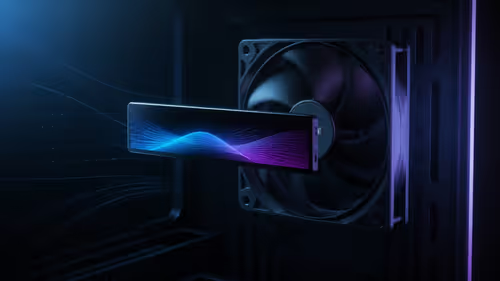
- Add a fast NVMe upgrade (roughly R600 to R1,400 for 1TB) rather than relying on the slot
- Keep it out of direct summer sun, which cooks the battery and storage
frame rate to 40 or 45 fps and the wattage to 15W for double the battery life with barely noticeable smoothness loss in most single-player games.
Budget, Balanced And Premium
Split the choice into three honest tiers. Budget covers the core job and nothing more; balanced adds the one or two features you will actually use; premium only pays back if longevity or a specific need demands it.
- Budget: does the main task reliably, skip extras
- Balanced: the sweet spot for most buyers
- Premium: worth it only for a clear, named need
FAQ
Is a handheld better than a budget gaming laptop?
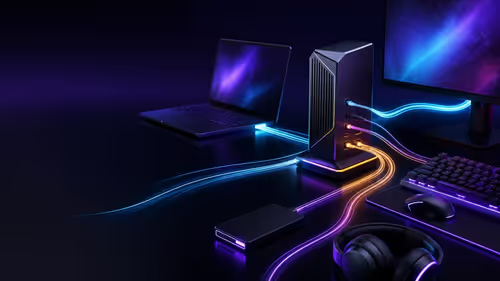
For pure portability and couch play, yes. For coursework, typing and a bigger screen, a gaming laptop in the R15,000 to R22,000 range does more. Many SA buyers pair a handheld with a docking station for both.
How long do handheld batteries really last?
Plan for 1.5 to 3 hours in heavy games and 4 to 6 hours in light or capped titles. Lowering wattage to 15W and brightness below 70% is the single biggest way to stretch a charge.
Can I upgrade the storage myself?
Most current handhelds take a single 2280 or 2230 NVMe SSD plus a microSD slot. A 1TB NVMe runs around R600 to R1,400 locally and is a safer long-term store than relying on a microSD card alone.
Browse the handheld gaming PCs stocked at Evetech, then add a hard case and a 1TB NVMe before your first long trip.