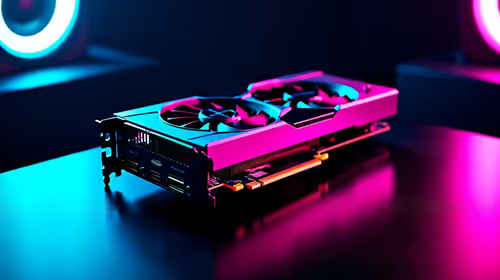
A rear bracket carrying five or six connectors looks generous until you actually try to build a desk around it, because not every one of those ports behaves the same way once a second or third monitor joins the first. The real planning question behind any output configuration claim is not how many ports a card has, it is which of them can share a single connection and which cannot.
Quick Answer
DisplayPort can carry more than one monitor down a single cable through daisy-chaining; HDMI cannot, so every HDMI screen needs its own dedicated port. That single difference, not the raw port count printed in marketing copy, is what actually decides how many monitors a desk can support and in what arrangement. A card able to do this properly, the ROG Astral Edition 20, costs R119,999.
🔀 Daisy-chaining: what it actually buys you
DisplayPort's Multi-Stream Transport feature lets one cable run from the card to a first monitor, then a second cable continue from that monitor's own output to a next screen, and sometimes a third screen after that. This only works if each monitor in the chain, other than the last one, has its own DisplayPort output built in, not just an input, since a monitor with no output has nowhere to pass the signal onward.
HDMI has no equivalent. Every HDMI-connected monitor is its own dedicated run back to the card, full stop, which is why a desk mixing HDMI and DisplayPort screens often uses more physical ports on the HDMI side even with fewer monitors connected there.
📉 Where chaining runs out of bandwidth
A chained connection splits the single port's total bandwidth across every monitor riding it, it does not multiply the port's capacity. Two 1080p screens at 60Hz chained off one DisplayPort output share that port comfortably, since neither one needs much of the available bandwidth on its own.
Two 4K screens at 144Hz chained the same way is a different story, because a single one of those screens can already use most of what a current DisplayPort output carries. Chaining rarely works cleanly once the combined demand of the chained monitors approaches what the port could deliver to just one of them, which is the calculation worth doing before assuming any four-monitor plan is as simple as counting cables.
🖥️ Planning the desk from the monitors backward
List every monitor you intend to run and its resolution and refresh rate, then sort that list from most demanding to least. Connect the most demanding panel directly to its own port every time, since that is the one screen where a shared or chained connection is most likely to show its limits.
For the remaining, lighter screens, check each one's own manual for whether it carries a DisplayPort output, not only an input, before assuming a chain is possible. A screen limited to 1080p at 60Hz for chat or reference material is the easy case; two of those chained together off one port rarely strain anything.
Where a monitor has no DisplayPort output at all, or where its input is HDMI-only, it needs a dedicated port regardless of how the rest of the desk is wired. This is also where the exact port count actually matters: the precise arrangement for this model is the one figure genuinely worth checking against your finished monitor list, since it is set by the card's design rather than a rule this article can state for every model in the family.
🎯 A worked example
Say the plan is one primary 4K gaming monitor, one 1440p reference screen, and two small 1080p panels for chat and system stats. The 4K panel gets its own direct port without question. The 1440p screen, if it carries DisplayPort output, can often chain from the 4K panel's pass-through without a visible penalty, since the combined demand still sits well inside one port's headroom. The two 1080p panels, being the lightest load on the desk, are the safest candidates to share a second chained connection, or to sit on HDMI if no DisplayPort output is available on either.
That order, heaviest connected directly and lightest chained last, is the planning method itself, and it holds regardless of the specific card or monitors involved.
🛒 Choosing panels that actually support chaining
Not every monitor marketed as high-end includes a DisplayPort output built in, and this is worth checking before the rest of the plan is built around it. Premium panels, including the OLED monitor range, more commonly carry the output needed for pass-through than entry-level screens do, since the feature targets exactly the kind of buyer assembling a multi-monitor desk.
Where a monitor genuinely lacks the output needed to continue a chain, a small monitor accessory such as a compact hub can substitute, though it introduces the bandwidth-splitting trade-off already covered above rather than avoiding it. Treat a hub as the fallback for a screen that cannot chain natively, not the default plan for a desk that could otherwise be wired directly.
Frequently Asked Questions
Can any DisplayPort monitor be chained to another?
Only if it has its own DisplayPort output as well as an input. A monitor with input only can receive a chained signal but cannot pass one on to a further screen.
Does chaining monitors reduce picture quality?
Not directly, but it divides available bandwidth, which can force a lower resolution or refresh rate on the chained screens if their combined demand exceeds what the port can deliver in full to each.
Is it better to use a hub or daisy-chain monitors natively?
Native chaining through each monitor's own output is generally simpler and avoids adding another device to the setup; a hub is the fallback when your monitors do not support pass-through themselves.
How do I know if my card supports enough chained or direct connections for my plan?
Check that specific card's own listing for its exact port mix, since this varies by model even within one generation, and plan your heaviest monitor onto a direct connection regardless of what the rest allows.
Does USB-C change any of this?
USB-C carrying a DisplayPort signal behaves the same as a standard DisplayPort connection for chaining purposes, provided both ends of the cable and any hub involved support that mode.
Ready to wire a multi-monitor desk that actually works the way you planned it?
Sort your monitors by demand, connect the heaviest directly, and chain only the lightest.