Quick Answer
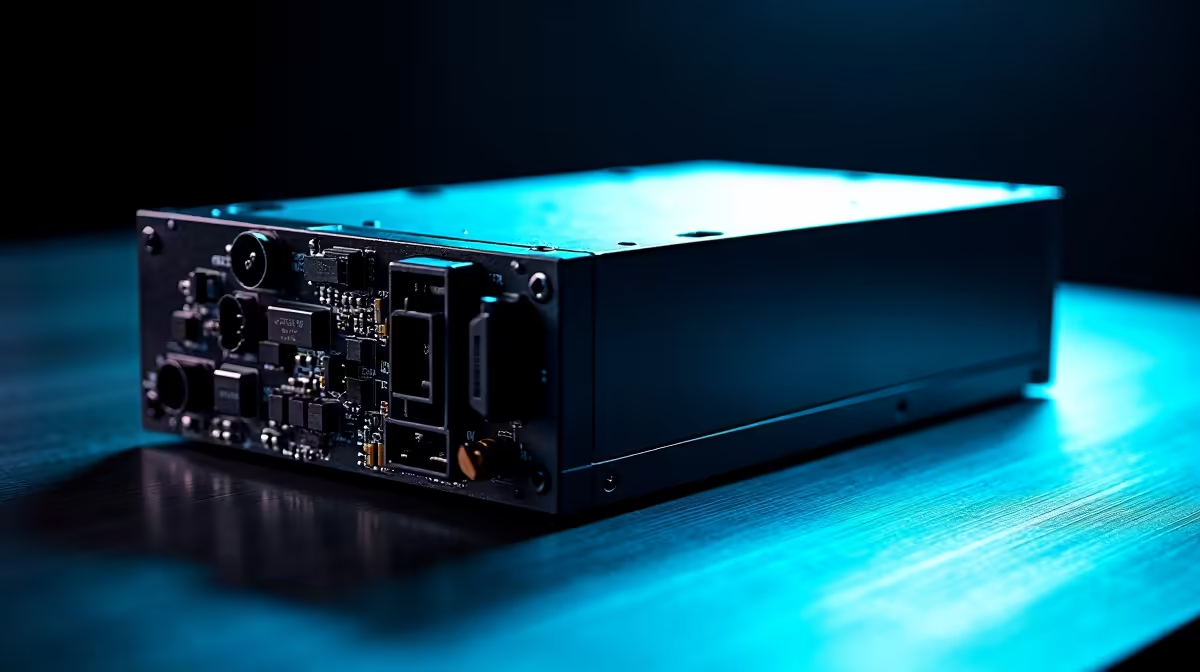
Gallium nitride (GaN) MOSFETs switch faster and with less conduction loss than silicon MOSFETs, allowing PSU designers to operate at higher frequencies with smaller passive components, higher power density, and efficiency ratings pushing into the Platinum and Titanium range. In PC PSUs, GaN is primarily used in the primary-side switching stage of high-end units.
Why GaN Outperforms Silicon in Power Conversion ⚡
Traditional silicon MOSFETs have a gate charge that limits switching speed. Switching faster reduces transformer core size but increases switching losses, so designers face a trade-off. GaN MOSFETs have far lower gate charge, typically one-quarter to one-eighth of equivalent silicon parts, and near-zero reverse recovery time, allowing operation at 300 kHz to 1 MHz without the switching loss penalty that would plague a silicon design at those frequencies. A 1000W GaN PSU can achieve 94 to 96% efficiency at 50% load, comfortably reaching Titanium-tier numbers versus 92% for a comparable silicon Platinum design. Units cost R5,000 to R9,000 in South Africa and are noticeably more compact than equivalent silicon designs.
GaN PSU Architecture in Practice 🔧
Consumer PC PSUs using GaN typically employ a GaN full-bridge LLC resonant converter on the primary side driving a high-frequency transformer, with silicon synchronous rectifiers on the secondary side. This approach reduces switching node ringing and EMI compared to early high-frequency silicon designs. A 1000W GaN PSU may have the same chassis depth as a conventional 750W silicon unit, making it useful in tighter builds. Manufacturers including Corsair and SilverStone have GaN-primary units currently available at Evetech.
Reliability and SA Climate Considerations 🌡️
GaN threshold voltage shifts more with temperature than silicon. Reputable PSU designers mitigate this with careful PCB thermal management and conservative gate-drive design. In South African conditions where Pretoria can reach 35 to 38 degrees Celsius outdoors and PSU internal ambient may reach 45 to 50 degrees Celsius, quality GaN PSUs rated to full load at 40 to 50 degrees Celsius ambient remain within specification. Cheap GaN units from unverified brands may cut corners on thermal design. Stick to units from established brands stocked at Evetech with published full-load temperature ratings.
GaN Units Need Good Case Airflow ⚡
GaN PSUs run at higher switching frequencies with smaller internal capacitors, leaving less energy storage to buffer brief thermal events. Ensure your case has a filtered intake vent directed toward the PSU with at least one 120mm fan in positive pressure configuration, especially in a SA summer.
FAQ
Are GaN PSUs safe and reliable for everyday PC use?
Yes, provided they come from reputable manufacturers. GaN power conversion has been used in commercial and industrial supply for over a decade. Consumer PC PSUs using GaN primary switches have shipped since around 2022 with a solid reliability record from established brands.
Do GaN PSUs require special cables or connectors?
No. GaN refers to internal switching technology only. External connectors, cable types, and ATX pinout are identical to any other ATX PSU. A GaN unit may come with ATX 3.1 certification and a 12V-2x6 connector, but those are ATX standard choices, not GaN requirements.
Will GaN PSUs become mainstream in South Africa?
Likely over the next three to five years as device costs fall. Currently, GaN-primary designs concentrate in the R4,500 and above segment locally. Mid-range adoption should accelerate as production volumes increase and rand-denominated import pricing adjusts.
Looking for a high-efficiency, compact power supply?
Evetech stocks premium PSUs including advanced high-efficiency designs suited to next-gen builds. Explore the power supply range at Evetech for options in the 850W to 1200W class.