


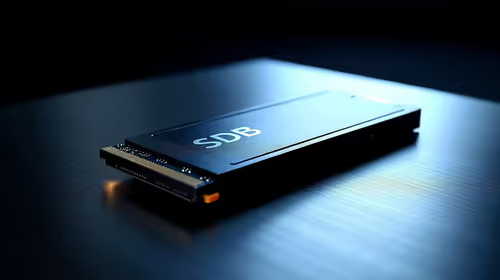
PCIe 5.0 vs PCIe 4.0 for Video editing in 4k in SA
PCIe 5.0 vs PCIe 4.0 for video editing in 4k is mainly about fit, features, compatibility, cost, and upgrade path, not one automatic winner. SA buyers should match the choice to the setup.
Read moreMechanical switches shape actuation feel and feedback; daily reliability also depends on button construction. A label cannot describe the entire experience. The R499 NIRO B40 uses durable mechanical switches beside its optical sensor and three connection paths.

Every click passes through a button, switch and shell before the game responds. A clear view of mechanical mouse switches considers actuation feel, repeated use and whole-device construction without turning the switch label into an automatic verdict. The R499 NIRO B40 uses durable mechanical switches beside optical tracking and tri-mode connectivity.
Mechanical mouse switches generally provide distinct actuation feedback that can make repeated clicks easier to recognise. At R499, the NIRO B40 combines durable mechanical switches with six DPI levels and three connection routes, so click feel should be judged as part of the full control system.
The switch supplies the actuation, but the button above it changes leverage, travel and sound. Shell shape determines finger position, while grip changes how much force reaches the control. This is why the same switch category can feel different across mouse designs.
Press the main buttons slowly to identify the transition, then repeat typical game and work patterns. A useful click feels distinct without making the finger brace before every input. Long sessions reveal more than a few demonstration presses.
Evetech's gaming mouse range lets buyers place switch type beside button layout, sensor and connection choices.
The NIRO B40's mechanical switches are built for durable operation, while button construction, shell support and everyday treatment remain part of reliability. Keep liquids away, avoid unnecessary impact and transport the mouse so its buttons are not held under pressure.
Repetition should remain comfortable. Test click-and-drag actions, rapid alternating presses and ordinary browsing. If the hand becomes tense, assess grip and shape before deciding that stronger feedback is the problem.
The mouse's R499 price places it within Evetech's gaming mice below R1,000. Compare build qualities as a package rather than pricing a switch in isolation.
The moment of actuation should not push the pointer away from its target. Pick a controllable stage from the NIRO B40's six DPI choices, place the cursor on a small object and click repeatedly without letting the grip shift. Lowering sensitivity may reveal technique, but comfort and button leverage also deserve attention.
Its precision optical sensor reaches the screen through the chosen DPI setting. Use a consistent pad and keep host pointer options stable while assessing click movement. A satisfying sound cannot replace predictable tracking.
Mechanical actuation remains the common input whether the NIRO B40 uses 2.4GHz, Bluetooth or a cable. Connection changes should therefore be tested without altering sensitivity or hand position. If the click feels physically identical but the application response changes, investigate the host or link separately.
Windows, macOS, iOS and Android support allows the mouse to move among computer and mobile tasks. The wireless mouse collection can help buyers compare whether this cross-platform flexibility belongs with the switch character they prefer.
The 500mAh battery supports cable-free use, while wired mode provides a direct path. These ownership details matter because a mouse judged only through click feel can still fit the desk poorly.
Check where the index and middle fingers rest, whether the thumb must squeeze the shell and whether the wrist stays neutral. A good switch becomes easier to appreciate when the hand reaches it without strain. Return to this assessment after extended use, not only during setup.
Mechanical actuation happens physically before software reacts. Test clicks on the desktop and in more than one application. If the button feels normal but one program behaves differently, inspect that program's control binding rather than changing the mouse connection immediately.
Use the cable as a direct comparison only after preserving the same DPI and surface. This reveals whether the response difference follows the link while the physical click remains constant. A careful sequence protects three distinct observations: finger feedback, pointer position and software action.
Repeated selection in a strategy title, a held click during dragging and short rapid presses each stress control differently. Try all three without chasing an artificial click-count test. The useful question is whether actuation remains distinct and comfortable through tasks you actually perform.
Pay attention to release as well as press. A button that feels comfortable on the way down should also let the finger reset without lifting the hand or shifting grip. Smooth recovery supports the next input.
Store the mouse where objects cannot hold its buttons down, and keep the shell free from debris around the control gaps. These simple habits respect the assembly without pretending they create an unlimited lifetime. Reliability remains a whole-device outcome.
If another person shares the mouse, compare their grip without forcing the same conclusion. Different finger positions change leverage and can make identical actuation feel lighter or firmer. The switch has not changed; the hand's relationship with the button has. A household choice should therefore consider both users during sustained tasks.
Keep each user's preferred DPI stage separate during that comparison, so sensitivity does not distort the judgement of physical click character.
Choose three ordinary actions: selecting a small interface control, issuing repeated in-game inputs and dragging an object while holding a button. Complete each at a relaxed pace, then write down actuation clarity, release comfort, unwanted double inputs and whether the pointer moved during the press. A short journal across several sessions reveals more than rapid clicking for a few seconds.
Keep the mouse on a stable surface and select a familiar DPI stage before comparing the buttons. If the cursor shifts at actuation, repeat with less grip pressure and a more centred finger position. Mechanical feedback can feel precise while a tense hand still disturbs aim. The NIRO B40 combines its mechanical switches with a precision optical sensor, so movement and click quality should be assessed together without confusing their roles.
The finger presses the external button, the shell transfers force, the switch actuates and the button must recover for the next input. Shape, leverage and hand position affect every part of that path. Compare the main buttons during sustained use, not just at the easiest centre point. If two people share the mouse, let each use a natural grip and record separate results rather than forcing one hand position.
Avoid translating durable into an invented click count. Protect the assembly by storing the mouse without weight on its buttons, keeping control gaps clean and carrying it so the cable and receiver cannot strike the shell.
The same click hardware operates through the 2.4GHz receiver, Bluetooth and wired modes on supported Windows, macOS, iOS and Android hosts. Six DPI choices reach 10,000, while a 500mAh battery powers wireless sessions. Repeat one journal task after changing hosts to confirm that platform settings have not altered the movement context. Switch value comes from comfortable, repeatable actuation within the buyer's real workload, not from the mechanical label in isolation.
It usually provides a distinct actuation point and feedback. Button and shell construction shape the final feel.
No. Mechanical controls still depend on the complete button assembly, careful handling and ordinary wear over time.
Yes. A grip that shifts during actuation can move the pointer, especially around small targets.
No. Hand position and button leverage determine how the switch feels in actual use.
No. The same hardware operates through the receiver, Bluetooth and cable paths.
It is R499 with mechanical switches, optical tracking, six DPI positions and tri-mode connectivity.
Ready to judge the click through a full session instead of one press? Browse Evetech's gaming mice and compare switch feedback only after shape, tracking and connection needs join the test.
It usually provides a distinct actuation point and feedback. Button and shell construction shape the final feel.
No. Mechanical controls still depend on the complete button assembly, careful handling and ordinary wear over time.
Yes. A grip that shifts during actuation can move the pointer, especially around small targets.
No. Hand position and button leverage determine how the switch feels in actual use.
No. The same hardware operates through the receiver, Bluetooth and cable paths.
It is R499 with mechanical switches, optical tracking, six DPI positions and tri-mode connectivity.
PCIe 5.0 vs PCIe 4.0 for video editing in 4k is mainly about fit, features, compatibility, cost, and upgrade path, not one automatic winner. SA buyers should match the choice to the setup.
Read more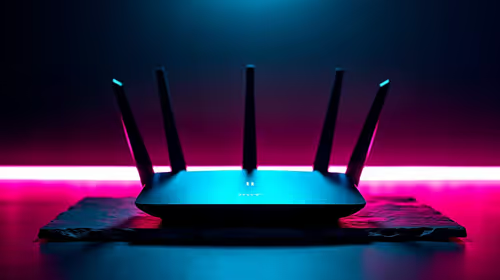
Wi-Fi 7 vs Wi-Fi 6e for competitive esports comes down to router support, latency goals, device compatibility, and coverage. SA buyers should match the choice to the real network setup.
Read more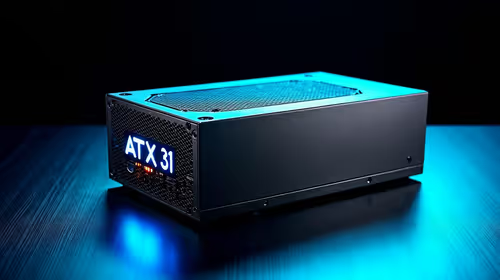
ATX 3.1 vs ATX 3.0 for mMO and live-service games buyers - what changes is mostly about compatibility, budget, upgrade path, and setup fit. SA buyers should check device support and real needs before expecting a clear win from either option.
Read more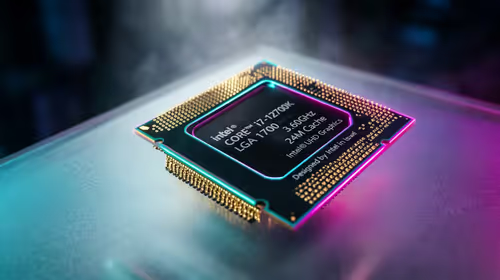
LGA 1851 vs LGA 1700 can affect Twitch and YouTube streaming when gaming and encoding share CPU resources. For SA creators, the real-world difference depends on encoder choice, memory support, motherboard cost, thermals, and upgrade plans.
Read more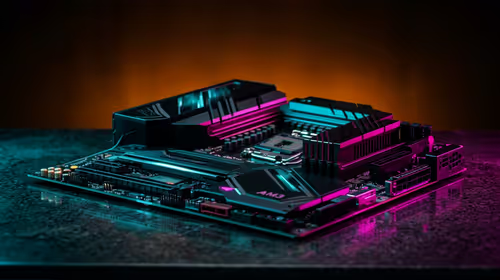
X870E vs X670E for aaa single-player gaming is mainly about fit, features, compatibility, cost, and upgrade path, not one automatic winner. SA buyers should match the choice to the setup.
Read more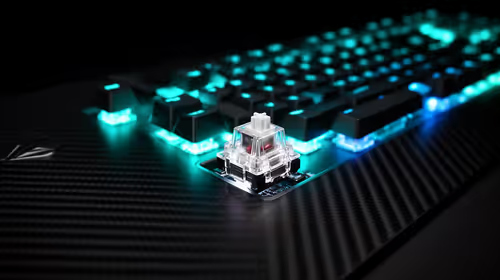
Hall Effect switches vs Mechanical switches for mMO and live-service games is mostly about compatibility, budget, upgrade path, and setup fit. SA buyers should check device support and real needs before expecting a clear win from either option.
Read more
A fake 113GB GTA VI ISO reportedly used empty padding around a small malware payload. SA gamers should delete unofficial builds, keep Windows security active and wait for official channels.
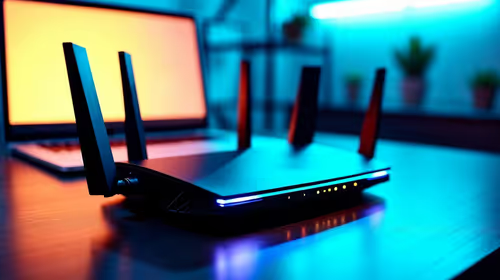
Wi-Fi 6E vs Wi-Fi 6 matters for 4K video editing when files move across a network. The real-world difference between Wi-Fi 6E and Wi-Fi 6 for video editing in 4K depends on NAS access, cloud uploads, router range, and SA creator workflows.

The difference between PCIe 5.0 and PCIe 4.0 for SA gamers is mostly bandwidth headroom. Compare GPU slot needs, NVMe speed, motherboard support, and upgrade timing before paying extra for a newer platform.

Gaming PC stuck pixel checks in South Africa should confirm the monitor fault first. Use colour tests, screenshot comparison, cable swaps, display menu checks, and clear photos before deciding on support.

Shokz OpenFit Air 2 earbuds weigh 7.2g each and use a redesigned dual-driver open-ear layout. SA buyers should choose them for comfort and awareness, not maximum isolation.

AMD's current driver now lists a Radeon RX 9050 4GB, while product coverage details a narrowed memory system. SA buyers should weigh the low VRAM ceiling against current local Radeon options.

Samsung Display has demonstrated a 16-inch 2.5K OLED laptop panel running at 300Hz. SA buyers should wait for a named notebook, full panel specifications and a local price before planning an upgrade.

Microsoft says some Windows 11 game crashes after recent updates are linked to RGB-related drivers. Affected SA gamers should confirm the update and driver before using the published registry workaround.
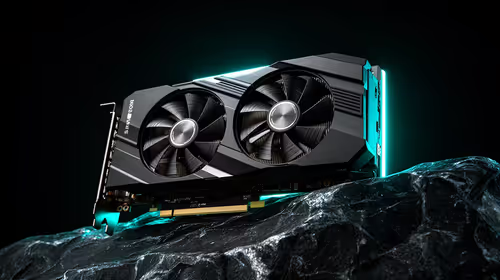
RTX 5090 on a 650W PSU is a tight pairing with very limited headroom. For SA gaming PCs, focus on total system draw, PSU quality, connector support, CPU choice, and avoid OC plans unless the full build is carefully power-limited.
PCIe 5.0 vs PCIe 4.0 for video editing in 4k is mainly about fit, features, compatibility, cost, and upgrade path, not one automatic winner. SA buyers should match the choice to the setup.
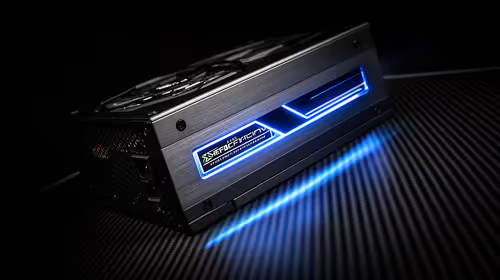
850W PSU safety for RTX 5090 is plausible with a quality unit and balanced parts. In SA, confirm connector support, CPU power draw, case airflow, PSU age, and spare capacity before building around 850W.
Wi-Fi 7 vs Wi-Fi 6e for competitive esports comes down to router support, latency goals, device compatibility, and coverage. SA buyers should match the choice to the real network setup.