



PCIe 5.0 vs PCIe 4.0 for Video editing in 4k in SA
PCIe 5.0 vs PCIe 4.0 for video editing in 4k is mainly about fit, features, compatibility, cost, and upgrade path, not one automatic winner. SA buyers should match the choice to the setup.
Read moreTri-mode means a mouse can connect through dedicated 2.4GHz wireless, Bluetooth or a USB-C cable. Each path serves a different role: performance play, convenient device access or direct wired operation.

Tri-mode connectivity gives one mouse three distinct routes rather than three identical ways to play. Understanding a 2.4GHz, Bluetooth and USB-C mouse means assigning performance wireless, convenient pairing and direct wired operation to the situations they serve best. The R2,399 Wireless MG packages all three into a 56g magnesium device with an 8,000Hz ceiling.
Use dedicated 2.4GHz for competitive gaming, Bluetooth for ordinary access to a compatible secondary device, and USB-C for wired use or charging. The R2,399 Wireless MG includes this tri-mode set with a 33,000 DPI sensor and a 120-hour battery specification, so profiles can follow each connection's role.
Dedicated wireless uses the included receiver to create the gaming link. Place that receiver close to the mouse area and clear of dense obstructions. Hiding it behind a metal PC case may produce a tidier photograph but a less dependable radio path.
Use a direct USB port for the initial setup and avoid unnecessary adapters. Then run repeated fast sweeps and clicks in the intended game. Keep polling, DPI and sensitivity fixed while moving the receiver so placement remains the only variable.
Mark the working receiver location before tidying the desk. Cable management should preserve the proven radio route rather than returning the dongle to an obstructed rear port. If an extension is used, secure it so routine desk movement does not change distance.
An 8,000Hz profile places additional demands on the input and radio path. Watch frame-time behaviour as well as tracking because a processing hitch can feel similar to a connection interruption. If the maximum is not stable, test intermediate rates before changing the entire desk.
Evetech's wireless mouse category supplies broader context for receiver-based gaming designs.
Bluetooth is useful when a laptop, tablet or second computer needs routine pointer control without moving the dedicated receiver. Pair it once, give the device a recognisable name and remove stale duplicate entries if switching becomes confusing.
Do not assume that Bluetooth mirrors the highest polling behaviour of the performance path. Its role is convenient access, and that is valuable on a mixed-use desk. A work device can remain paired while 2.4GHz belongs to the gaming PC.
Switch only after saving any open work and confirm which screen is receiving input. This simple habit prevents a click intended for one device from landing on another during transitions.
Pairing records can become untidy after operating-system reinstalls or device renaming. Remove only stale entries that are clearly duplicated, then reconnect once. A clean device list makes it obvious which host should respond.
Keep a modest, familiar DPI across Bluetooth and 2.4GHz unless the secondary device has a specific scaling need. Large sensitivity jumps make the connection switch feel like a tracking change and complicate diagnosis.
USB-C supplies a direct wired route. It can keep the mouse usable during charging and provides a valuable diagnostic comparison when 2.4GHz behaviour is uncertain. Route the cable with enough slack that it does not pull against the light shell.
If a tracking problem disappears over USB-C while game settings remain fixed, inspect receiver placement and wireless routing. If the fault remains, sensor surface, polling load or the game path deserves attention. Wired comparison removes one entire class of uncertainty.
Plan a regular charge point before a long session rather than waiting for an urgent warning. The product's 120-hour battery figure is context for the battery system, while connection mode, polling and activity shape practical intervals.
Run one normal charge cycle and note the indicator before assuming a single percentage change signals abnormal behaviour. Battery displays can update in steps, so comparable start and finish observations are more useful than watching every minute.
During wired play, prevent the cable from scraping the pad edge or pulling at an angle. The direct route should remove wireless uncertainty, not introduce a mechanical force that changes the feel of 56g handling.
The gaming mouse department helps compare wired and wireless flexibility across other shapes.
Create names based on purpose: Match for 2.4GHz high polling, Work for the Bluetooth device and Cable for direct diagnosis or charging. Keep DPI stages intentional and avoid switching sensitivity merely because the connection changes.
The Wireless MG's MARKSMAN S 33K sensor provides up to 33,000 DPI, but no route requires selecting that maximum. A controllable scale should travel with the user, while report rate can change according to workload and PC stability.
Test profile switching after a restart and after waking the secondary device. A software arrangement is dependable only if it returns predictably across the transitions that happen during an ordinary week.
If a game ignores the intended profile, open the mouse software and confirm the active assignment before altering the connection. This keeps a profile fault from being misdiagnosed as radio failure.
Buyers evaluating the feature tier can examine gaming mice over R2,000. The magnesium Wireless MG at R2,399 is the correct 56g reference for this connection architecture.
Record which receiver, port and paired device belong to each profile. On a desk with several similar dongles and USB cables, that note prevents accidental swaps. A small label can be more useful than repeatedly rebuilding software settings.
Add the chosen polling rate and charging day to the map. The result is a complete operating plan: where input travels, which device receives it and when the battery returns to USB-C.
After the map works for a week, remove obsolete pairings and labels that no longer serve a device. A concise connection plan is easier to maintain than a history of every temporary setup.
It means the device supports dedicated 2.4GHz wireless, Bluetooth and a USB-C wired path, each suited to a different use.
Its dedicated receiver route is designed for gaming use and should be positioned carefully for stable high-rate reporting.
It provides convenient control for a compatible secondary device without moving the gaming receiver from the main PC.
It supplies charging, continued wired use and a direct diagnostic route that removes the radio link from troubleshooting.
No. Performance play, easy device access and direct operation have different priorities, which is the reason tri-mode is useful.
The Wireless MG combines a 56g magnesium body with 2.4GHz, Bluetooth and USB-C connectivity at that price.
Name profiles clearly, pair devices once, record the receiver port and confirm the active screen before sending input.
Ready to turn three connection labels into a tidy device plan? Browse Evetech's wireless gaming mice and assign the receiver, Bluetooth pairing and USB-C cable to the jobs each handles most reliably.
It means the device supports dedicated 2.4GHz wireless, Bluetooth and a USB-C wired path, each suited to a different use.
Its dedicated receiver route is designed for gaming use and should be positioned carefully for stable high-rate reporting.
It provides convenient control for a compatible secondary device without moving the gaming receiver from the main PC.
It supplies charging, continued wired use and a direct diagnostic route that removes the radio link from troubleshooting.
No. Performance play, easy device access and direct operation have different priorities, which is the reason tri-mode is useful.
The Wireless MG combines a 56g magnesium body with 2.4GHz, Bluetooth and USB-C connectivity at that price.
Name profiles clearly, pair devices once, record the receiver port and confirm the active screen before sending input.
PCIe 5.0 vs PCIe 4.0 for video editing in 4k is mainly about fit, features, compatibility, cost, and upgrade path, not one automatic winner. SA buyers should match the choice to the setup.
Read more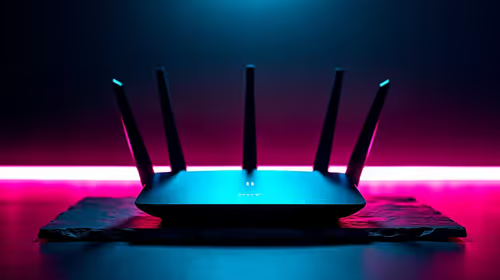
Wi-Fi 7 vs Wi-Fi 6e for competitive esports comes down to router support, latency goals, device compatibility, and coverage. SA buyers should match the choice to the real network setup.
Read more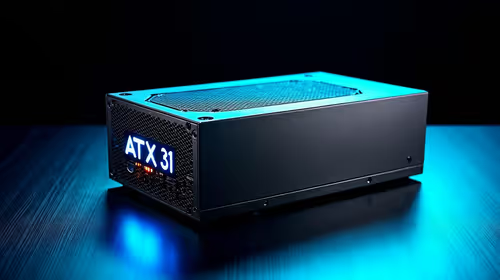
ATX 3.1 vs ATX 3.0 for mMO and live-service games buyers - what changes is mostly about compatibility, budget, upgrade path, and setup fit. SA buyers should check device support and real needs before expecting a clear win from either option.
Read more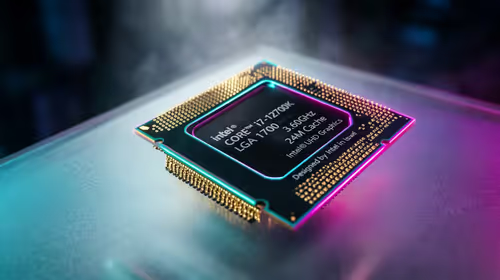
LGA 1851 vs LGA 1700 can affect Twitch and YouTube streaming when gaming and encoding share CPU resources. For SA creators, the real-world difference depends on encoder choice, memory support, motherboard cost, thermals, and upgrade plans.
Read more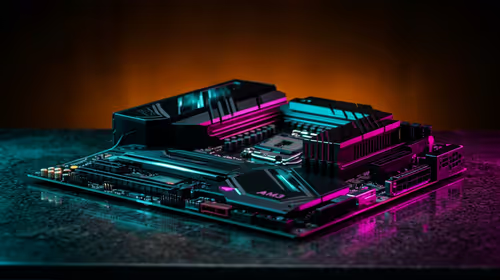
X870E vs X670E for aaa single-player gaming is mainly about fit, features, compatibility, cost, and upgrade path, not one automatic winner. SA buyers should match the choice to the setup.
Read more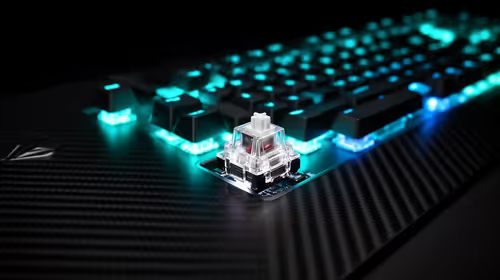
Hall Effect switches vs Mechanical switches for mMO and live-service games is mostly about compatibility, budget, upgrade path, and setup fit. SA buyers should check device support and real needs before expecting a clear win from either option.
Read more
A fake 113GB GTA VI ISO reportedly used empty padding around a small malware payload. SA gamers should delete unofficial builds, keep Windows security active and wait for official channels.

Wi-Fi 6E vs Wi-Fi 6 matters for 4K video editing when files move across a network. The real-world difference between Wi-Fi 6E and Wi-Fi 6 for video editing in 4K depends on NAS access, cloud uploads, router range, and SA creator workflows.

The difference between PCIe 5.0 and PCIe 4.0 for SA gamers is mostly bandwidth headroom. Compare GPU slot needs, NVMe speed, motherboard support, and upgrade timing before paying extra for a newer platform.

Gaming PC stuck pixel checks in South Africa should confirm the monitor fault first. Use colour tests, screenshot comparison, cable swaps, display menu checks, and clear photos before deciding on support.

Shokz OpenFit Air 2 earbuds weigh 7.2g each and use a redesigned dual-driver open-ear layout. SA buyers should choose them for comfort and awareness, not maximum isolation.

AMD's current driver now lists a Radeon RX 9050 4GB, while product coverage details a narrowed memory system. SA buyers should weigh the low VRAM ceiling against current local Radeon options.

Samsung Display has demonstrated a 16-inch 2.5K OLED laptop panel running at 300Hz. SA buyers should wait for a named notebook, full panel specifications and a local price before planning an upgrade.

Microsoft says some Windows 11 game crashes after recent updates are linked to RGB-related drivers. Affected SA gamers should confirm the update and driver before using the published registry workaround.
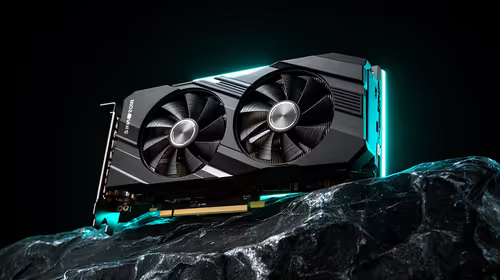
RTX 5090 on a 650W PSU is a tight pairing with very limited headroom. For SA gaming PCs, focus on total system draw, PSU quality, connector support, CPU choice, and avoid OC plans unless the full build is carefully power-limited.
PCIe 5.0 vs PCIe 4.0 for video editing in 4k is mainly about fit, features, compatibility, cost, and upgrade path, not one automatic winner. SA buyers should match the choice to the setup.
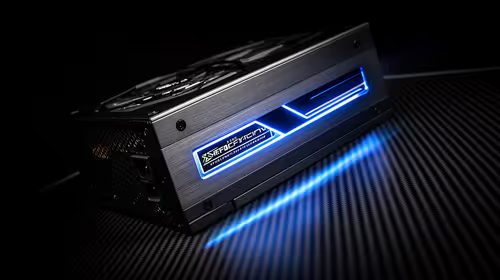
850W PSU safety for RTX 5090 is plausible with a quality unit and balanced parts. In SA, confirm connector support, CPU power draw, case airflow, PSU age, and spare capacity before building around 850W.
Wi-Fi 7 vs Wi-Fi 6e for competitive esports comes down to router support, latency goals, device compatibility, and coverage. SA buyers should match the choice to the real network setup.