You’re deep into a boss fight in Elden Ring on your handheld, the final blow is moments away... and a bright red low-battery icon flashes on screen. Heartbreak. We’ve all been there. This is where understanding a crucial piece of tech saves the day: USB-C Power Delivery (PD). It’s the unsung hero behind modern handheld gaming, ensuring you spend more time playing and less time tethered to a wall, wondering why your console is charging so slowly.
What is USB-C Power Delivery Anyway?
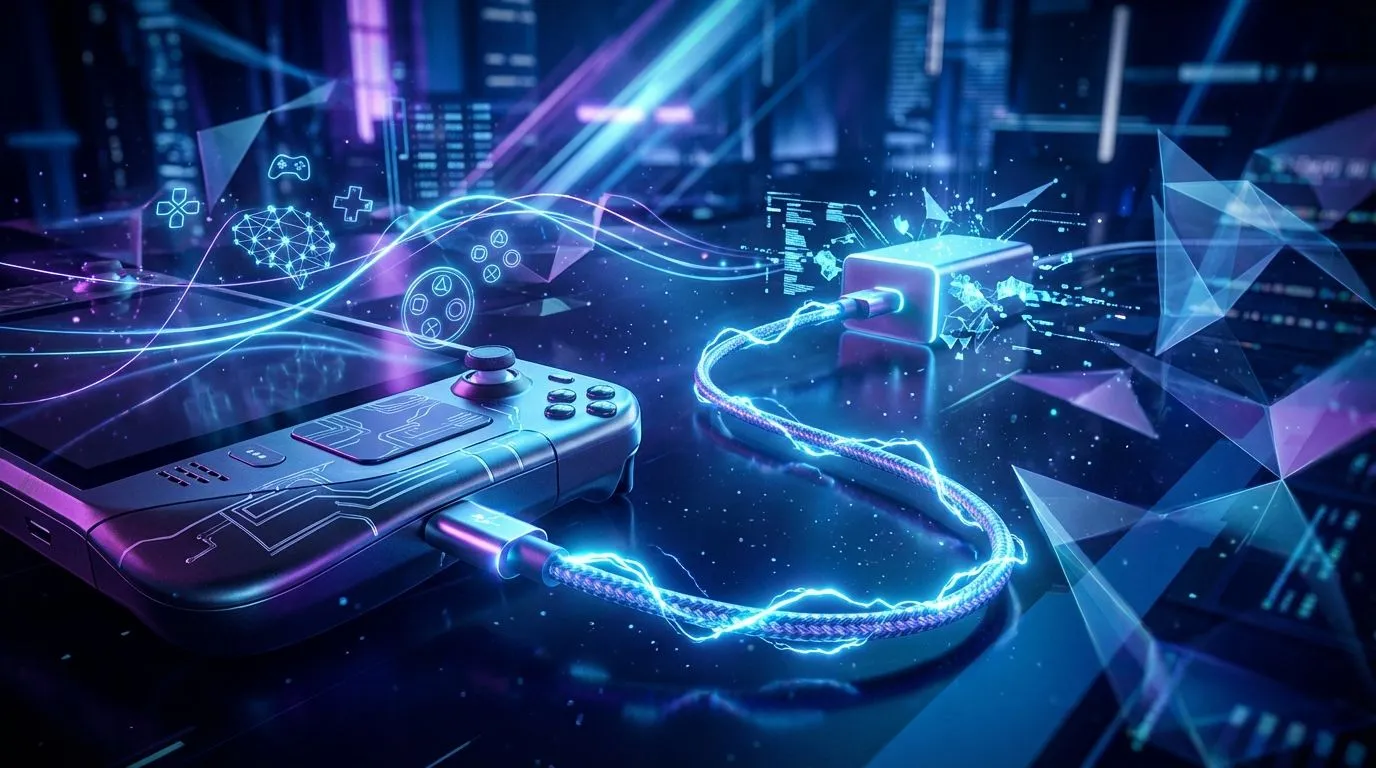
Think of USB-C Power Delivery (PD) as a smart, high-speed pipeline for electricity. Older USB chargers were like a slow, dripping tap… they sent a fixed, small amount of power, and that was that. USB-C PD, however, is a dynamic standard. It allows your charger and your handheld console to have a conversation ⚡.
Your device says, "I'm a power-hungry beast, give me everything you've got!" and a compatible PD charger responds, "Roger that, I can supply up to 65 Watts. Engaging maximum power!" This negotiation happens in a split second to deliver the optimal charging speed safely. It’s the difference between a full charge in an hour versus several hours.
Why PD is Critical for Your Handheld Console
Modern handheld gaming consoles are essentially compact gaming PCs. They pack immense power, and with great power comes a great need for... well, power.
Take the brilliant ASUS ROG Ally, for example. To unlock its highest performance "Turbo Mode," it requires a 65W power source. Plug it into a weak, non-PD charger, and you won't just charge slowly; you might not get full performance, even while plugged in. The same principle applies to the powerhouse Lenovo Legion Go, which needs the correct wattage to stretch its legs. Using the wrong charger is like putting retread tyres on a Ferrari.
This tech is the future standard, with upcoming devices like the MSI Claw also built around the USB-C PD ecosystem. Getting your head around it now means you're ready for whatever comes next.
Check Your Watts ⚡
Always match your charger to your console's needs. Look for the tiny print on the original charger to see its Wattage (W). A 65W handheld needs a 65W or higher PD charger to perform its best. Using a 100W laptop charger is perfectly fine, as the device will only draw the power it needs. But using a 20W phone charger will result in a very slow charge and limited performance.
Decoding Chargers and Power Banks
When shopping for a new charger or a power bank for your handheld, don't just look for a USB-C port. You need to confirm it supports "Power Delivery" or "PD".
Here’s what to look for:
- Total Wattage: This is the big number, like 65W or 100W. It must be equal to or greater than what your console requires for maximum performance.
- PD Logo: Look for the official Power Delivery logo on the product or packaging.
- Voltage/Amperage Outputs: For the tech-savvy, you can check the specific outputs (e.g., 20V/3.25A = 65W). Your console needs the charger to support its preferred voltage profile.
Investing in a good quality, high-wattage GaN (Gallium Nitride) charger is a great move. They are typically much smaller and more efficient than older chargers, making them perfect for your travel bag. 🚀
Ready to Unleash True Portable Power?
Understanding USB-C Power Delivery is the key to unlocking the full performance of today's best handhelds. No more slow charging or throttled gameplay. Explore our incredible range of handheld gaming consoles and find the perfect device to dominate on the go.