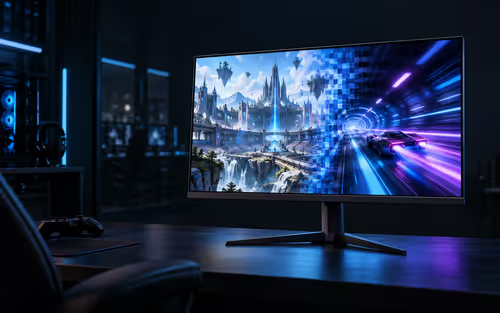
So, you’ve got that massive 55-inch 4K TV in your lounge, and a thought crosses your mind: “Why not use this as my PC monitor?” It’s bigger, it’s already there, and it seems like a lekker way to save some cash. But before you hook up your rig, hold on. While it’s a tempting idea, there are significant using TV as monitor drawbacks that can seriously impact your gaming and productivity. Let's dive in.
Input Lag & Response Time: The Gamer's Kryptonite
Ever feel like your character moves a split-second after you press a button? That’s input lag. It’s the delay between your PC sending a frame and the screen actually displaying it. TVs are notorious for high input lag because they do a lot of image processing to make movies look good. For gaming, this is a disaster. 🐢
A dedicated gaming monitor is built for speed. It bypasses heavy processing, resulting in near-instantaneous response. The difference between a TV’s 30ms+ lag and a monitor’s sub-5ms lag is the difference between winning a firefight in Apex Legends and staring at a respawn screen. The same goes for response time—how quickly pixels change colour. Slow response times on a TV cause distracting motion blur or “ghosting,” making fast-paced scenes a blurry mess. If competitive performance matters, browsing all gaming monitors is non-negotiable.
Pixel Density & Text Clarity: Why Your Eyes Feel Strained
Here’s a simple truth: size isn’t everything. A 27-inch 4K monitor and a 55-inch 4K TV have the exact same number of pixels (3840 x 2160). But on the TV, those pixels are spread over a much larger area. This results in a lower Pixel-Per-Inch (PPI) count.
Up close, where you'd sit for PC use, low PPI makes text look fuzzy and pixelated. Reading documents or browsing the web becomes a strain on your eyes. For crisp detail in creative work or just comfortable daily use, the higher pixel density of today's 5K and 4K monitors provides a sharpness that no living room TV can match at a desk distance. ✨
Check Your Chroma Subsampling! 🔧
TVs use a compression technique called Chroma Subsampling (like 4:2:2 or 4:2:0) to save bandwidth. This is fine for video but terrible for text, causing colour fringing and blurriness. For PC use, you need full 4:4:4 colour data. Before using a TV, dig into its advanced settings and see if you can enable a 'PC Mode' or 'Game Mode' that supports 4:4:4 to get the clearest possible image.
Colour Accuracy and Connectivity Drawbacks
Another one of the key using TV as a monitor drawbacks is how they handle colour. TVs are designed to produce vibrant, saturated colours that pop for movies. This often means they aren't colour-accurate. For content creators, photographers, or anyone who needs to see true-to-life colours, this is a major problem.
Monitors, especially those designed for creative work, are calibrated for accuracy. Furthermore, while TVs have HDMI ports, many lack DisplayPort, which is often required for higher refresh rates and features like G-Sync on PCs. Purpose-built displays like curved monitors not only offer better specs but also the right connections for a seamless PC experience.
Finding the Right Display for Your Needs
So, is using a TV as a monitor always a bad idea? Not entirely. For casual couch gaming with a controller or as a secondary screen for watching videos, it can work. But for any serious gaming, productivity, or creative work, the drawbacks are too significant to ignore.
The world of dedicated PC monitors is vast and tailored to specific needs. Whether you need a high-refresh-rate panel for esports, an ultrawide for productivity, or even one of the handy new portable monitors for your laptop setup, there's a perfect fit out there. Don't forget to complete your setup with the right VESA mount or stand from a good range of monitor accessories.
Ultimately, investing in the right tool for the job will save you a lot of frustration. With frequent promotions and a huge variety, finding excellent PC monitor deals in South Africa is easier than ever. Your eyes (and your K/D ratio) will thank you for it. 🚀
Ready to See the Difference?
The TV vs. monitor debate is clear for serious PC users. A dedicated monitor offers the speed, clarity, and features you need to win. Explore our massive range of PC components and deals and find the perfect screen to conquer your world.