


PCIe 5.0 vs PCIe 4.0 for Video editing in 4k in SA
PCIe 5.0 vs PCIe 4.0 for video editing in 4k is mainly about fit, features, compatibility, cost, and upgrade path, not one automatic winner. SA buyers should match the choice to the setup.
Read moreWaiting for global graphics card price drops rarely pays off in SA, since local pricing follows landed cost in Rand and shifts only once stock clears and the rate holds. Evetech prices reflect current landed cost, so waiting on a US cut is also a bet on Rand volatility.
Waiting for a global GPU price drop is worth it in South Africa only when your current card still meets your needs and you are comfortable with uncertain local timing. A foreign price announcement does not set the next South African shelf price.
Record today's price for two named local cards, set the performance target and wait only when the upgrade is optional. Buy when an exact model meets your budget and game requirement. Do not build the decision around a predicted rand rate or future clearance.
Compare named cards in the NVIDIA graphics-card range and current GPU best sellers. The Palit GeForce RTX 5060 Infinity 2 OC 8GB cost R6,999 as of July 2026, providing a dated anchor rather than a forecast.
A foreign recommended price excludes or includes different taxes, distribution and retail structures. A US dollar cut can take time to reach stock already bought through an earlier supply chain.
Local pricing can reflect currency conversion, freight, insurance, distributor cost, stock age and promotion. These inputs can move in opposite directions. A global reduction can arrive while the rand weakens or local stock remains on its prior cost.
This does not mean local prices never fall. It means the date and amount cannot be inferred from one foreign headline.
A retailer or distributor may hold cards acquired before a supplier change. Selling that inventory follows local stock and pricing decisions, which are not visible from the global announcement.
New shipments can enter at a different landed cost. Whether the new cost changes the shelf price depends on demand, competing models and remaining inventory.
Avoid claiming that stock must clear by a certain date. Watch the named local model and record what happens.
The rand amount paid through the supply chain depends on the relevant transaction timing and hedging, not the exchange rate shown in a news article alone.
A stronger rand can help future landed cost and does not guarantee an immediate shelf reduction. A weaker rand can offset part of a foreign cut.
Do not postpone a required GPU on an exchange-rate prediction. Treat currency as one uncertainty in the wait, not a signal you can trade confidently.
A new generation can reduce demand for an older card, keep it attractive through lower local pricing or make it disappear before the reduction reaches your target.
New models can bring features, efficiency and performance while launching at a different tier. Compare actual game results and VRAM, rather than assuming a replacement number is a direct substitute.
An old flagship can remain fast and carry a high power draw or limited feature path. A new mid-range card can be slower in some raw tests and more efficient. Name the workload.
Benchmark the current GPU in the two games that matter. Record resolution, settings, average, one-percent lows and VRAM use. Note the specific failure: low frame rate, stutter, unsupported feature or insufficient output.
Choose the minimum card that fixes it with headroom. This stops a sale from steering you towards a model that is cheap but still misses the target.
If the current card remains comfortable, waiting costs little. Clean it, update supported drivers and review the decision in a set month.
Use the R6,999 Palit RTX 5060 snapshot only when that performance tier fits. Add one faster or higher-capacity named model and its approved July 2026 price.
Set the maximum you will pay for each exact card. Include any PSU, case or cable change. A lower GPU ticket can be false value when the rest of the build needs replacement.
Check once a week or month, rather than reacting to every rumour. Buy when one named model crosses its trigger and stock is real.
A GPU may not be the only limit. At low resolution and high refresh, the CPU can cap performance. A weak PSU or compact case can block the chosen card.
Price a GPU-only path and a platform path. If a cheaper card plus CPU upgrade produces better lows in your games, waiting for a flagship GPU cut misses the problem.
Check the monitor. Buying 4K graphics performance for a 1080p 60Hz screen may bring little daily value.
Private-sale GPU values can react quickly to launches, mining demand, stock and buyer confidence. Condition and remaining warranty create wide differences.
If you plan to sell the old card, record its likely value now and the minimum acceptable amount. Waiting can reduce both the new-card price and the old-card proceeds.
Test and document the old GPU before any sale. A working fallback has value while the new market is uncertain.
A low advertised number is useless when the card is not available, the model has an unsuitable cooler or the seller's terms do not fit.
Check exact stock, delivery, warranty and return terms. Similar GPU names can hide different card dimensions and power limits.
For work, downtime can justify buying a suitable card now. For hobby play, a temporary settings reduction can make waiting easy.
Leaks and overseas deal trackers do not establish South African stock or pricing. Wait for official products and live local named listings before changing the plan.
Do not assume Black Friday, a quarter end or a product launch guarantees your model will be cheaper. Promotions are model- and stock-specific.
A fixed review date keeps the wait bounded. If the trigger is still missed, reassess performance and budget rather than extending the prediction forever.
Clean filters and heatsinks without dismantling a working card unnecessarily. Check fan behaviour and case airflow. Use a sensible frame cap and tuned high settings instead of maximum presets.
Upscaling can extend performance in supported games. Reducing ray tracing and one texture tier can relieve load with a smaller visual change than dropping resolution heavily.
Avoid unstable overclocks to bridge a long wait. Clean frame times and reliable hardware preserve resale and gameplay.
The R6,999 price applies to the Palit RTX 5060 Infinity 2 OC 8GB as of July 2026, not the whole 5060 category and not a future date.
When reviewing later, compare the same model where available. If it is gone, compare a true replacement by game performance, VRAM, power and support.
Record the result. A simple dated table protects you from remembering a launch price, sale price and different model as one number.
No timing or amount is guaranteed. Local stock, landed cost, currency and demand affect the result.
Only when you have a usable fallback. Downtime can cost more than an uncertain future reduction.
Set a performance requirement and maximum price for exact named cards, then buy when both are met.
Benchmark the current card, save the R6,999 July 2026 Palit reference and wait only until a named local GPU crosses your performance and price triggers.
No timing or amount is guaranteed. Local stock, landed cost, currency and demand affect the result.
Only when you have a usable fallback. Downtime can cost more than an uncertain future reduction.
Set a performance requirement and maximum price for exact named cards, then buy when both are met. {{PRODUCTS: { facets: { query: "NVIDIA gaming graphics card" }, limit: 12, title: "Track Named Local GPU Prices", style: "4" } }}
PCIe 5.0 vs PCIe 4.0 for video editing in 4k is mainly about fit, features, compatibility, cost, and upgrade path, not one automatic winner. SA buyers should match the choice to the setup.
Read more
Wi-Fi 7 vs Wi-Fi 6e for competitive esports comes down to router support, latency goals, device compatibility, and coverage. SA buyers should match the choice to the real network setup.
Read more
ATX 3.1 vs ATX 3.0 for mMO and live-service games buyers - what changes is mostly about compatibility, budget, upgrade path, and setup fit. SA buyers should check device support and real needs before expecting a clear win from either option.
Read more
LGA 1851 vs LGA 1700 can affect Twitch and YouTube streaming when gaming and encoding share CPU resources. For SA creators, the real-world difference depends on encoder choice, memory support, motherboard cost, thermals, and upgrade plans.
Read more
X870E vs X670E for aaa single-player gaming is mainly about fit, features, compatibility, cost, and upgrade path, not one automatic winner. SA buyers should match the choice to the setup.
Read more
Hall Effect switches vs Mechanical switches for mMO and live-service games is mostly about compatibility, budget, upgrade path, and setup fit. SA buyers should check device support and real needs before expecting a clear win from either option.
Read more
A fake 113GB GTA VI ISO reportedly used empty padding around a small malware payload. SA gamers should delete unofficial builds, keep Windows security active and wait for official channels.

Wi-Fi 6E vs Wi-Fi 6 matters for 4K video editing when files move across a network. The real-world difference between Wi-Fi 6E and Wi-Fi 6 for video editing in 4K depends on NAS access, cloud uploads, router range, and SA creator workflows.

The difference between PCIe 5.0 and PCIe 4.0 for SA gamers is mostly bandwidth headroom. Compare GPU slot needs, NVMe speed, motherboard support, and upgrade timing before paying extra for a newer platform.

Gaming PC stuck pixel checks in South Africa should confirm the monitor fault first. Use colour tests, screenshot comparison, cable swaps, display menu checks, and clear photos before deciding on support.

Shokz OpenFit Air 2 earbuds weigh 7.2g each and use a redesigned dual-driver open-ear layout. SA buyers should choose them for comfort and awareness, not maximum isolation.

AMD's current driver now lists a Radeon RX 9050 4GB, while product coverage details a narrowed memory system. SA buyers should weigh the low VRAM ceiling against current local Radeon options.

Samsung Display has demonstrated a 16-inch 2.5K OLED laptop panel running at 300Hz. SA buyers should wait for a named notebook, full panel specifications and a local price before planning an upgrade.

Microsoft says some Windows 11 game crashes after recent updates are linked to RGB-related drivers. Affected SA gamers should confirm the update and driver before using the published registry workaround.
RTX 5090 on a 650W PSU is a tight pairing with very limited headroom. For SA gaming PCs, focus on total system draw, PSU quality, connector support, CPU choice, and avoid OC plans unless the full build is carefully power-limited.
PCIe 5.0 vs PCIe 4.0 for video editing in 4k is mainly about fit, features, compatibility, cost, and upgrade path, not one automatic winner. SA buyers should match the choice to the setup.
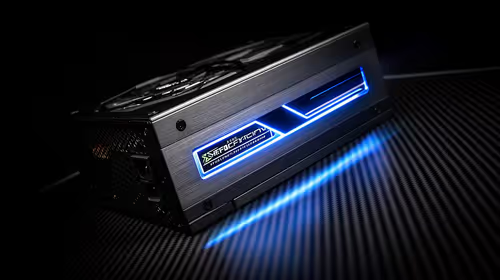
850W PSU safety for RTX 5090 is plausible with a quality unit and balanced parts. In SA, confirm connector support, CPU power draw, case airflow, PSU age, and spare capacity before building around 850W.
Wi-Fi 7 vs Wi-Fi 6e for competitive esports comes down to router support, latency goals, device compatibility, and coverage. SA buyers should match the choice to the real network setup.