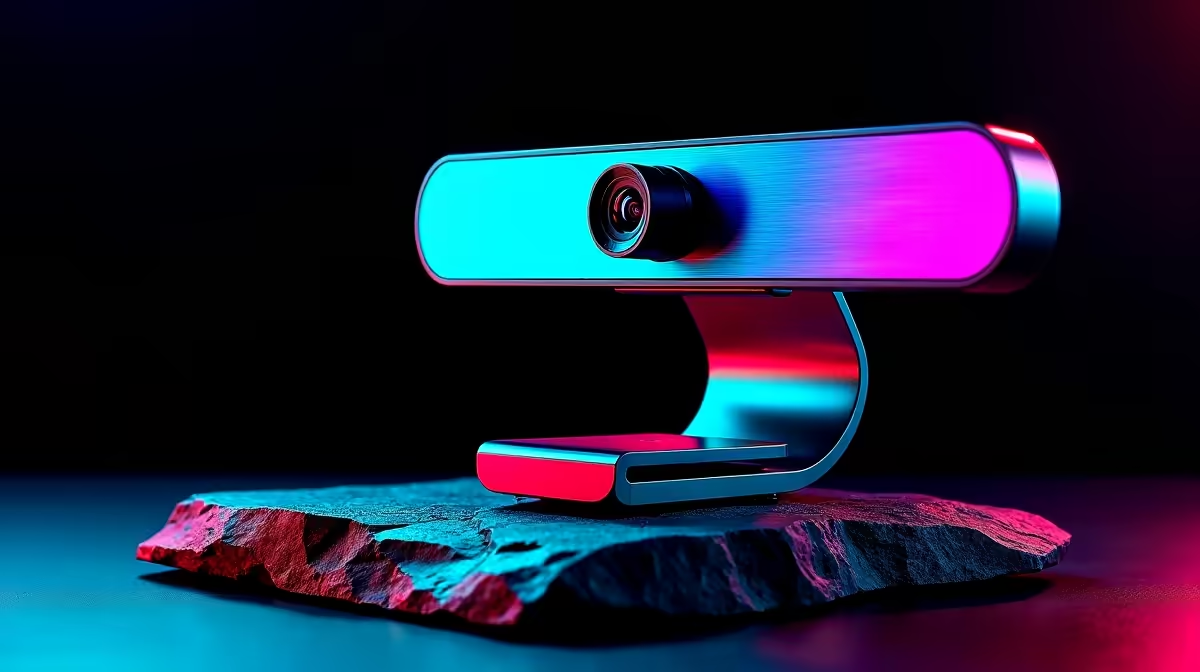
Webcam stands do not carry the same consumer excitement as the cameras themselves, which is why people routinely underspend on them and then wonder why their carefully positioned camera drifts after an hour. The local webcam stand market has a real value band that solves the stability problem without demanding studio-rig money. Knowing where that band sits, and what separates a stand worth buying from one that will frustrate you, saves both Rand and time.
Quick Answer
The South African value band for a webcam stand sits at roughly R250 to R450. At that price you get a metal column, a weighted base, and a lockable head. Under R150 the materials shift to light plastic with joints that flex and droop. Above R500 the gains are real but are designed for cameras heavier than a webcam.
💰 The Sub-R150 Category and Why It Falls Short
The cheapest stands on the local market, mostly plastic column units with hollow bases, cost very little and feel like it. The column flexes when the head is loaded with a 150 to 200g webcam, because the joint tolerances in moulded plastic are loose enough to allow micro-movement under even light loads. Over a multi-hour stream, that flex becomes creep: the camera slowly tilts away from the locked position, and the framing that was perfect at the start is noticeably off by the end.
The hollow plastic base compounds this. A base that weighs 150g with a 200g webcam mounted above its centre of gravity will tip if the desk is nudged or a cable is pulled. Stands in this category use threaded plastic at the mounting point rather than metal, which also means the locking mechanism strips before the product reaches the end of its useful life.
For a fixed, light-use setup where the camera is adjusted once and never touched, very cheap stands can work. The problem is that they are bought by people who intend to adjust and reposition, and those people will find the plastic joints frustrating immediately.
🔧 The R250 to R450 Value Band
This is where the engineering changes. Stands in this range switch to an aluminium or steel column, a cast or machined metal head, and a base that contains a weighted insert to bring the total base mass to 400 to 600g. The difference is not theoretical.
An aluminium column resists the flex that leads to creep. Once the lock is set, the column holds the angle because the material is stiff enough to not deform under a 200g load. A weighted base means the centre of gravity is below the mounting point, so the stand resists being tipped by cable tension or a nudge.
Metal threads at the 1/4 inch mounting point, which are standard in this price range, handle many attachment and detachment cycles without wearing. A lockable head in this range typically uses a thumb screw rather than a friction collar, which means the locked position is definite rather than dependent on maintained tension. Set it, tighten the screw, and the camera stays.
What Specific Features to Look For at This Price
Four characteristics mark a well-specified stand at this price: a metal column with at least 300mm of height extension, a base weighing more than 500g, a 1/4 inch metal thread at the head, and a thumb-lock or twist-lock mechanism. Any stand at this price carrying all four will hold a webcam reliably through years of daily use, not just months.
If a stand at this price uses a plastic column, the weight saving has come at the wrong place. The base can be plastic if it is filled with ballast, but the column and head should both be metal.
Pro Tip ⚡
Before buying, check whether the head rotation unlocks independently of the tilt lock. A dual-lock head, one for tilt and one for pan, is more stable than a single collar that controls both axes together. Dual-lock heads are more common in the R350 to R450 range and are worth the slight premium for any setup that requires precise repeatable framing.
📺 R500 and Above: Where the Gains Are Real but Mismatched
Studio and photography rigs in the R500 to R1,500 range are built for DSLRs and mirrorless cameras that weigh 500g to 1.5kg. The engineering is excellent: machined aluminium columns, precision ball heads, 2kg-rated mounting plates. None of those features make a 200g webcam sit more steadily than a good R400 stand, because the lighter stand is already stiff enough for the load.
What the higher range does offer that genuinely applies to webcam use is a smooth quick-release system. Arca-Swiss compatible plates in the R600 to R900 range allow the camera to be removed and replaced with one hand in under two seconds, with the camera returning to the same locked framing. For a streamer who also uses the camera for desk work and needs to reposition frequently, this is a functional upgrade.
The other real differentiator at higher price points is a fluid head rather than a ball head. Fluid heads allow controlled pan and tilt movements with adjustable drag resistance, which is useful if you are doing live camera moves during a broadcast. For a fixed face-cam, this is unnecessary, but for presenters or content creators who track movement, a fluid head in the R700 to R1,000 range makes sense.
For most local streamers buying their first or second stand, spending above R450 on a webcam mount is spending money that would do more work as a better microphone or a higher-quality light.
Frequently Asked Questions
How much should a stable webcam stand cost in South Africa?
The practical target is R250 to R450. That range covers stands with a metal column, a weighted base, and a locking 1/4 inch head, which is everything needed to hold a webcam reliably. Below that, material quality drops noticeably; above R500, you are buying load capacity and precision engineered for cameras heavier than a webcam.
Does a cheaper plastic stand really drift over time?
Yes, consistently. Plastic joints in stands under R150 have loose tolerances that allow the camera to slowly shift from its set position under sustained load. Metal joints at the R250 threshold hold the set angle without creep through a multi-hour session. The difference is apparent within the first few weeks of regular use.
Can a mid-priced stand hold a webcam as steadily as an expensive studio rig?
For a webcam, yes. A 200g webcam is well within the rated capacity of a R400 metal-column stand, and the stiffness of the column is more than sufficient to prevent flex at that load. A R1,500 studio rig holds the same weight no more steadily; its extra engineering is for heavier cameras that the cheaper stand cannot accommodate.
Why do weighted bases cost more than hollow ones?
Adding mass to the base requires either more material or ballast inserts, both of which add manufacturing cost. A hollow plastic base at 150g costs very little to produce; a steel-filled base at 600g requires either thicker walls or a separate ballast insert, both of which add to the unit cost. The cost difference between a hollow and a weighted base is usually R50 to R100.
Which stand features actually justify spending R400 rather than R250?
A dual-lock head that controls tilt and pan independently, a column height range that reaches 400mm above the desk surface, and a base mass above 600g are the features that justify the upper end of the value band. A stand at R400 with all three is genuinely better than one at R250 with only a metal column and a single-lock head.
Is an aluminium column better than steel for a webcam stand?
Aluminium is lighter and resists corrosion, which matters in humid coastal cities like Cape Town and Durban. Steel is marginally stiffer but heavier. Either metal is stiff enough for a webcam load; aluminium is the better long-term choice for coastal SA conditions because salt air does not rust it.
Ready to upgrade from a wobbly plastic stand to something that holds?
Browse the webcam stand range for local-market options in the R250 to R450 value band that keep your camera locked and your framing steady.