Quick Answer
Case fan noise has four main sources: bearing friction, blade turbulence at high RPM, resonance from the fan frame vibrating against the case, and aerodynamic noise from air moving through restricted intake panels. PWM control reduces noise by keeping fans at the lowest RPM adequate for current system temperatures rather than running at full speed continuously.
The Four Sources of Fan Noise 🔬
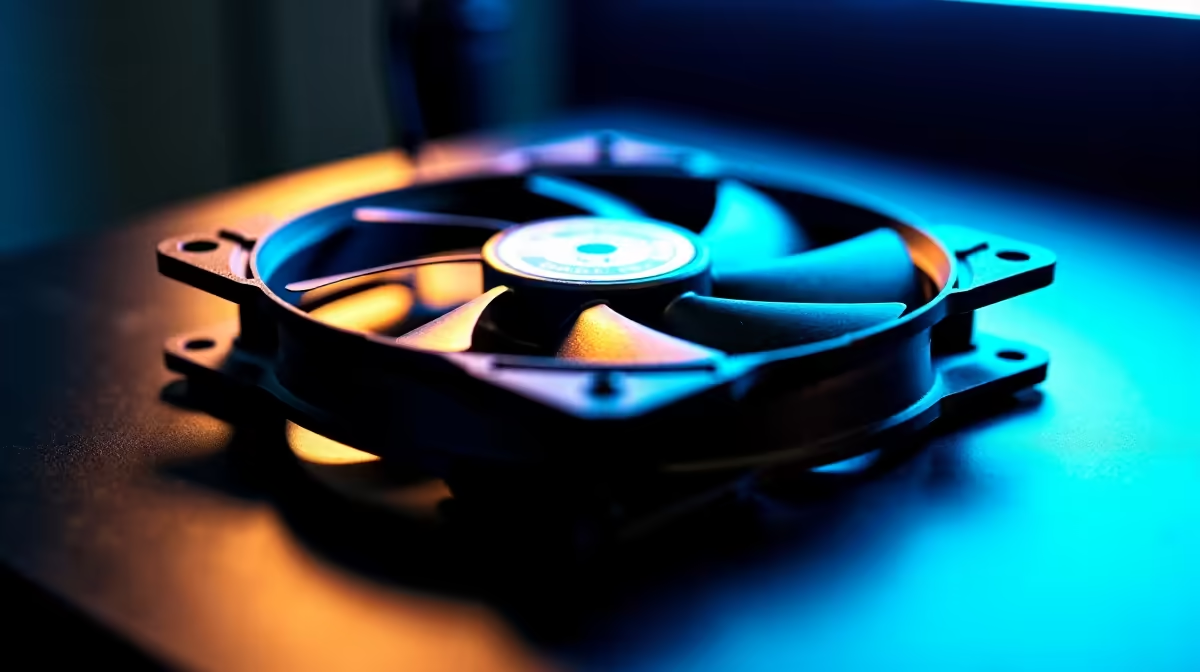
Bearing noise is the most recognisable: sleeve bearing fans develop a whirring or grinding sound as the lubricant degrades, typically starting within two to four years. Fluid dynamic and dual-ball bearing fans resist this much longer. Blade turbulence generates broadband rushing or hissing sound proportional to RPM: a 120mm fan at 2,000 RPM generates roughly 35 dBA while the same fan at 1,000 RPM produces around 22 dBA, a massive perceptible difference. Frame resonance occurs when the fan body vibrates at frequencies that match case panel resonant frequencies, creating a buzzing that seems louder than the fan itself.
How PWM Reduces Noise Effectively 🔧
A 4-pin PWM fan receives a duty cycle signal from the motherboard header that pulses power on and off thousands of times per second. At 30% duty cycle, the fan runs near its minimum RPM (typically 300 to 600 RPM), producing 15 to 20 dBA, virtually inaudible. The BIOS fan curve ties this duty cycle to temperature sensors: at idle the curve holds fans at 25 to 35%, ramping only when temperatures rise. The practical result is that during web browsing, video playback, and light office work, the build is nearly silent. Only during gaming or rendering when temps exceed 70 degrees Celsius do fans ramp to audible levels.
Diagnosing Resonance and Frame Vibration 🛠️
If your build has a buzzing disproportionate to fan speed, resonance is likely. Press your hand flat against each case panel while the PC runs; if the noise changes or stops, that panel is resonating. Fit silicone fan mounts or anti-vibration pads between the fan frame and case standoffs. These pads decouple the fan vibration from the chassis and can reduce resonance buzz by 50 to 80%. Anti-vibration mounts for 120mm fans cost R20 to R60 per set of four in SA.
Long-Term Noise Management 🌍
Fans in SA builds accumulate dust faster in inland regions with dry, particulate-heavy air. Dust on blades shifts the mass distribution, increasing vibration and ultimately bearing load. Clean case fans every eight to twelve weeks using short bursts of compressed air with the system powered off. Hold the blade hub stationary while spraying to prevent over-spinning the bearing beyond its rated RPM.
Set a Temperature Breakpoint at 50 Degrees Celsius ⚡
Configure your PWM fan curve so that fans begin ramping only when any sensor exceeds 50 degrees Celsius. Below this threshold most modern CPUs and GPUs run efficiently without risk, and holding fans at minimum RPM keeps the system near-silent during the majority of a typical workday in an SA home office.
FAQ
Why does my new fan make a clicking sound at low RPM?
A clicking or ticking at low speed often indicates the fan blade is very slightly contacting the frame or a cable is near the blades. Check for cables routed too close to the blade path and confirm the fan frame is fully seated and screwed flat.
Can PWM control damage a fan by running it too slowly?
Quality 4-pin PWM fans are designed for reliable operation down to their specified minimum RPM (typically 200 to 400 RPM). Running a fan below its stated minimum causes cogging and erratic rotation, so never set a PWM floor below the manufacturer's minimum RPM specification.
Do anti-vibration fan mounts affect airflow performance?
No. Silicone anti-vibration mounts decouple the fan from the case mechanically without altering blade clearance, airflow path, or motor performance. They are a pure noise reduction measure with no thermal trade-off.
Dealing with noisy fans in your SA build?
Evetech stocks PWM case fans with fluid dynamic bearings, anti-vibration mounting kits, and fan controllers that solve the most common sources of case fan noise.