Quick Answer
Front I/O bottlenecks when transferring large files from external drives are caused by one or more of these: the front panel header running at USB 3.2 Gen 1 (5Gbps) when the drive supports faster speeds, the internal header on the motherboard not supporting the case's rated front-panel speed, or using an external drive enclosure that tops out below the header's rated bandwidth. The result is transfer speeds that plateau at 450 to 480 MB/s instead of the 900 MB/s to 2,000 MB/s your drive is physically capable of.
The Three Layers of a Front I/O Speed Chain 🔧
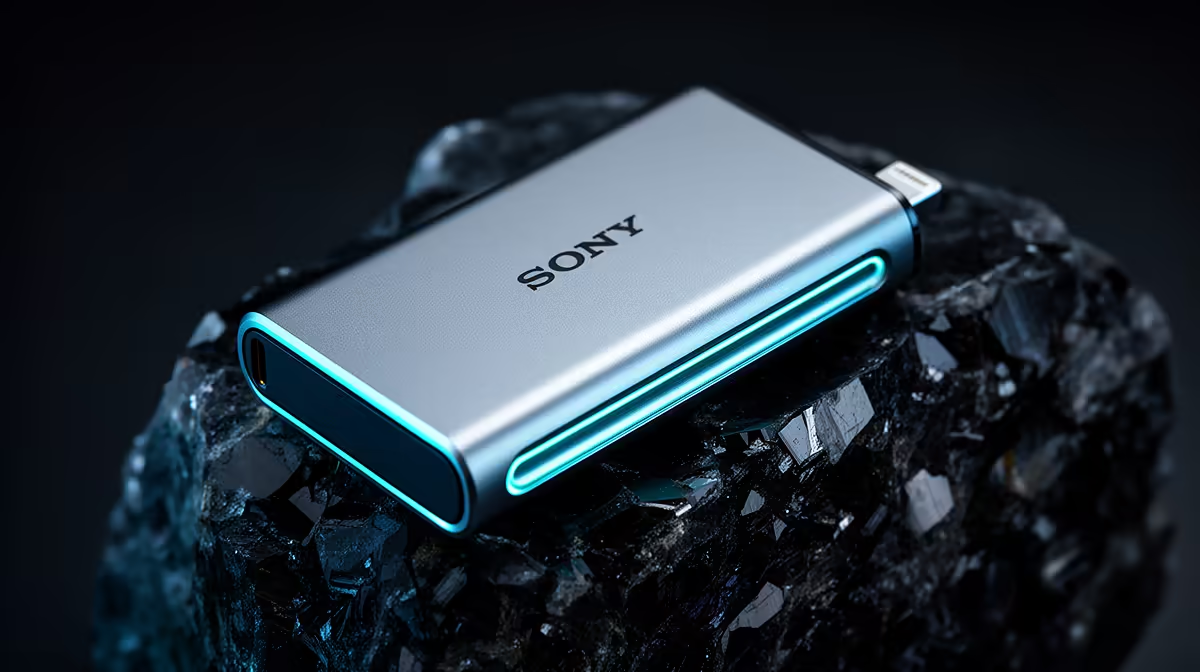
Every front-panel USB transfer passes through three layers, each of which can become the bottleneck. Layer one is the external drive enclosure: even a fast NVMe SSD inside a USB-A enclosure limited to 5Gbps will max out at around 450 MB/s. Layer two is the case's internal header cable running from the front panel connector to the motherboard: if the case ships with a USB 3.0 header cable rather than a USB 3.2 Gen 2 or Gen 2x2 cable, the connection is limited at source. Layer three is the motherboard's internal USB header: many mid-range B650 boards have one USB 3.2 Gen 2 (10Gbps) header and one Gen 1 (5Gbps) header; if the front panel cable connects to the slower one, the front ports run at half speed. Identifying which layer is throttling requires testing each one systematically.
How to Diagnose Your Specific Bottleneck 🖥️
The fastest diagnostic is comparing transfer speeds on a known-fast USB device between the front panel and a rear motherboard port. If the rear port delivers 900 MB/s and the front panel delivers 450 MB/s with the same external SSD, the bottleneck is either the case's internal header cable or the motherboard header the cable is connected to. Swap the internal USB header connector to a different motherboard port, confirm which is Gen 2, and retest. If speeds remain slow, the case's internal cable itself may only support Gen 1 speeds despite the case advertising Gen 2 front ports. This is not uncommon in mid-range cases priced below R2,500 in SA.
Solving the Bottleneck for Large File Transfers 💡
If the bottleneck is the motherboard header assignment, the fix is free: simply move the front panel USB connector to the correct Gen 2 header. If the bottleneck is the case's internal cable, contact the case manufacturer for a Gen 2 replacement cable; many brands supply these at no cost under warranty. If the bottleneck is the external drive enclosure, upgrading to a USB 3.2 Gen 2 enclosure for NVMe drives costs around R400 to R900 at SA pricing and immediately unlocks read speeds of 850 MB/s to 1,000 MB/s on a modern NVMe SSD. For heavy video capture workflows where large files move regularly, this upgrade pays back its cost in time savings within the first few weeks of use.
Label Your Motherboard Headers ⚡
After building your system, print and tape a small label near each internal USB header indicating its speed (Gen 1, Gen 2, Gen 2x2) and what is connected to it. This saves significant diagnostic time during upgrades or troubleshooting when you cannot easily read the PCB silk-screen with the case fully built.
FAQ
Can a USB front panel bottleneck affect game loading times?
No. Games load from your internal NVMe or SATA SSD, not through the front USB ports. Front I/O speed only affects transfer rates to and from external devices plugged into those ports. Internal storage performance is unaffected.
Does case price reliably predict front I/O speed quality?
Roughly. Cases above R3,000 in SA generally include USB 3.2 Gen 2 internal header cables and sometimes Gen 2x2 for the Type-C port.
Will a USB hub on the front panel solve the bottleneck?
No, a passive hub shares the single port's bandwidth across all connected devices. For maximum speed you need each device on its own dedicated port, with that port's header running at the highest speed the drive supports.
Tired of slow front-panel transfers?
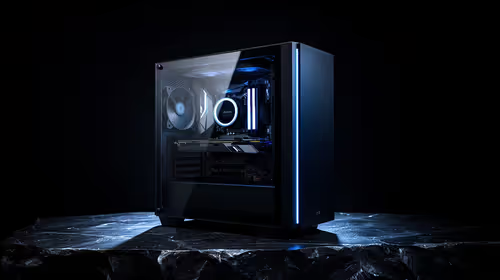
Browse Evetech's range of gaming cases with premium USB 3.2 Gen 2 and 20Gbps Type-C front I/O to eliminate transfer bottlenecks.