Quick Answer
Poor mic clarity on wireless gaming headsets is caused by four issues: the microphone capsule being too far from your mouth, the headset using a low-bitrate Bluetooth HFP codec, radio interference compressing the audio stream, or incorrect gain settings causing clipping or noise floor bleed. Fixing mic placement and codec settings resolves most complaints without any hardware change.
Microphone Position and Capsule Distance 🎙️
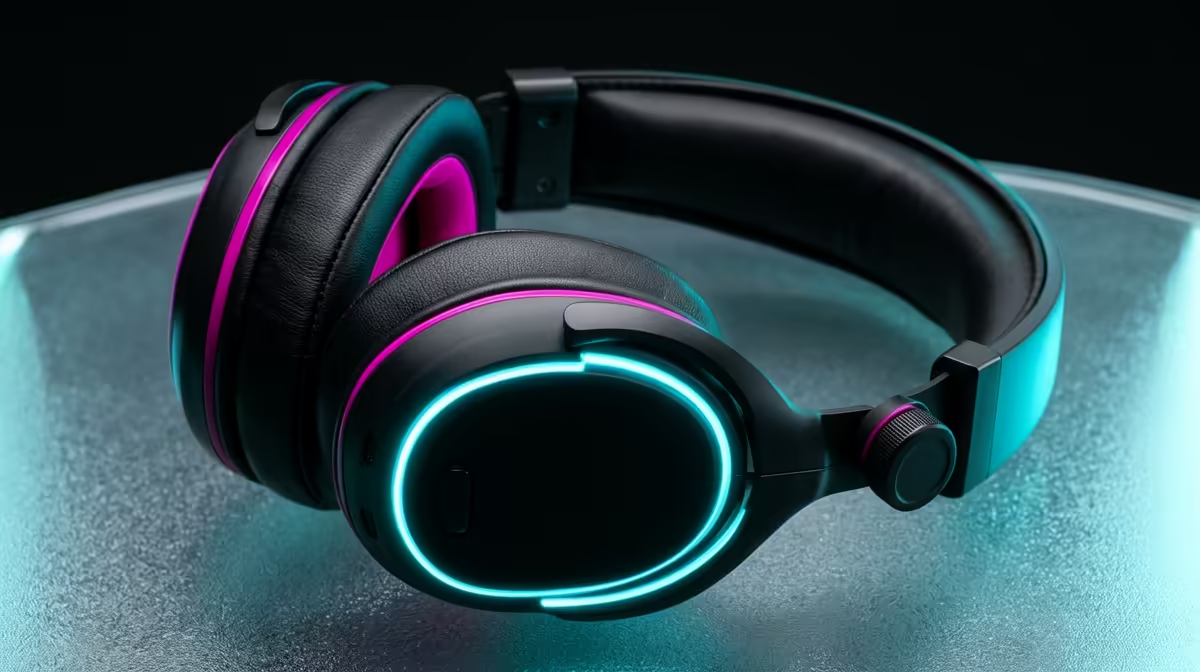
Gaming headsets with boom mics are tuned to capture voice at 5 to 10 cm from the mouth. Further away and the capsule picks up far more room noise relative to your voice, making speech sound thin. Position the boom just below and slightly in front of your lip line. Headsets using hidden beamforming arrays, such as the Razer Barracuda series, rely on DSP rather than physical proximity, but even those perform better when you speak toward the cup. Speak at a consistent volume; fluctuating loudness causes compressors in Discord and Teams to pump audibly.
Codec Quality and Bluetooth HFP Limitations 📻
When a wireless headset uses Bluetooth for both audio output and microphone input simultaneously, it is constrained to HFP, which caps mic audio at 8 kHz or 16 kHz with mSBC support. That sounds noticeably worse than a 2.4GHz headset transmitting at 48 kHz. Headsets using a dedicated 2.4GHz dongle bypass this entirely because the dongle handles mic data on a separate, uncompressed channel. If mic clarity on calls is a priority, a 2.4GHz wireless headset delivers significantly better voice quality than a Bluetooth-only option at the same price point.
Software Gain, Noise Suppression, and Driver Settings 🔧
Windows 11 has a built-in voice clarity feature under System then Sound then your input device. If the headset gain is too high, background noise gets amplified alongside your voice. Set microphone level to 70 to 80 percent in Windows Sound Settings rather than 100, preventing the pre-amp from clipping transients. In Discord, disable automatic input sensitivity and set a fixed level manually. Discord's Krisp noise suppression cannot fix a clipping signal or a mic positioned 30 cm from the mouth.
HFP vs. A2DP Mic Quality Test ⚡
To confirm if Bluetooth HFP is degrading your mic, record a voice memo using a 2.4GHz-connected headset and compare it to a Bluetooth recording. If the Bluetooth recording sounds hollow or muffled, switch Discord voice settings to use the headset only via the dedicated dongle, keeping Bluetooth for phone calls only.
FAQ
Why does my headset mic sound fine in Windows but terrible in Discord?
Discord applies its own noise gate and echo cancellation that can interact poorly with Windows voice processing. Go to Discord's Voice and Video settings and turn off Echo Cancellation and Noise Suppression, then re-enable only the ones that help. Running both Windows and Discord processing at once often causes a phased, hollow sound.
Does wireless interference affect mic quality or just audio playback?
Both directions are affected. Interference causes packet loss in the microphone upload stream as well as playback. If your mic sounds choppy to teammates even when headphone audio is fine, interference is likely the cause. Moving the USB dongle to a rear motherboard port away from USB 3.0 drives is the fastest fix.
Is a detachable boom mic better than a hidden beamforming mic for gaming?
For gaming chat, a correctly positioned boom mic typically outperforms a beamforming array in loud or reverberant rooms because physical proximity is more reliable than DSP-based directionality. Beamforming mics excel in quieter environments and offer a cleaner look for streaming setups.
Struggling with unclear mic audio in your squad?
Browse Evetech's range of wireless gaming headsets with dedicated 2.4GHz dongles and boom mics for broadcast-quality voice in every session.