Quick Answer
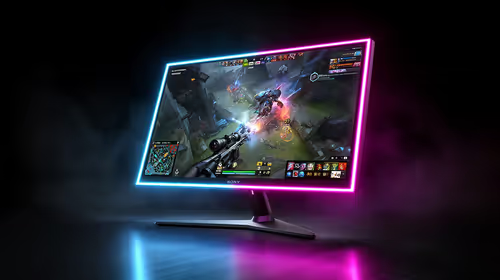
Before buying a 512-bit memory bus GPU, verify your PSU has sufficient wattage (at minimum 1,000W for a 512-bit flagship card), your case has the physical length and slot clearance for a triple-slot card, your motherboard has a PCIe 4.0 or 5.0 x16 slot, and your monitor resolution and refresh rate actually leverages the card's capability rather than leaving performance unused.
Understanding What 512-Bit Memory Bus Means 🔧
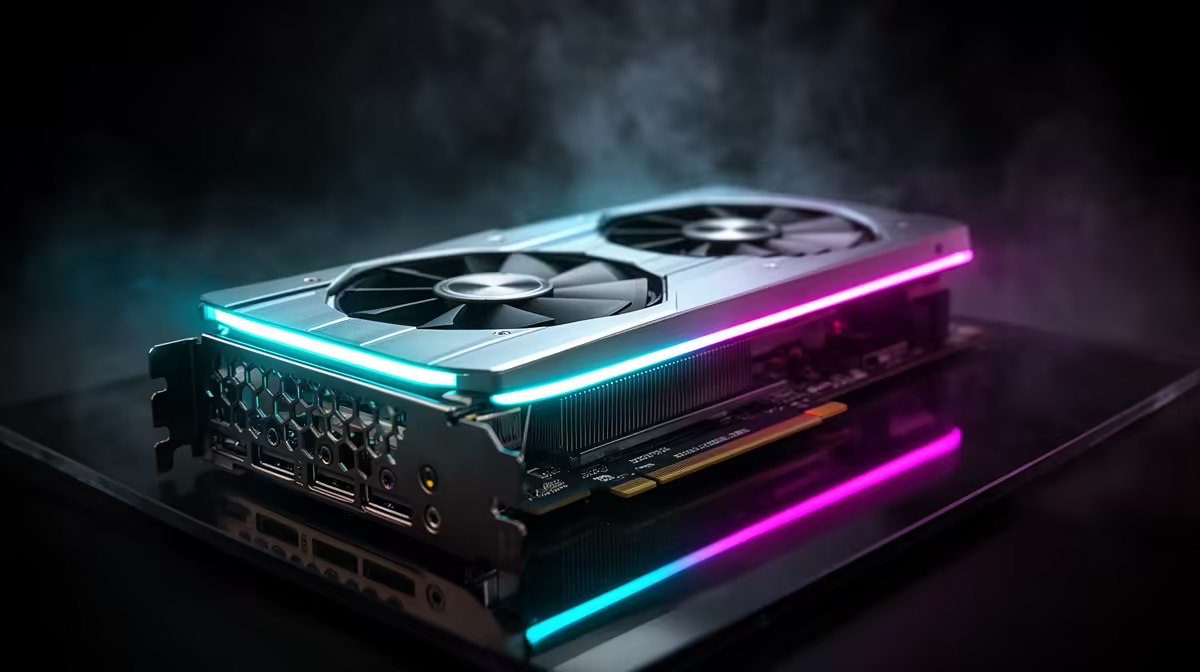
The memory bus width determines how much data the GPU can read from and write to its VRAM per clock cycle. A 512-bit bus paired with GDDR7, as found on the RTX 5090, delivers around 1,792 GB/s of bandwidth, more than double the 448-bit bus of the RTX 4090. This bandwidth advantage is most impactful at 4K where the GPU processes large frame buffers with complex shading, ray tracing, and AI upscaling simultaneously. At 1080p or 1440p, the excess bandwidth only becomes useful in content creation or AI inference tasks. In South Africa, 512-bit GPUs currently retail in the R55,000 to R70,000 range.
System Compatibility Checks Before Purchasing 🖥️
A 512-bit flagship GPU is a physically large component. The RTX 5090 measures over 33 cm in length and requires 3 to 3.5 expansion slot heights; measure your case's GPU clearance before ordering. The RTX 5090's 575W TDP requires a PSU with a native 16-pin 12VHPWR connector and a minimum 1,000W 80+ Gold unit to handle transient power spikes. Also verify that your motherboard provides a PCIe 4.0 or 5.0 x16 slot electrically, not just physically.
Matching the Card to Your Use Case and Budget 💰
A 512-bit GPU justifies its price in South Africa for users who run 4K gaming at maximum ray tracing settings with DLSS 4, 3D rendering in Blender Cycles or Unreal Engine 5 with complex scene lighting, or local large language model inference requiring maximum VRAM throughput. For 1440p gaming, an RTX 5080 at around R30,000 to R40,000 or an RX 9070 XT at R18,000 to R24,000 provides 85 to 95 percent of the gaming experience at roughly half to one-third the cost. The remaining R20,000 to R30,000 of budget difference is better invested in other system components, a better monitor, or simply kept for the next upgrade cycle.
Use a PSU Calculator Before Committing to a 512-Bit Build ⚡
Input your complete parts list into a PSU wattage calculator tool before purchasing a power supply for a 512-bit GPU build. Flagship GPUs have peak power transient spikes significantly above their rated TDP, and an undersized PSU causes system instability rather than a clean shutdown. Budget R3,000 to R6,000 for a quality 1,000W or 1,200W 80+ Gold or Platinum PSU when pairing it with a 512-bit flagship GPU.
FAQ
Does a 512-bit GPU require a new CPU to avoid bottlenecking?
Any current-generation mid-to-high-end CPU paired with a 512-bit GPU will not CPU-bottleneck it in GPU-limited workloads like 4K gaming. A Ryzen 9 9900X or Intel Core Ultra 9 285K paired with an RTX 5090 sees less than 3 percent fps gap compared to the theoretically fastest CPU pairing in GPU-heavy gaming scenarios.
Is a 512-bit GPU future-proof for the next five years in South Africa?
For 4K gaming and content creation workloads, a 512-bit GDDR7 GPU purchased in 2026 will remain capable through 2029 to 2030 based on historical GPU generational performance scaling. However, the price point means the hardware should serve your workload fully now rather than relying primarily on future-proofing arguments to justify the spend.
Are 512-bit GPUs available with local warranty in South Africa?
Yes. Evetech stocks RTX 5090 and other flagship cards with local South African warranty, meaning warranty claims are handled without international shipping.
Considering a flagship 512-bit GPU for your next build?
Evetech stocks high-end graphics cards including RTX 5090-class hardware with local warranty and nationwide delivery. Browse the GPU range at Evetech before committing to your build.